
The Taskforce on Nature-related Financial Disclosures identifies 1,154 organisations making some TNFD-aligned disclosures in 2026, roughly twice its prior-year count.
More reporting has not yet resolved investors’ demand for comparable, location-specific information.
For African companies and lenders, the practical test is whether reporting changes decisions about water, land and supply chains.
Nature Risk Moves Into Financial Decisions
Nature-related reporting has moved beyond early pledges, according to the Taskforce on Nature-related Financial Disclosures (TNFD).
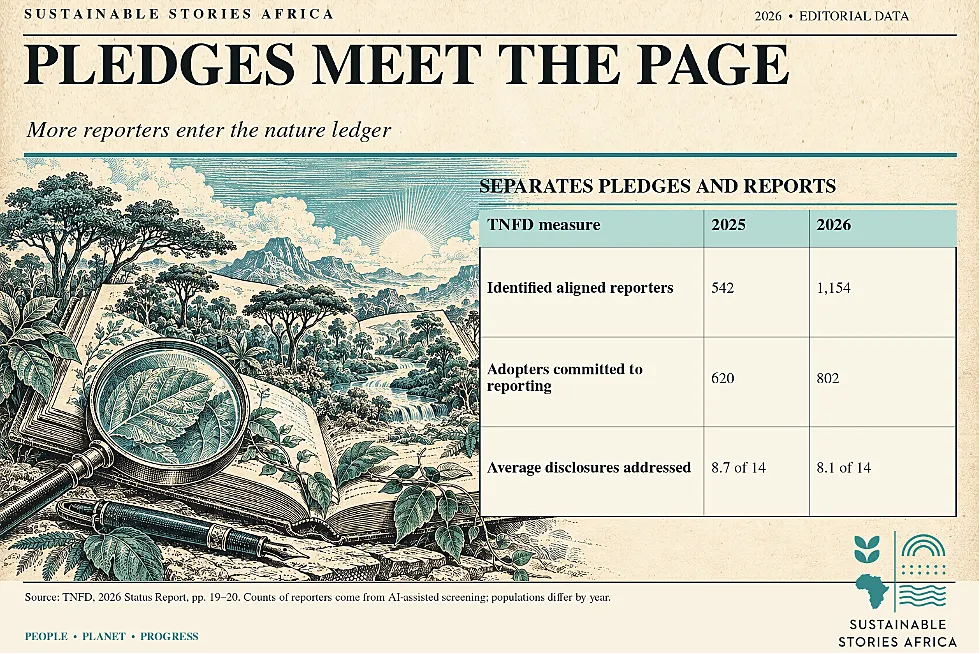
Its September 2026 status report identifies 1,154 organisations publishing some information aligned with at least one of its 14 recommended disclosures, compared with 542 in 2025.
The count reflects an AI-assisted review of company reports; it does not mean every organisation has completed all 14 disclosures or received independent assurance.
The distinction between a commitment and a published report is central.
- TNFD lists 802 adopters in 2026, organisations that have committed to report, while its screening identifies more than 1,100 organisations already publishing at least some aligned information.
The report covers a global market, and its survey of 527 respondents captures perspectives rather than a representative census of every company.
More Disclosures Leave Important Data Gaps
TNFD reports that 82% of the organisations it identified as reporting are publicly listed and that they span 56 countries.
- The infrastructure sector accounts for the largest share of the 2026 reporting sample, at 30%.
- Japan accounts for 24% of entities in that sample, while other markets have smaller shares.
Those distributions describe identified reports, not the exposure of all companies or a league table of nature performance.
Reporting depth also varies.
- The average 2026 report addresses 8.1 of 14 recommended disclosures, down from 8.7 in the smaller 2025 sample.
- That fall should not be treated as proof that existing reporters deteriorated: the two pools differ, and 62% of the 2026 sample are publishing a first-generation aligned report.
More experienced reporters address more disclosures on average, suggesting that the substance of reporting can develop over successive cycles.
TNFD says its AI system scanned roughly four million reports from 10,000 organisations in major capital markets.
- That approach can locate evidence across far more documents than a manual review alone, but the resulting count describes what the screen identified.
- It should not be confused with a regulatory register or certification of reporting quality.
- A company that mentions one recommendation may enter the count while another that reports detailed site-level risks will also be included.
This is why the number of disclosures and their usefulness need to be examined alongside the headline total.
African Firms Need Place-Specific Assessments
Nature risks depend on place.
- A food producer can have exposure through irrigation and soil conditions;
- A mine through land disturbance and water use; a lender through borrowers operating in vulnerable landscapes.
- A company-wide statement that nature matters will tell an investor less than a site-level account of dependencies, impacts, risks and the actions taken in response.
The TNFD’s LEAP approach: Locate, Evaluate, Assess and Prepare, offers a way to begin that work.
For African markets, an initial map of material sites and suppliers can help identify where scarce assessment resources should go.
- A bank might ask which borrowers depend on stressed catchments; a manufacturer might trace critical inputs to farms or ecosystems.
These are applications of the framework, not claims that the status report has measured particular African companies.
Common Rules Could Strengthen Market Confidence
More than 70% of TNFD survey respondents favour the clarity of mandatory reporting standards, according to the report.
- Investors seek consistent information, including cross-sector and sector-specific metrics and location data, while companies want practical requirements applied consistently.
The challenge for regulators is to make disclosures comparable without treating a small supplier’s capacity as identical to that of a large listed group.
The report also notes that investor assessments currently feed stewardship and risk management more clearly than portfolio allocation.
- A disclosure can support better conversations before it changes a lending price or an investment decision
- Boards should therefore ask what a reported metric reveals about operational continuity, alongside how it satisfies a template.
TNFD estimates that adopters manage $26.6 trillion in assets as of July 2026, up from $22.4 trillion in November 2025.
This is the aggregate assets under management of adopting institutions, not money already allocated to nature-positive investments.
- For a lender, the useful step is to ask how exposure to declining ecosystem services could affect borrowers, collateral or loan performance.
Clear definitions would help analysts compare answers across institutions and across years.
Path Forward – Starts With Material Locations
Companies can identify material sites and supply chains, use LEAP to assess exposure and disclose the evidence behind their priorities.
Investors can specify which location data and metrics they need for decisions.
Regulators and standard setters should pursue consistent, proportionate requirements.
Subsequent reporting cycles should be judged by improved comparability and management of nature risks, rather than the number of pledges alone.