
Julius Baer’s year-end 2026 outlook expects investment opportunities to broaden across sectors and regions after concentrated AI-led gains
Its constructive view also depends on assumptions about currencies, inflation and geopolitical conditions.
For African investors and businesses, the report is a scenario to examine.
Its usefulness lies in understanding transmission channels and risks, rather than assuming that a global market forecast will translate directly into local returns or cheaper finance.
Market Breadth Changes The Investment Conversation
Julius Baer expects a broader opportunity set across global markets as investment and earnings expand beyond the most prominent AI beneficiaries.
Its Market Outlook Year-End 2026, published on September 17, presents a constructive view while identifying policy error, weaker AI spending and geopolitical shocks as risks.
The publication is explicitly identified as marketing material.
- Its allocations and expectations reflect the bank’s house view at publication; they are not independent verification of future returns or recommendations tailored to an African reader.
For African markets, SSA’s analysis of the report raises questions about funding, currency exposure and capital distribution.
- A change in global conditions can affect local businesses through import costs, debt service and investment appetite.
- These connections depend on country and company fundamentals, not simply the direction of a global index.
Broader Growth Remains A Conditional Forecast
The outlook links growth with AI investment, corporate spending and supportive financial conditions.
- It expects opportunities beyond the United States and a softer dollar, while acknowledging that China’s technology-intensive industries and wider domestic economy face different conditions.
- These are the report’s assessments, rather than settled outcomes for the remainder of 2026.
Its fixed-income discussion favours intermediate maturities, particularly the five-to-ten-year segment, and higher-quality corporate credit.
- It also discusses selective emerging-market debt and inflation protection.
The underlying proposition is that attractive income can coexist with disciplined attention to credit and interest-rate risk.
The publication’s real-yield chart marks the US ten-year Treasury figure at 2.44% as of September 1, compared with a post-financial-crisis high of 2.52%.
- This is a dated yield indicator, rather than an expected portfolio return.
In equities, Julius Baer expects gains to broaden across sectors and regions while retaining an interest in AI-related opportunities.
It argues that monetisation and earnings should increasingly distinguish companies that benefit from AI spending from those that invest without a clear route to returns.

African Transmission Depends On Local Balance Sheets
A weaker dollar, if it occurs, can alter the local-currency cost of dollar-denominated obligations.
However, it does not guarantee that every African currency will strengthen.
- Domestic inflation, foreign-exchange availability, fiscal conditions and market confidence can change the outcome for a specific country.
Consider an illustrative manufacturer importing equipment and servicing a dollar loan while earning revenue locally.
- Its exposure depends on payment dates, exchange rates, contract terms and the ability to adjust prices.
- A global forecast provides a possible input to planning, but the company still needs to examine its own cash flows and financing arrangements.
The same specificity applies to emerging-market debt.
- The report’s selective preference does not imply that all issuers offer comparable value.
- Sovereign and corporate obligations differ in repayment capacity, legal terms, liquidity and currency exposure.
- Higher yield may compensate for greater risk rather than establish an obvious bargain.
Infrastructure links AI investment to a wider range of activities.
- Electricity networks, cooling, logistics and technical services may receive demand from digital expansion.
For African businesses seeking to participate, SSA’s inference is that reliable delivery and credible contracts matter more than proximity to a fashionable investment theme.
Financing conditions can also diverge from global sentiment.
- A project may face high local borrowing costs or uncertain revenues even when international investors become more positive.
- The practical assessment should identify who pays, in which currency, under what conditions and over what period.
Diversification Can Support More Resilient Decisions
The report’s broadening thesis invites a review of concentrated exposures.
- Holding several assets does not necessarily create diversification if they depend on the same source of demand, currency or funding.
- A portfolio concentrated in different AI-related companies may still respond similarly to a decline in expected technology profits.
For African institutions, SSA recommends examining diversification against actual obligations.
- A pension fund, an operating company and a household have different cash requirements and investment horizons.
- A long-term asset can become problematic if it must be sold quickly to meet an immediate payment.
Sustainability also needs a separate assessment.
- Exposure to electrification or infrastructure does not establish that an investment delivers environmental or social benefits.
- Project-level information should address resource use, labour conditions, resilience and the distribution of costs and benefits.
Julius Baer’s discussion of alternatives recognises lower liquidity and longer horizons.
- These characteristics can be material when evaluating private infrastructure, private debt or equity strategies.
- Expectations of attractive returns should be tested alongside the ability to absorb delays, additional commitments or losses.
Decision Makers Should Stress Test Assumptions
SSA recommends building decisions around several plausible conditions rather than a single forecast.
- A company can examine how its financing and operating plans perform if the dollar weakens, remains firm or moves sharply against the local currency.
- It can also assess the effect of higher costs and weaker demand arriving together.
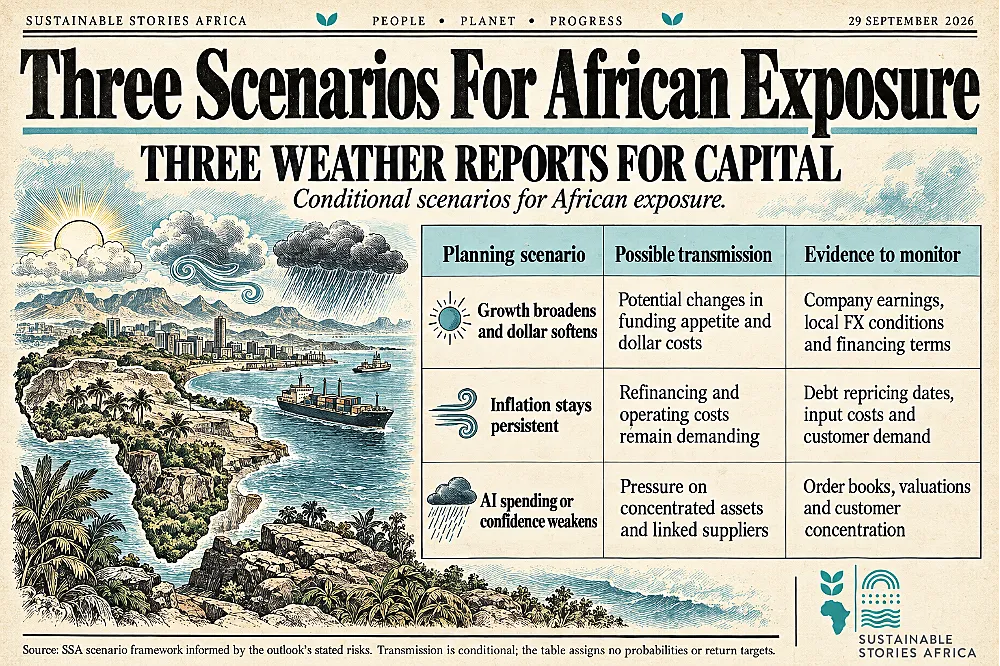
Treasury teams should identify the obligations most exposed to each scenario and document the assumptions used.
Boards should ask whether a funding plan depends on refinancing at an uncertain future rate or an exchange-rate movement outside the company’s control.
Investment committees should examine fees, access to liquidity, counterparty strength and hidden concentration within asset categories.
- Comparisons should use compatible currencies, periods and risk measures.
- A quoted yield, a forecast capital gain and a private-market return estimate are different quantities.
Policymakers can support investment by strengthening institutions and credible project information.
- A favourable external environment cannot substitute for clear revenue arrangements, enforceable contracts and transparent reporting.
These conditions help capital providers assess whether an opportunity can deliver through a range of outcomes.
Path Forward – For Disciplined Market Interpretation
African decision-makers should treat the outlook as a dated investment scenario and test its assumptions against local exposures.
Currency risk, refinancing needs and liquidity should shape the assessment of potential opportunities.
Broader global growth could support investment, but outcomes will remain uneven.
Credible project economics, transparent sustainability evidence and resilient balance sheets provide a firmer basis for decisions than confidence in a single market forecast.