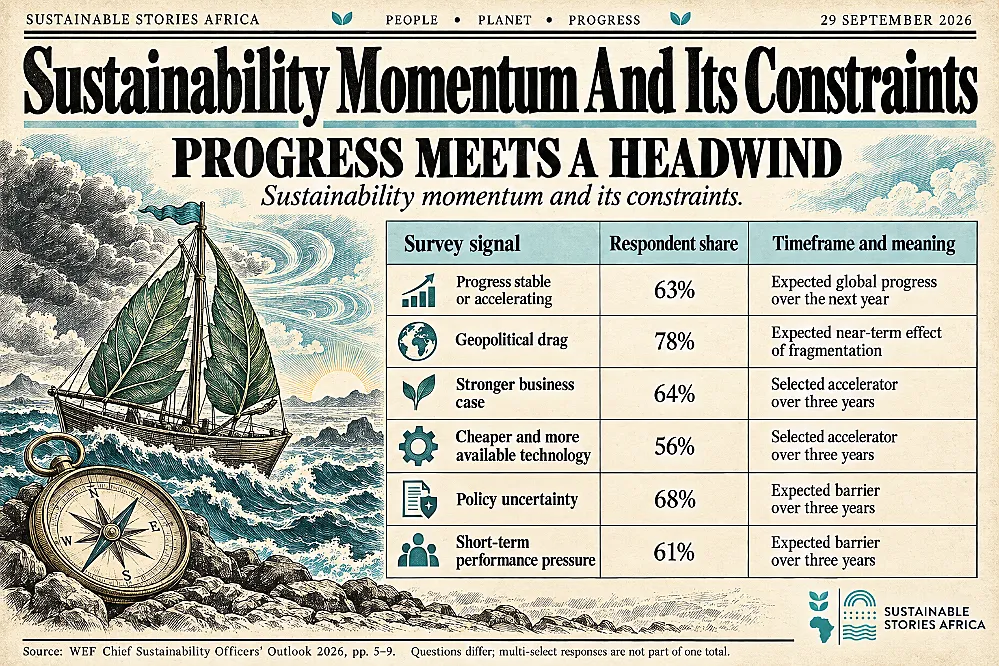
The World Economic Forum’s inaugural Chief Sustainability Officers’ Outlook finds that 63% of surveyed leaders expect global sustainability progress to hold steady or accelerate.
That confidence sits alongside geopolitical pressure, uneven commercial gains and difficulties funding adaptation.
For African companies, the report raises a practical question: how can environmental commitments become operating decisions that protect communities, improve competitiveness and remain credible when budgets tighten?
Sustainability Moves Into Core Business Decisions
Sustainability leaders expect continued progress, but delivering it is becoming a stronger test of corporate capability.
The World Economic Forum’s Chief Sustainability Officers’ Outlook aligns environmental action with investment, operations and resilience, rather than treating it solely as a reporting exercise.
The findings draw on 103 anonymised responses from the Forum’s Chief Sustainability Officers Community, collected between February 10 and March 18, 2026.
- They describe leadership sentiment across large companies; they are neither a measure of global sustainability outcomes nor a representative survey of African businesses.
For African markets, the report’s value lies in its management questions.
- Who owns implementation?
- Which investments create demonstrable benefits?
- How are physical risks affecting operations and people?
The answers determine whether sustainability can survive short budgeting cycles and changing policy conditions.
Confidence Persists While External Pressures Intensify
The headline 63% combines respondents expecting unchanged progress with those expecting acceleration over the next year.
- The other 37% expect deceleration.
- Around three-quarters also expect their companies’ transition-related investment to hold steady or increase.
Confidence therefore reflects expectation of continued movement, rather than universal acceleration.
The pressures are substantial.
- 78% expect geopolitical fragmentation to create a significant drag on progress.
- Over the next three years, respondents identify policy uncertainty, short-term performance pressure and international tensions as constraints.
The report describes an uneven transition across sectors and markets, with commercial and technological opportunities advancing at different speeds.
For a company operating across several African countries, that unevenness could mean projects face different funding costs, energy conditions and institutional requirements.
The appropriate response is to assess the business and social case locally, while maintaining consistent disclosure and implementation standards.
Commercial Opportunities Depend On Institutional Capability
The report identifies a gap between sustainability’s potential business value and its place in executive decision-making.
- Roughly two-thirds of respondents say their C-suite still views sustainability primarily through compliance.
- Respondents nevertheless expect a stronger business case and lower technology costs to help accelerate progress.
SSA’s inference is that the next improvement should often be organisational.
- A company may have environmental targets without translating them into procurement criteria, project budgets or operating responsibilities.
- A reporting team can compile indicators, but it cannot independently change equipment, supplier contracts or investment approvals.
Consider an illustrative manufacturer evaluating an efficiency upgrade.
- The sustainability team can estimate energy and emissions effects, finance can examine payback, and operations can assess production reliability.
- Procurement must verify technical claims and maintenance arrangements.
If these teams work separately, the project may remain a proposal even when its combined benefits justify consideration.
Adaptation presents its own challenge because value often appears as losses avoided.
- 85% of respondents expect adaptation to become a greater global focus over three years;
- 62% identify uncertain cost-benefit assessments as a constraint on investment.
Distribution and logistics, alongside operations, feature prominently among perceived physical-risk exposures.
For African businesses, the implications include examining exposure along supply chains and at facilities.
- Resilience assessments should also consider employees, nearby communities and infrastructure on which several users depend.
- Protecting a factory entrance will not sustain production if workers cannot reach the site or essential water supplies fail.
Digital Gains Need Full Resource Accounting
AI illustrates the report’s balance between opportunity and cost. Respondents see potential in environmental risk modelling, resource efficiency and measurement.
However, 77% identify the energy and resource intensity of AI infrastructure as one of its most significant negative sustainability impacts.
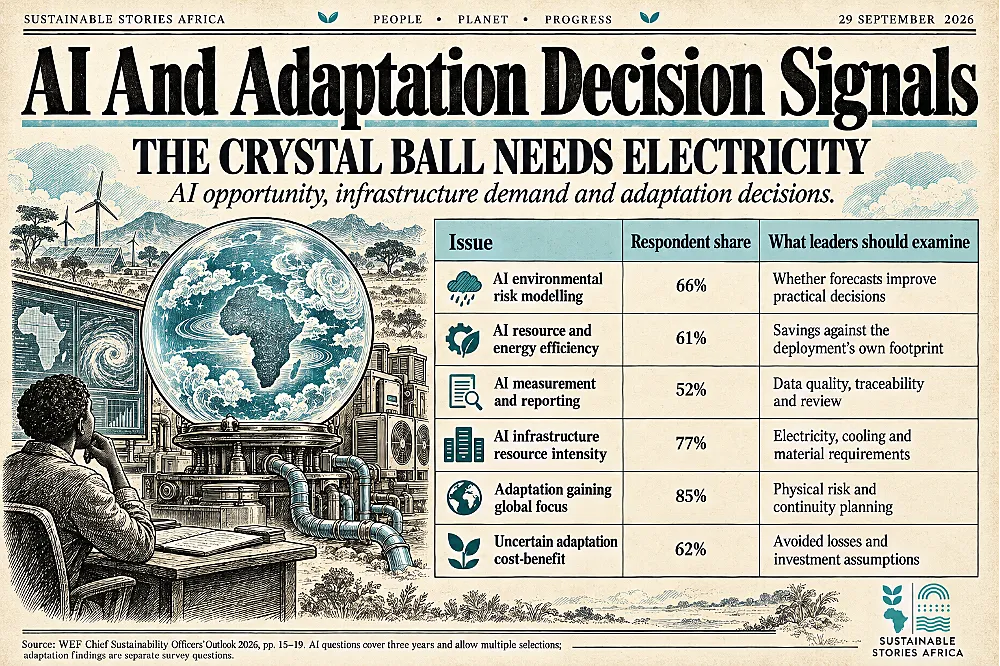
SSA’s recommendation is to evaluate a defined application rather than make a general claim that AI is sustainable.
- A system for forecasting should be judged by decisions improved, resources saved and costs incurred.
- Its own power requirements and dependence on data infrastructure belong within that assessment.
The same discipline can improve adaptation proposals.
- Clear assumptions about downtime, repair costs and vulnerable assets make resilience investments easier to scrutinise.
- Where benefits extend beyond one company, public-private arrangements may be needed to share costs and responsibilities fairly.
Companies Must Assign Ownership To Delivery
Boards should require sustainability proposals to identify an accountable executive, an operating baseline and a method for assessing results.
- SSA recommends joining environmental indicators to financial and service measures so that investment committees can examine them together.
- Claimed benefits should remain distinguishable from realised benefits.
Finance teams should help build adaptation cases that consider plausible disruption scenarios and the distribution of benefits.
Operations should document actual dependencies, including transport, energy, water and key suppliers.
Procurement should verify performance claims, while workforce teams should identify training requirements and impacts on employees.
For regulators and policymakers, predictable implementation rules can help firms plan.
- However, clearer rules cannot replace credible company data.
- Organisations should explain methods, reporting boundaries and changes in assumptions so that stakeholders can compare performance over time.
Community effects also need their own review standards.
- A business intervention that improves resilience at one site while worsening water pressure or excluding smaller suppliers can create new vulnerabilities.
- Consultation and transparent monitoring should inform project design, especially where firms depend on shared resources.
The report’s sentiment should encourage practical investment, but not complacency.
- Companies need evidence that environmental action is changing the way resources are used and risks are managed.
- Progress becomes more defensible when independent review can connect the reported result to the underlying operational change.
Path Forward – For Credible Sustainability Delivery
Companies should link sustainability priorities with capital allocation, operating responsibilities and measurable outcomes.
Adaptation proposals need credible assumptions about avoided disruption and clear arrangements for shared infrastructure.
African businesses can use the outlook to strengthen decision-making while testing local conditions.
AI should support reliable information and efficiency, including its resource demands. The priority is implementation that improves resilience and remains accountable to affected people.