
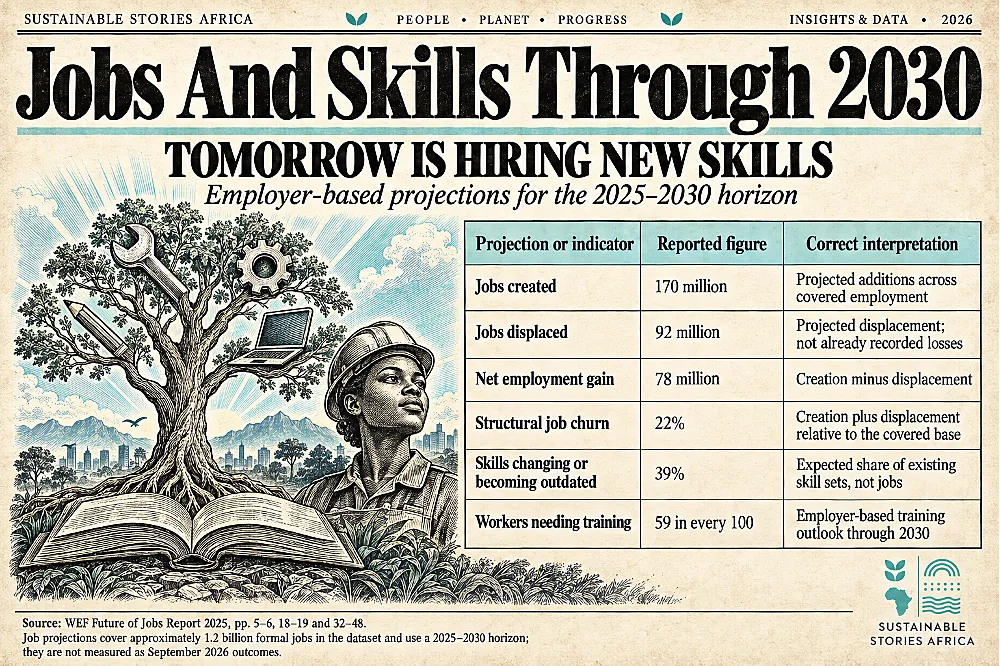
The World Economic Forum’s Future of Jobs Report 2025 projects 170 million jobs created and 92 million displaced by 2030, with substantial changes in skills.
These are employer-based projections, rather than confirmed employment outcomes.
For Africa, the central challenge is connecting growing labour forces with viable work.
The report’s first part shows why technology, climate, economic conditions, training and talent strategies must be considered together.
Employment Growth Requires A Managed Transition
The global labour market could gain a net 78 million jobs through structural change between 2025 and 2030, according to the World Economic Forum’s Future of Jobs Report 2025.
However, that positive total sits alongside projected displacement and major changes in the capabilities employers seek.
Published in January 2025, the report draws on a late-2024 survey of more than 1,000 employers representing over 14 million workers across 55 economies and 22 industry clusters.
For African businesses and policymakers, SSA’s analysis is that job creation needs a transition plan.
- The report’s first part connects macroeconomic drivers, employment, skills, workforce strategies and regional differences.
- That sequence helps identify which investments in training and institutions could make emerging opportunities more accessible.
Labour Market Headlines Hide Unequal Opportunities
The report’s introduction describes a global unemployment rate of 4.9% in its contemporary baseline, alongside youth unemployment of 13%.
- It also cites an International Labour Organisation jobs gap of 402 million in 2024.
- The jobs gap captures a broader unmet need for employment than the conventional unemployment measure.
These figures show why a single headline cannot describe the quality of opportunities.
- The introduction highlights differences by income group and gender, while growing working-age populations increase the need for job creation in lower-income settings.
These baseline measures should not be read as September 2026 statistics.
SSA’s inference is that African planning needs to examine access, earnings and progression alongside the number of jobs.
- A growing occupation can still be difficult to enter if training, transport or recruitment practices exclude people.
- Projections of demand are useful only when they inform practical routes into employment.
Multiple Forces Reshape Jobs And Businesses
Chapter 1 identifies technological change, economic uncertainty, demographic shifts, geoeconomic fragmentation and the green transition as interconnected drivers.
- 60% of employers expect broader digital access to transform their business by 2030;
- 86% identify AI and information processing as transformative technologies.
- These percentages measure expectations, rather than completed adoption.
Costs and climate also matter.
- Half of respondents identify the rising cost of living as a transformative trend.
- Climate mitigation and adaptation are cited by 47% and 41%, respectively, while geopolitical fragmentation is identified by 34%.
- Different combinations shape recruitment and operating decisions across markets.
Chapter 2 estimates that by 2030, 170 million jobs will be created and 92 million displaced, a net gain of 78 million.
- The underlying extrapolation covers the employment represented by the report’s occupational dataset; it is not a promise about all work, including every informal livelihood.
- Creation and displacement together represent 22% of the employment base used for the projection.
Technology occupations are among the fastest growing in percentage terms.
- Frontline roles, including farming, delivery, construction and sales, account for much of the expected growth in absolute numbers.
- Care and education occupations also feature, while several clerical roles are expected to decline.
- Percentage growth and total job additions answer different questions.
Skill Disruption Requires Accessible Learning Routes
Chapter 3 estimates that 39% of workers’ existing skills will change or become outdated by 2030, compared with 44% in the 2023 edition.
- The report links changing demand with technology, climate pressures and evolving organisational needs.
- It identifies AI and big data, networks and cybersecurity, and technological literacy among the fastest-growing skill areas.
Human capabilities remain central.
- Analytical thinking is considered a core skill by roughly seven in ten respondents.
- Resilience, leadership, creative thinking and lifelong learning sit alongside technical abilities.
- Environmental stewardship enters the list of the ten fastest-growing skills, reflecting the influence of climate-related change.
The training outlook makes the implementation challenge concrete.
- In a workforce of 100 people, employers expect 59 to need training: 29 could be upskilled in their existing roles, and 19 retrained and redeployed.
- 11 are expected to miss the training they need.
These categories describe the report’s scenario, not a schedule employers have already delivered.
SSA recommends connecting courses with specific tasks and opportunities.
- An employee learning cybersecurity needs supervised practice and a credible route to relevant work.
- Paid learning time, equipment and accessible assessment can determine whether workers can participate, especially where responsibilities outside work limit availability.
Workforce Strategies Must Improve Talent Availability
Chapter 4 identifies skills gaps as the leading transformation barrier, cited by 63% of employers.
- Organisational resistance follows at 46%.
These findings show that buying technology and recruiting specialists cannot, on their own, solve implementation problems.
- Work design and management practice also need attention.
- 85% plan to upskill employees, 70% to hire people with new skills, and 51% to move workers from declining to growing roles.
- 41% anticipate reductions where skills become less relevant, or roles are no longer needed.
These are overlapping employer strategies, not percentages of workers destined for each outcome.
Talent availability depends partly on whether people can stay and progress.
- The report identifies employee health and wellbeing, reskilling and promotion routes as important employer practices.
- Public funding and the provision of training also feature among policies employers see as useful.
SSA’s recommendation is to assign responsibility for transitions before roles change.
- Managers should identify transferable capabilities, training requirements and vacancies that offer progression.
- Governments and employers should examine barriers such as transport, care responsibilities and recruitment filters alongside course provision.
Regional And Industry Differences Shape Priorities
Chapter 5 shows why a global skills list cannot substitute for local planning.
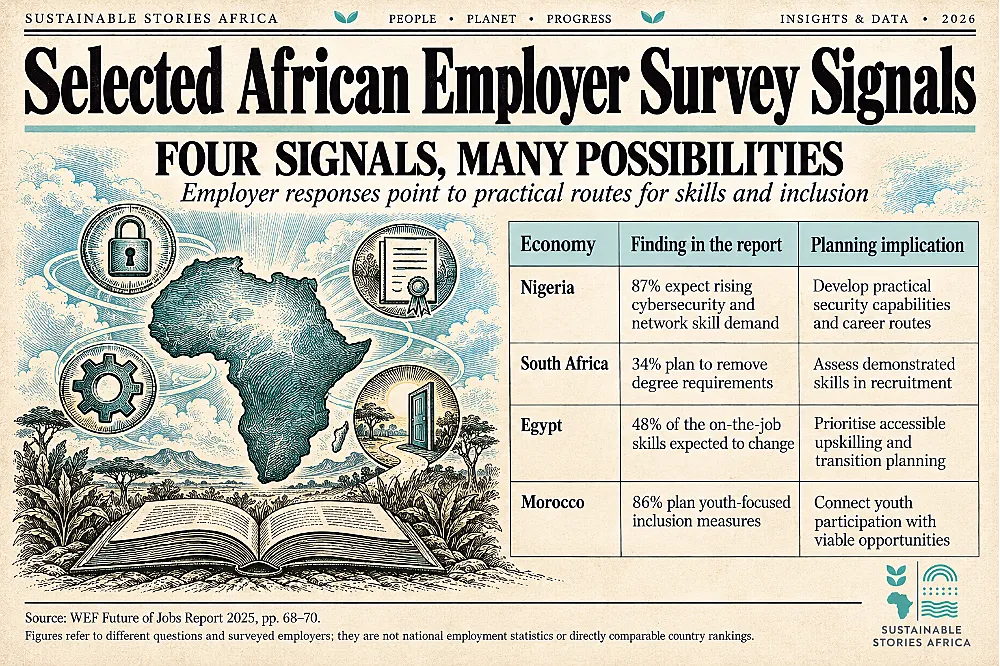
- Nigerian respondents anticipate strong demand for networks and cybersecurity, while Egyptian respondents project above-average skill disruption.
- Morocco and South Africa identify different routes to expanding participation and addressing transformation barriers.
Industry differences are equally important.
- Skills gaps lead to perceived barriers in 19 of 22 sectors, but organisational resistance is especially prominent in government and healthcare.
- Real estate highlights difficulty attracting talent, while several industries, including agriculture and IT services, identify data and infrastructure constraints.
SSA’s inference is that training priorities should reflect actual investment and service needs.
- Energy projects require the skills to build and maintain equipment; financial services need reliable technology and accountable decisions; health and education require human expertise alongside digital tools.
Sector partnerships can translate these needs into training, assessment and paid opportunities.
Path Forward – For Inclusive Workforce Transformation
African governments, employers and educators should connect labour-market evidence with practical training, recruitment and progression.
Workforce plans need to address both emerging roles and workers exposed to displacement.
The report offers a dated global outlook, while local demand determines priorities.
Affordable learning, credible assessment, supportive infrastructure and measurable employment outcomes can help turn projected growth into opportunities people can reach.