
Nigeria’s upstream regulator is reinforcing the finite terms and work obligations attached to petroleum prospecting licences.
A September circular invites affected holders facing constraints to report their compliance position and proposed remedies by October 31, 2026.
The implications reach investors, lenders and host communities.
Licence ownership alone cannot establish project viability; performance, contractual arrangements, environmental responsibilities and procedural safeguards also matter.
Petroleum Rights Carry A Performance Clock
Nigeria is assessing petroleum prospecting licences through the work their holders deliver.
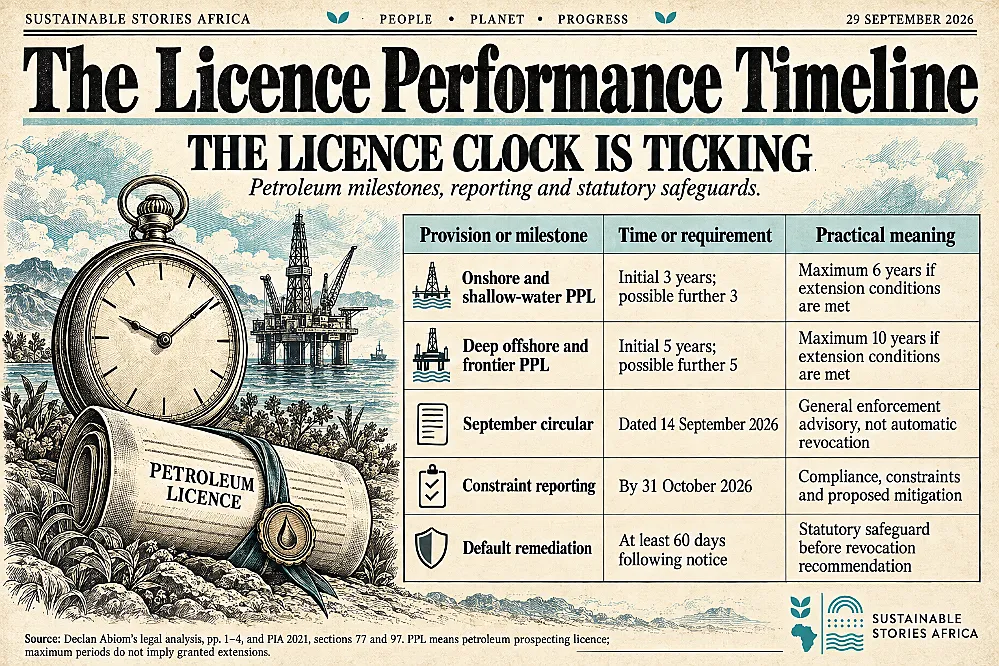
The Nigerian Upstream Petroleum Regulatory Commission’s September 14, 2026 circular reinforces obligations to execute approved programmes within the applicable licence term, according to legal analysis by Declan Abiom.
The circular covers petroleum prospecting licences awarded through the 2020 Marginal Field Bid Round, the 2022/2023 Mini Bid Round and the 2024 Licensing Round.
Holders experiencing constraints are invited to provide compliance information, explanations and proposed mitigation by October 31, 2026.
- For investors reviewing assets, the development brings regulatory performance closer to the centre of valuation.
- For communities, its significance will depend on how projects are implemented and supervised.
SSA’s analysis is that acreage management must combine credible work delivery with environmental and social responsibilities, rather than measure success solely through activity.
Licence Terms Define The Immediate Stakes
The Petroleum Industry Act 2021 sets finite exploration periods.
- The analysis explains that an onshore or shallow-water prospecting licence can run for a maximum of six years, comprising an initial three-year term and a possible three-year extension.
- Deep offshore and frontier acreage can have a maximum ten-year term, with an initial five-year period and a possible five-year extension. Extensions are conditional rather than automatic.
Work commitments are connected to those terms.
- The legal brief identifies approved programmes, annual reporting and performance security as parts of the obligation.
- An investor should therefore establish what has been completed and what remains outstanding, alongside confirming ownership.
The enforcement consequences are distinct.
- Relinquishment concerns acreage returned under the statutory framework and can apply to portions of a licence.
- Revocation follows a different process.
The brief states that the general circular is not itself a notice of default or an immediate revocation notice.
Compliance Evidence Determines What Investors Can Trust
The regulatory package extends beyond the licence instrument.
- According to the brief, the circular requires relevant licence conditions, concession arrangements, minimum work programmes and performance security to be read together.
- These documents can reveal obligations and exposures that a headline asset description misses.
Consider an illustrative farm-in transaction where an incoming investor agrees to finance exploration in return for an interest in the asset.
- If a work milestone is already overdue or a licence term is close to ending, capital availability may not be the only issue.
- The transaction must also establish whether the proposed programme is feasible within the regulatory position and whether relevant approvals can be obtained.
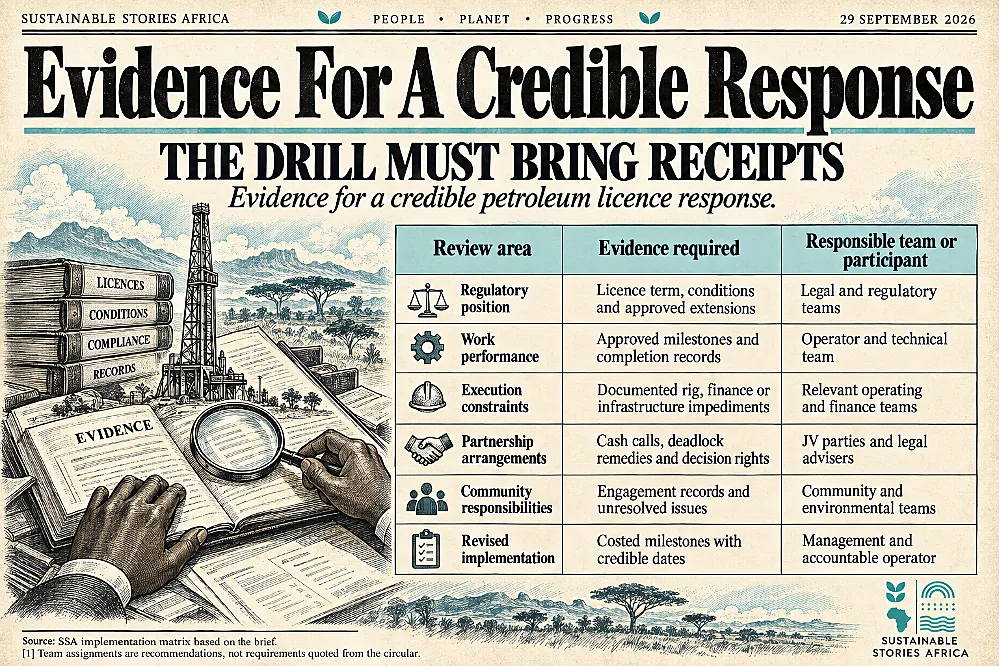
The brief recognises financing, rig availability, security, community engagement, infrastructure, approvals and partner arrangements as possible constraints.
- A credible response links each outstanding obligation with supporting evidence, a proposed remedy and a realistic implementation date.
- General descriptions of difficulty do not demonstrate that the underlying problem can be resolved.
Partner disputes require particular attention.
- An unresolved cash call or deadlock can interrupt operations, but the analysis explains that engagement and internal disputes do not automatically suspend licence terms.
- Commercial agreements therefore need mechanisms to address disagreement before it prevents performance.
SSA’s inference is that due diligence should assess regulatory, technical and contractual information together.
- The licence’s remaining life, the programme’s funding needs and the partners’ capacity to make decisions are interdependent.
- Treating them as separate workstreams can obscure the risk that a commercially attractive asset cannot deliver its required programme.
Acreage Discipline Must Protect Community Interests
Active acreage management can create a route for unworked areas to return to the government and potentially be considered for subsequent allocation.
- However, the circular does not establish that production will increase by a specified amount or that every affected licence is non-performing.
- These outcomes depend on subsequent decisions and project conditions.
For host communities, stronger emphasis on implementation could create demand for services and employment where projects proceed.
- These are possibilities, rather than promises in the document.
- Communities also need clear information about project timing, land use, safety, environmental effects and how concerns will be handled.
The governance challenge is to avoid equating speed with responsible delivery.
- Resolving engagement delays requires meaningful dialogue, rather than treating community concerns as administrative obstacles.
- Financing and work schedules should account for the resources needed to meet applicable environmental and social obligations.
For capital providers, the better outcome is a clearer understanding of asset risk.
- Evidence of completed work and a credible remaining programme can support decisions; an unsupported expectation of extension can distort them.
Transparent regulatory communication can help distinguish recoverable constraints from persistent inability to perform.
Licensees Need Documented And Feasible Responses
SSA recommends that affected holders undertake a coordinated review before the reporting date.
- Legal teams should establish the exact licence status and instruments. Technical teams should verify completed work and outstanding milestones.
- Finance should identify the funding required to deliver the proposed timetable and the consequences of performance-security exposure.
Lenders and incoming investors should examine the same evidence before committing funds.
- Check transaction assumptions against granted approvals and documented performance, with clear responsibility for outstanding work.
- Where an extension is only requested, it should remain identified as a request.
The regulator’s role includes applying the statutory process consistently.
- Revocation is a serious legal consequence: the analysis describes a notice of default, a remediation period of at least 60 days and ministerial action on the commission’s recommendation where the applicable requirements are satisfied.
These safeguards ensure credible enforcement.
Path Forward – For Responsible Acreage Management
Affected holders should establish their exact regulatory position, document outstanding work and submit credible mitigation information by October 31.
Investors should assess licence performance alongside technical prospects and financing.
Enforcement should preserve statutory safeguards and support transparent decision-making.
Project delivery must also account for community engagement and environmental responsibilities, so that stronger acreage discipline advances accountable development rather than creating avoidable local risks.