
Airport slots increasingly determine who can compete at congested gateways.
ACI World’s 2026 white paper proposes stronger governance and transparency while preserving an internationally compatible administrative system.
For African aviation, the issue links scarce capacity with regional access, infrastructure investment and public value.
Reform should improve the evidence behind allocation decisions while preserving the predictability airlines need to plan services.
Scarce Airport Access Becomes Public Policy
ACI World is calling for airport slot policy to evolve as congestion makes access to critical gateways more valuable.
Its 2026 white paper argues that existing rules embed choices about competition and public interest, even when allocation appears to be a technical scheduling exercise.
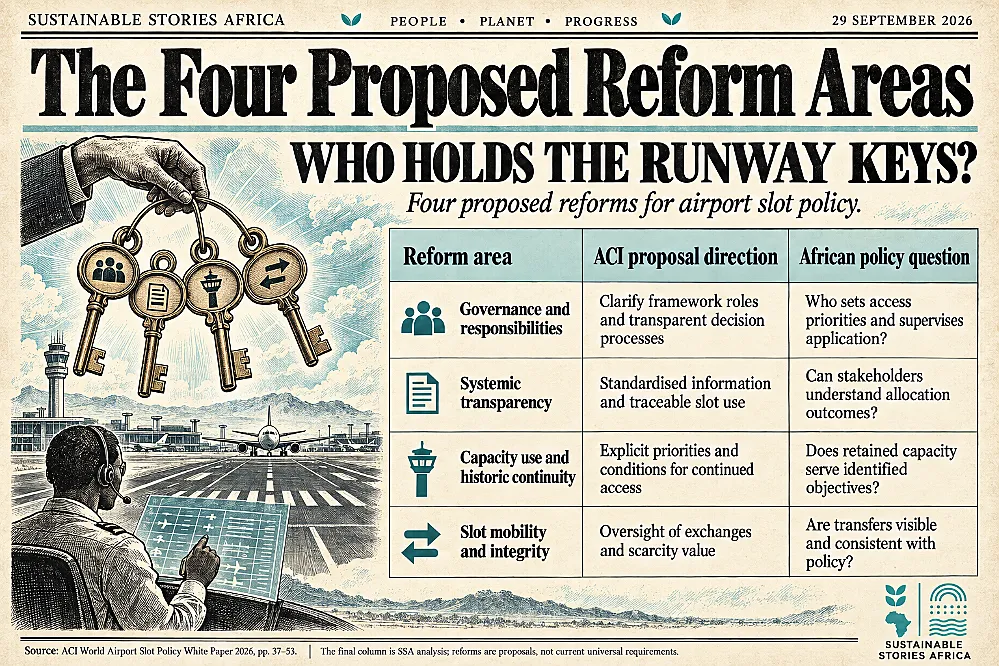
The proposals focus on governance, transparency, capacity use and slot mobility.
- They retain the administrative allocation framework and independent coordination.
- They are recommendations from the global airport association, rather than enacted rules binding every airport or airline.
For African markets, SSA’s analysis is that the debate matters both at home and overseas.
- Carriers’ access to constrained destinations can affect the viability of regional networks, while growing domestic hubs need allocation processes that support reliable service and responsible use of infrastructure.
Assess reforms through these practical effects.
Passenger Growth Increases Pressure On Gateways
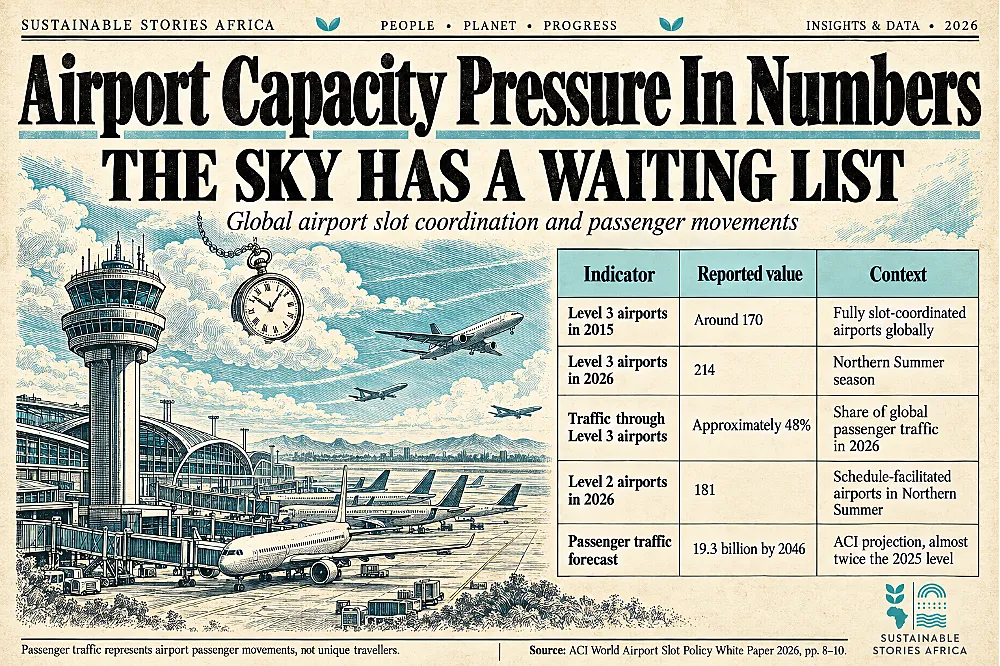
ACI World projects global passenger traffic of 19.3 billion by 2046, almost twice the 2025 level.
- That is a long-term forecast, not a measure of current demand.
The paper also records a rise in fully coordinated Level 3 airports, from around 170 in 2015 to 214 in Northern Summer 2026.
- These airports account for approximately 48% of global passenger traffic.
A slot is permission to operate at a coordinated airport at a specified time.
- The paper distinguishes Level 1 airports, with unrestricted access, from schedule-facilitated Level 2 airports and fully coordinated Level 3 airports.
- Formal slots apply at Level 3; historic precedence does not apply at Level 2.
The distinction matters for policy.
- A terminal bottleneck, runway limit or passenger-processing constraint may require different operational responses.
- Slot coordination manages access within declared capacity; it does not create the physical infrastructure needed to remove the constraint.
Historic Priorities are Shaping Opportunities For Competition
Under the framework described in the paper, operating a slot series at least 80% of the time generally supports historic eligibility in the equivalent following season.
- Historic allocations are made before the remaining pool is distributed.
- Half of available pool slots are reserved for new entrants, subject to the framework’s definition.
ACI’s concern is that at heavily congested airports, little useful capacity returns to the pool.
- A new-entrant allocation rule cannot provide meaningful access if available timings do not support viable services.
- Historic holders retain flexibility over routes and aircraft within coordination parameters, while potential competitors may face limited opportunities.
The existing arrangements also provide benefits.
- Airlines need predictable access to make schedules, connect services and commit resources.
- Sudden changes can affect passengers and commercial planning.
The reform question is therefore how to make continuity accountable while preserving reasonable planning certainty.
An illustrative African carrier may secure a destination slot that does not align with its home-hub connections.
- The permission to operate exists, but the timing may undermine its proposed network.
- Understanding competition therefore requires examining the quality and practicality of access, alongside counting allocated slots.
SSA’s inference is that public scrutiny should examine actual use over time.
- Authorities need evidence about unmet demand, cancellations, returned slots and the effect of timing on services.
- Such information can help distinguish a genuine capacity shortage from allocation practices that deserve review.
Transparent Allocation Can Strengthen Infrastructure Value
The white paper proposes broader systemic transparency so that stakeholders can understand how scarce capacity is allocated, used and exchanged.
- It also calls for clearer responsibilities and public-interest oversight.
- This places airport policy within the governance of valuable infrastructure.
For African governments and airport operators, improved evidence could support better investment planning.
- If a constraint is accurately identified, capital can be directed towards the relevant runway, stand, terminal or processing capacity.
- Poorly diagnosed congestion can lead to expensive projects that fail to improve actual service.
Public value needs explicit definition.
- It may include reliable connectivity, competitive access and efficient use of infrastructure.
- Environmental objectives can also inform policy, but more passengers or larger aircraft do not automatically establish lower total emissions.
Assessments need operating data and a clearly stated comparison.
Passengers and businesses could benefit if better allocation supports dependable routes and viable competition.
- These remain potential outcomes.
ACI’s proposals do not establish a guaranteed reduction in fares or a specific traffic increase for African airports.
Reform Requires Independent And Predictable Oversight
ACI organises its proposals into four reform areas.
- The approach seeks to strengthen oversight without making slot coordinators responsible for creating policy themselves.
- Neutral administration and clear policy responsibilities are intended to reinforce each other.
SSA recommends that authorities begin with an assessment of local constraints and existing legal arrangements.
- Policy changes should specify objectives, evidence requirements and the roles of regulators, operators, airlines and independent coordinators.
- Stakeholders should have time to assess the likely operational effects.
The white paper recommends that additional historic-continuity conditions be defined in advance, applied prospectively and reviewed periodically.
- Its annex suggests intervals typically spanning three to five equivalent seasons, adapted to the nature of local constraints.
- These are proposed review arrangements, not an existing global expiry rule.
Airlines should be able to understand decisions and challenge inconsistent application through the relevant processes.
- Airport operators should supply dependable capacity information and explain which infrastructure limitations drive coordination.
- Competition and transport authorities need to examine whether the resulting access arrangements meet their stated objectives.
Cross-border cooperation remains essential because a viable service depends on conditions at both ends.
- A reform that improves one airport’s allocation process can still fail to support connectivity if corresponding destination timings remain unusable.
Path Forward – For Fair Airport Access
African aviation authorities should assess capacity constraints, publish useful allocation evidence and clarify accountability before introducing reforms.
Predictable rules and independent coordination remain necessary for viable services.
ACI’s proposals offer a framework for examining historic access and public value.
The priority is transparent use of scarce infrastructure that supports reliable connectivity and fair competition, alongside investment where physical capacity genuinely needs expansion.