
SS&C Intralinks’ 2026 PE Dealmaking Report describes a market in which megadeals support headline value while transactions, fundraising and exits remain under pressure.
Its annualised estimates put deal activity below 2025 levels.
For African founders and investors, the implications concern selection, financing and exit preparation.
Global totals do not forecast local deal flow, but they help explain why credible cash generation and dependable information matter in a more selective market.
Megadeals Conceal A More Selective Market
Large private equity transactions are supporting global headline deal value while the broader market loses momentum, according to SS&C Intralinks’ 2026 PE Dealmaking Report.
- Its annualised estimates indicate fewer deals and lower invested value than the previous year.
The report uses PitchBook data, with most market charts dated August 3, 2026.
- Annualised totals are estimates based on activity to that point, rather than completed full-year results.
- Some discussion also refers to subsequent macroeconomic developments, so the dates of individual figures need to remain attached to them.
For African markets, SSA’s analysis is that the report offers a global financing context
- It does not establish a continent-wide private equity forecast.
- Its practical lessons concern how companies demonstrate value, how investors fund transactions and how fund managers prepare to return capital to their own backers.
Deal Counts Tell A Different Story
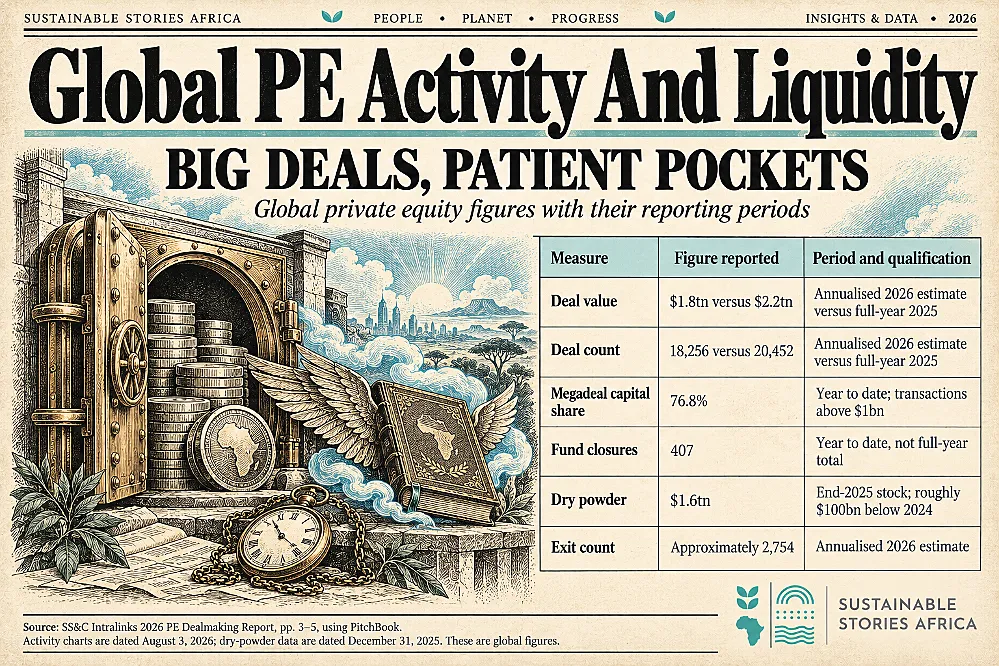
The report estimates an annualised 2026 deal value of $1.8 trillion across 18,256 transactions, below the $2.2 trillion and 20,452 deals recorded for 2025.
- It also reports that transactions exceeding $1 billion account for 76.8% of year-to-date global PE capital.
- That is a share of value, not a share of deal count.
Fundraising and exits help explain the pressure.
- The report records 407 fund closures year-to-date and puts annualised exits at approximately 2,754 transactions and $1.1 trillion in value.
- It reports dry powder of $1.6 trillion at the end of 2025, down by around $100 billion from 2024.
Dry powder means capital available for investment under fund arrangements.
- Its existence does not mean that every attractive company can readily access it.
- Managers’ mandates, risk appetite and ability to raise subsequent funds influence deployment decisions.
Financing Structures Reveal Greater Investment Discipline
The report describes a move towards greater equity contributions and lower leverage across several strategies.
- It records a global median enterprise-value-to-EBITDA multiple of 10.2 times year to date, compared with 11.9 times in 2025 and 12.7 times in 2024.
The ratio compares enterprise value with earnings before interest, taxes, depreciation and amortisation.
- It is a valuation indicator, rather than a cash return to an investor.
- Differences can reflect changes in the companies being acquired as well as changes in prices, so a lower median does not prove that identical assets have become cheaper.
The report suggests that acquisition activity has become more selective, with add-ons and growth or expansion funding accounting for 77.2% of year-to-date deal count, against 75.3% in 2025.
- Its interpretation is that sponsors are seeking opportunities that fit a more demanding financing environment.
For an illustrative African business seeking capital, the lesson is to explain how the company can use investment productively.
- A plan based on verifiable demand, margins and operational improvements is easier to evaluate than one that depends principally on a higher valuation at exit.
- Currency exposure and customer concentration also need clear treatment.
SSA’s inference is that local conditions can amplify execution demands.
- An investor financing a company with revenue in one currency and obligations in another needs to understand cash conversion and stress scenarios.
- Global market statistics cannot answer those company-specific questions.

Operational Improvement Can Create Durable Value
The report’s emphasis on selection and execution shifts attention towards the business itself.
- Investors can examine whether capital improves capacity, reliability, working capital or access to customers.
- Gains should be supported by operating evidence, with a clear explanation of the resources and time needed to achieve them.
For African companies, governance and sustainability information can contribute to that evidence.
- Labour practices, resource dependencies and environmental exposure can affect costs and continuity.
- These matters should be assessed as part of the investment case, rather than appended as claims after a transaction has been agreed.
Founders can also benefit from clarity about the proposed funding structure.
- More equity may reduce some borrowing pressure, but it changes ownership and may affect governance rights.
- Lower leverage does not eliminate commercial risk or guarantee a successful exit.
The report’s holding-period figures require care.
- They describe investments that have exited; they do not measure the age of all unsold assets.
- A fall in the holding time of completed exits can coexist with a backlog elsewhere.
Fundraising recovery ultimately depends on actual capital returned and investors’ confidence in future deployment.
Managers Should Prepare Evidence Before Transactions
SSA recommends that companies maintain a dependable record of financial performance, material contracts, ownership and key risks before entering a fundraising process.
- A well-organised information set can help investors identify issues earlier, but presentation cannot replace accurate records or management competence.
Investors should test earnings quality, cash conversion and the assumptions behind the proposed value-creation plan.
- They should also examine who can buy the business at exit, how that buyer would fund the purchase and what conditions could interrupt the process.
- Exit routes need realistic alternatives.
Fund managers should distinguish unrealised valuations from cash distributed to limited partners.
- Reporting should explain the basis for changes in value and the liquidity assumptions within fund plans.
- A large headline transaction elsewhere offers little reassurance to an investor awaiting distributions from a different portfolio.
The report’s publisher supplies transaction technology and discusses AI-supported diligence.
- Such tools may help organise information and surface questions, but they do not independently validate a company’s prospects or reopen an exit market.
- Responsibility remains with the people evaluating evidence and making decisions.
Path Forward – For Accountable Private Capital
African companies and investors should build transaction plans around dependable cash flows, clear governance and credible operational improvements.
Funding structures need to reflect currency exposure and the risk of exit delays.
Global PE figures provide context, while local evidence determines investment viability.
Managers should prepare assets early, report valuations transparently and judge recovery through realised exits and returned capital, alongside headline deal values.