
Banks can automate a task without improving the corresponding service. West Monroe’s banking analysis argues that lasting AI value depends on connecting technology to complete customer and employee journeys, with reusable data and governance capabilities.
For African lenders, the practical test is whether deployment improves access, decision quality and accountability.
Faster processing matters most when customers experience fewer delays and retain a clear route to human review.
Banking AI Faces An Execution Test
African banks considering their next AI investment face a management question:
- Which customer problem will the institution actually solve?
An impressive document-extraction demo says little about whether a business processes loan decisions on time or understands why it rejects an application.
In its August 26, 2026 analysis, West Monroe recommends prioritising complete banking journeys and incorporating AI into existing work, while building reusable integration and oversight capabilities.
It presents a practical consulting argument rather than a statistical study of pilot failure.
This distinction matters because banks must decide how to extend experiments without letting fragmented tools multiply operational risk.
For African institutions, SSA’s analysis is that success should be judged through customer outcomes and the institution’s ability to explain, supervise and sustain the resulting service.
Adoption Numbers Conceal The Scaling Challenge
AI adoption is already substantial in one well-documented market.
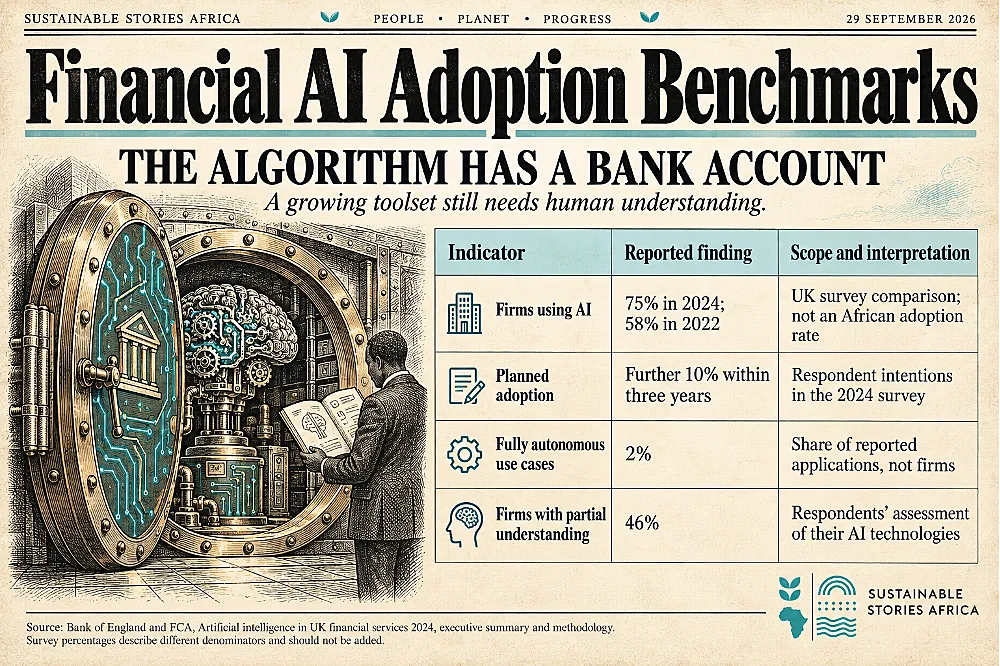
The Bank of England and Financial Conduct Authority’s 2024 survey received 118 responses:
- 75% of firms reported using AI, compared with 58% in 2022.
- However, only 2% of reported use cases involved fully autonomous decision-making.
These are UK financial-services findings, not adoption estimates for African banks.
That combination offers a useful benchmark.
- Widespread adoption can coexist with a continuing need for supervision.
- Counting applications therefore tells a board much less than understanding their materiality, the decisions they influence and the safeguards surrounding them.
The Financial Stability Board’s risks, summarised by the Bank for International Settlements, include concentrated technology dependencies, weaknesses in data and model governance, cyber vulnerabilities and correlated behaviour.
- Scaling can expand exposure to these risks when several business functions rely on the same service.
For a customer, the relevant question is simpler:
- Does the bank become easier to deal with?
A system that produces a faster internal summary but leaves the applicant chasing missing records has improved one activity while preserving the wider delay.
Lending Journeys Reveal Where Value Leaks
West Monroe uses commercial lending to illustrate how work passes between relationship managers, underwriters, credit teams and operations.
- It recommends improvements in the connected journey so that one investment supports subsequent deployments.
- It also argues that institutions should choose architecture according to strategy and risk appetite.
Consider an illustrative small business applying for working capital.
- Staff may need to reconcile invoices, account movements and financial statements before reviewing repayment capacity.
- Automated extraction could help assemble that information.
However, a useful deployment would also identify inconsistencies, tell the customer what remains missing and preserve evidence for the person making the lending decision.
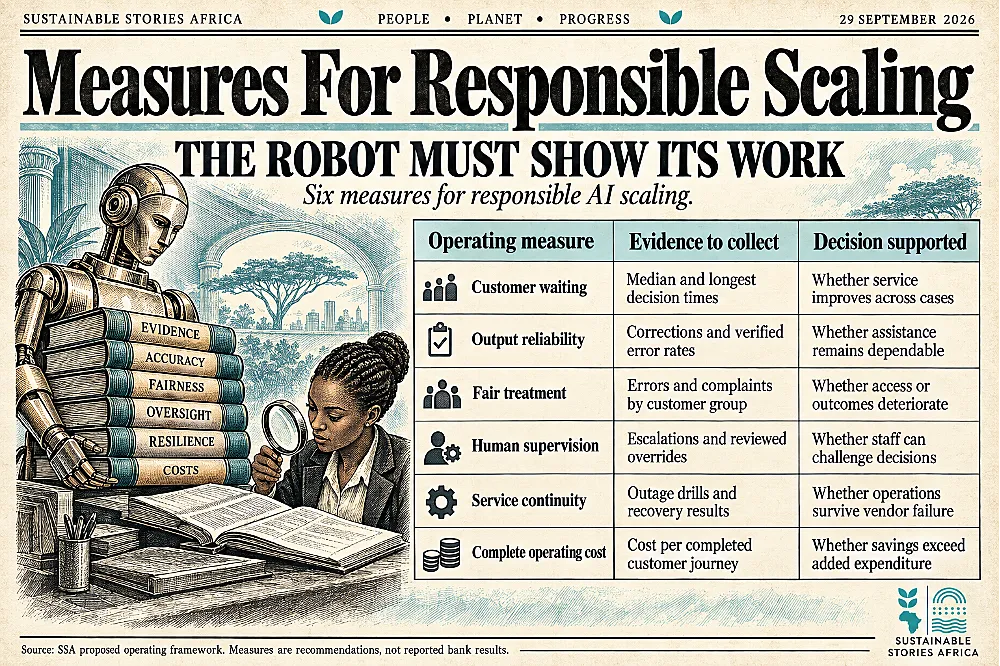
SSA recommends establishing a baseline before changing that process.
- Measure elapsed time from application to decision, repeat document requests, manual corrections and the proportion of cases requiring escalation.
- Afterwards, compare like-for-like applications rather than treating a shift towards easier customers as a technological improvement.
Inclusion requires an additional test.
- Applicants with irregular income, limited documentation or unfamiliar trading patterns should not become invisible because their records differ from the training material.
- Banks should examine error rates across relevant customer groups and investigate complaints.
They should also test local terminology and language where these affect document interpretation or customer communication.
Nigeria’s Data Protection Commission has highlighted the risks of unauthorised profiling and automated decisions affecting loans and other significant opportunities without adequate oversight or explanation.
That public guidance reinforces the need to involve privacy specialists when designing a deployment.
Better Service Requires Measurable Customer Benefits
A well-designed implementation could shorten avoidable wait time, free employees to investigate complex cases and make documentation easier to retrieve.
- These are potential benefits to be demonstrated through operating results.
- They should not be presented as guaranteed consequences of buying an AI product.
For small businesses, predictable processing can support planning around stock, salaries and supplier payments.
For the bank, clearer records can reduce duplicated work and improve review consistency.
- The same evidence can help supervisors and internal auditors reconstruct what happened when a customer challenges an outcome.
Efficiency also needs a full cost calculation.
- Licence fees, integration, validation, employee review, incident handling and vendor changes all contribute to the cost of a completed service.
- A decline in processing time may be worthwhile even without an immediate reduction in headcount, particularly where staff can resolve more difficult cases.
The social dimension belongs in that calculation.
- Customers need accessible explanations and meaningful escalation.
- Employees need training that lets them question an output, rather than a workflow that rewards accepting suggestions without scrutiny.
Boards Must Govern Scaling Through Evidence
SSA recommends that banks select one priority journey and assign a business owner responsible for its results.
- Technology, risk, compliance and customer-service teams should agree what evidence is required before expanding deployment.
- Approval should cover failure handling and withdrawal as well as expected benefits.
Banks should test fallback procedures with the employees who would actually use them.
- A manual route that exists only in a policy document may fail during an outage.
- Contract reviews should establish access to records, change notifications and the practical cost of replacing a provider.
Regulators can support this work by asking firms to describe actual applications, material decisions and dependencies consistently.
- Boards should require periodic review after launch because model updates, changing customer behaviour and new data can alter performance.
Evidence for the next deployment should emerge from the first deployment’s experience.
Path Forward – For Accountable Banking AI
Banks should fund a complete service improvement, establish its baseline and retain accountable human decision-makers.
Expansion should follow evidence of reliable performance, fair treatment and manageable operating costs.
For African markets, the development opportunity lies in better access and more dependable service.
Reusable data, trained employees and tested recovery procedures can turn isolated experiments into a capability the institution can sustain.