An earlier study of Botswana, Zambia and Zimbabwe shows why mineral wealth produces different industrial outcomes. Ownership, procurement, technical skills and policy enforcement all shape the businesses that develop around mining.
Its historical evidence remains useful for today's industrial debate, provided the dates stay visible.
Local sourcing is an incomplete measure when domestically registered suppliers mainly distribute imported goods.
Mining Linkages Depend On Policy Choices
Mineral development can support industrial growth through firms that supply mines and those processing their output.
Judith Fessehaie and Zavareh Rustomjee's Resource-based industrialisation in Southern Africa: Domestic policies, corporate strategies and regional dynamics examines why those links developed differently in Botswana, Zambia and Zimbabwe.
Published in Development Southern Africa in 2018, the article draws on policy documents and interviews conducted in 2015 – 2016.
The lesson for African industrial policy is that a mineral resource does not determine the outcome on its own.
- Corporate purchasing strategies, public institutions and engineering capabilities influence whether mining demand creates domestic production.
- Regional markets can strengthen that opportunity when countries coordinate rather than designing supplier policies entirely within national boundaries.
Procurement Figures Can Conceal Imported Content
The Zambian evidence illustrates the difference between mining expenditure and industrial participation.
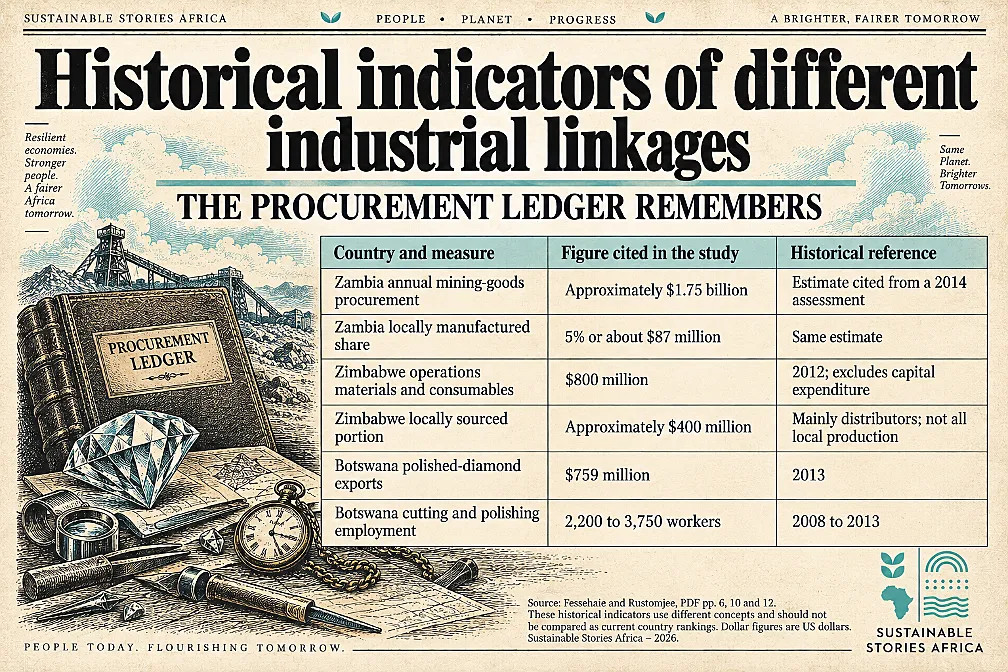
- An estimate cited in the study put annual industry procurement of goods at approximately $1.75 billion, with only 5%, or around $87 million, representing locally manufactured goods.
- The estimate drew on four major mining companies and appeared in a 2014 industry assessment.
Zimbabwe's historical case adds another distinction.
- The study reports that about $400 million of $800 million spent on materials and consumables during annual mining operations in 2012 was sourced locally.
- Much of that purchasing went through distributors, so it did not establish an equivalent amount of domestic production or value added.
Procurement location and production location need separate measurement.
Botswana Demonstrates Both Leverage And Vulnerability
Botswana's experience shows the importance of negotiating power and implementation.
- The government held a 50% interest in Debswana, its joint venture with De Beers.
- The authors describe how that position helped support the relocation of sorting and valuing activities and the development of cutting and polishing.
The historical policy package combined targets, incentives, public investment and skills transfer.
- The resulting increase in exports and employment provided evidence of movement into additional stages of the diamond value chain.
- It also depended on characteristics of the diamond market that could not simply be reproduced for every other commodity.
The 2015 market downturn exposed the strategy's vulnerability.
- The study reports closures and roughly 500 job losses against a workforce of 3,750.
- The government had interests in both rough-diamond production and downstream processing, complicating its response.
Greater domestic participation did not eliminate market risk or guarantee durable competitiveness.
Regional Suppliers Can Build Transferable Technical Skills
The study argues that upstream linkages often offer accessible opportunities across a wider range of firms than capital-intensive beneficiation.
- Mines purchase services and goods at different levels of complexity, allowing some domestic businesses to enter while others develop more specialised capabilities.
Engineering, repair and quality-control skills can also serve industries outside mining.
- A supplier capable of meeting demanding technical requirements may adapt those capabilities to manufacturing or infrastructure work.
- This is a potential development pathway, not an automatic result of a local-content percentage.
Regional demand can help suppliers achieve scale.
- The study describes South Africa as an equipment-supply hub for neighbouring mining economies, while documenting a decline in its share of selected Zambian equipment imports between 2004 and 2014.
- Those observations highlight the need to understand purchasing strategies and competitive pressure across the whole region.
Zimbabwe's loss of manufacturing skills and Zambia's policy discontinuities also weakened the supplier response.
- Procurement targets need institutions that sustain productive capability.
Design Local Content Around Productive Capability
Governments should define what local-content programmes are intended to achieve.
- Domestic ownership, local purchasing and domestic manufacturing measure different things.
- Reporting them separately can reveal whether policy builds production, merely changes intermediaries or distributes commercial opportunities without substantial capability gains.
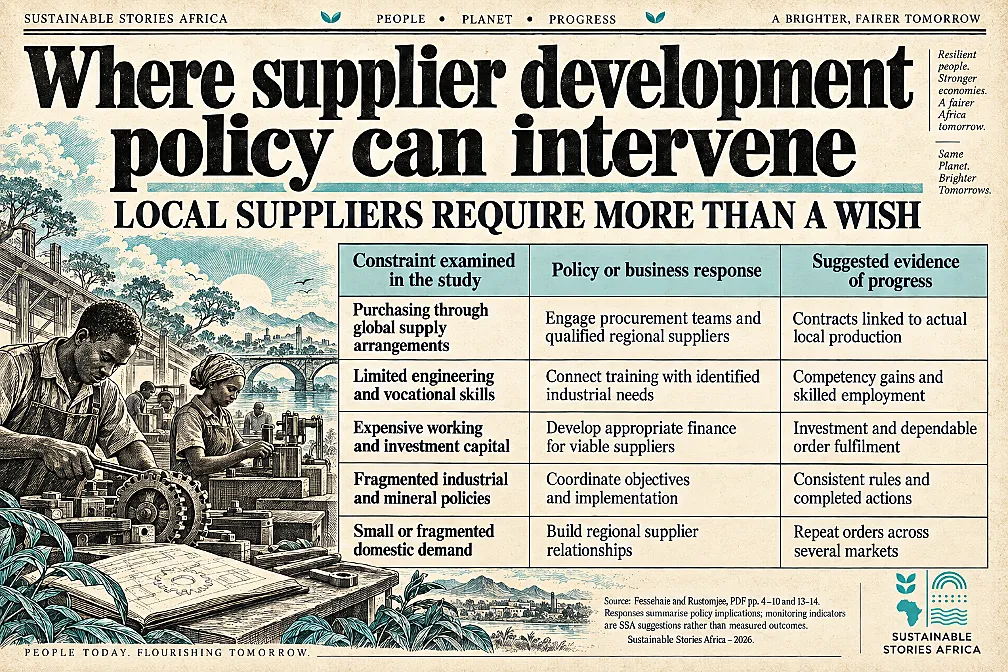
Mining companies can publish procurement opportunities early enough for suppliers to prepare.
- Technical assessments should identify specific quality gaps, while payment terms need to reflect suppliers' working-capital constraints.
- Supplier development should be connected to realistic demand rather than training firms for orders that never materialise.
Public institutions should align trade incentives, industrial support and mining commitments.
- The study's Zambian case describes incentives for imported equipment that could conflict with domestic assembly.
- Such inconsistencies can undermine manufacturing even when official strategy favours localisation.
- Reviewing the combined effects of policy is therefore more useful than adding another isolated target.
Regional cooperation should identify equipment and services with viable shared demand.
- It can support technical standards, supplier information and complementary specialisation while preserving competition.
- Public support should be time-bound and evaluated against productivity, quality and market performance.
ESG reporting should explain where production occurs, what skills remain locally and whether supplier relationships endure.
These indicators connect mineral ambitions with functioning enterprises and transferable capabilities.
Path Forward – Through Capable Regional Suppliers
Mining policies should support local and regional firms that can produce competitive goods and services.
Clear procurement definitions, technical training and consistent incentives can make that objective measurable.
Governments and industry should use the historical cases to identify mechanisms worth testing today, while collecting current evidence.
Success requires productive capability and durable supplier relationships, with employment and knowledge gains extending beyond the immediate extraction project.