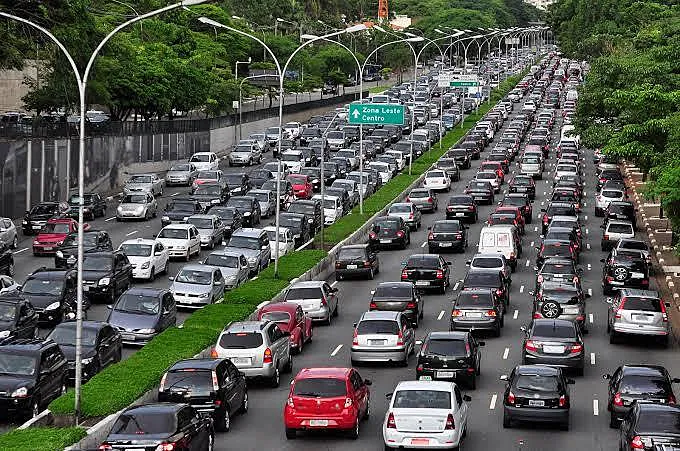
Transport affordability involves more than fuel prices. A US research brief finds that many drivers feel compelled to drive, while households without dependable vehicle access lose time and opportunities.
For African cities, the lesson is to measure whether people can affordably reach work, food and services.
The American figures describe the United States; the planning questions travel further.
Transport Costs Shape Access And Opportunity
Car dependence can strain a household budget even when a vehicle appears to offer freedom.
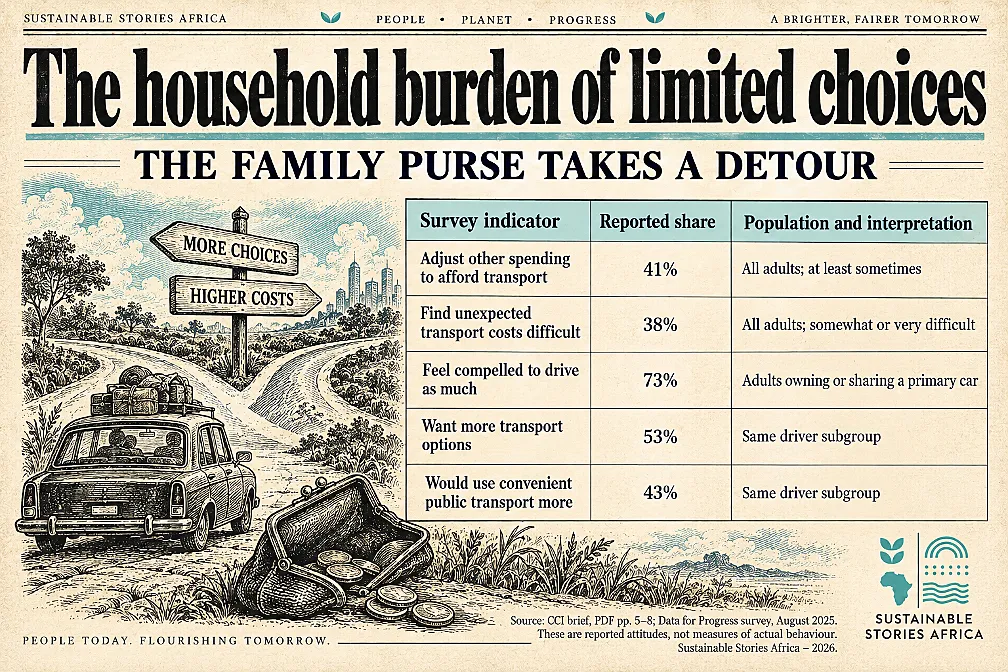
The September 2026 brief Cheated by Car Dependence: Drivers and Nondrivers in the United States, by Emmett Hopkins, Kira McDonald and Ruth Rosas, reports that 41% of surveyed US adults adjusted other spending sometimes to afford transportation.
Published by the Climate and Community Institute, it combines national polling, household data and interviews to examine the financial and practical consequences of limited transport choices.
Its implications for African and emerging markets are analytical, not statistical.
The study does not measure African commuters.
It nevertheless raises a relevant development question:
- Does transport investment expand access for residents who cannot afford, cannot operate or do not wish to depend on a private car?
When Driving Becomes A Household Obligation
The strongest signal concerns choice.
Among surveyed adults who owned or shared a car for their main transportation;
- 73% agreed that they had no choice but to drive as much as they did.
- 53% wanted more transport options
- 43% would use public transport more often if it were convenient and available.
These findings were from an August 15 – 18, 2025 survey of 1,419 US adults.
- The relevant driver subgroup had a weighted sample of 1,096. They describe attitudes at that time, rather than a new September 2026 poll.
- Their significance is that dependence and preference can diverge: frequent driving does not necessarily indicate satisfaction with the alternatives.
The interview accounts make the constraint concrete.
- Former car owners described insurance, repairs and other expenses competing with everyday spending. Nondrivers described coordinating grocery trips with relatives or allowing hours for a medical appointment.
These are individual accounts, not representative estimates, but they reveal costs that a vehicle-count statistic cannot capture.
Vehicle Ownership Conceals Unequal Household Access
One car can serve several adults unevenly.
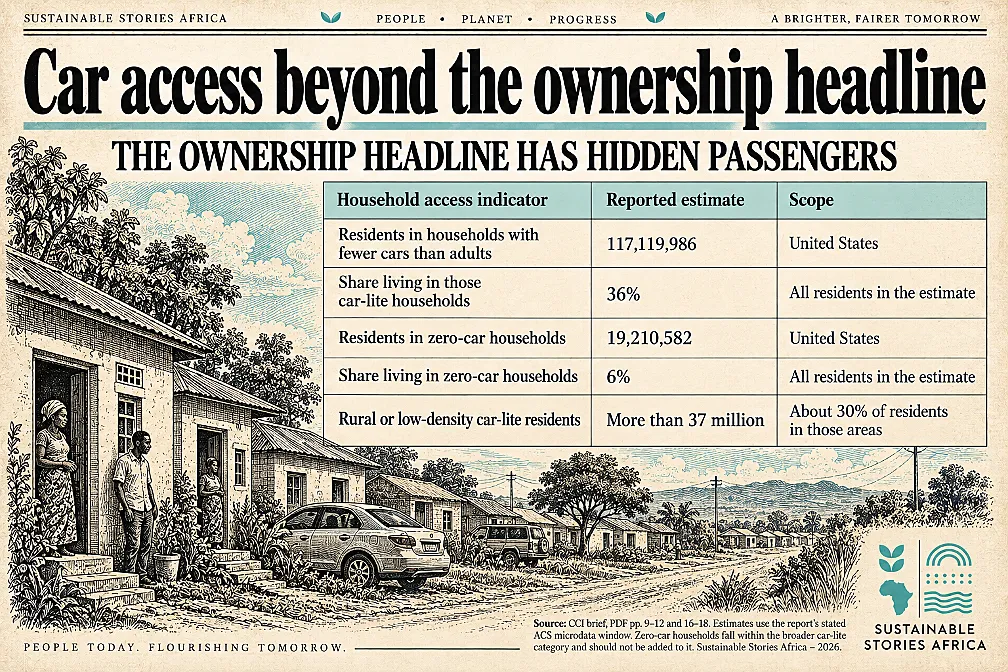
- The report defines a car-lite household as one with fewer vehicles than driving-age residents, using age 15 and over for its household analysis.
- A family may own a car while a worker, student or older relative still lacks reliable access at the time they need it.
CCI calculates that approximately;
- 117.1 million people lived in households with more adults than cars, representing 36% of the population covered by that estimate.
- About 19.2 million people lived in households with no cars.
- The separate finding shows that nearly 40% of driving-age people lived in car-lite households uses a different denominator.
These percentages should not be presented as interchangeable.
The geographic pattern also matters.
- The brief estimates that more than 37 million residents of rural or low-density communities lived in car-lite households.
- Low density therefore does not eliminate demand for shared transport; it can increase the difficulty of meeting that demand.
These estimates use the source's stated 2016 – 2021 American Community Survey microdata window.
- They are historical structural indicators, not a 2026 population census.
Similarly, its spending comparison draws on 2024 Bureau of Transportation Statistics data:
- Households with a vehicle spent $14,750 annually on transportation on average, compared with $2,165 for households without one.
That comparison does not isolate the causal effect of ownership, since household circumstances differ.
Better Mobility Can Strengthen Household Resilience
For African policymakers, the opportunity is to make access a transport objective alongside traffic movement.
- A road can carry vehicles efficiently while leaving a nearby resident unable to cross safely, board an accessible bus or reach a job at a reasonable cost.
- Evaluating the whole journey exposes these gaps.
An illustrative commuter may pay an affordable bus fare yet lose the benefit through long waits, unsafe walking connections or several transfers.
- This example is an application of the report's reasoning, not an African case documented by its authors.
- It suggests measuring fares together with journey time, reliability and the destinations served.
More dependable public transport can also benefit households that retain cars by making a second vehicle less necessary.
- Walking and cycling routes can support shorter trips where conditions are suitable.
- These benefits depend on service quality and street design; buying vehicles or announcing a fare reduction alone does not establish that access has improved.
The social dimension of ESG becomes tangible here.
- Transport determines who can participate in employment and community life, while land-use decisions determine how far everyday destinations are from homes.
- Climate objectives gain public support when alternatives offer a practical improvement in people's lives.
Fund Transport Around Measurable Access Improvements
Governments should establish a baseline number of residents able to reach essential destinations within defined time and cost limits.
- Results should be broken down by income, disability, age and location so that average improvements do not conceal persistent exclusion.
Transport authorities can then prioritise frequent services on routes with demonstrated need, safe pedestrian connections and accessible boarding.
- In dispersed settlements, the appropriate package may include scheduled shared services and carefully designed demand-responsive options.
- The report's American examples should inform questions about suitability rather than become a universal operating model.
Employers and property developers also influence transport burdens.
- Site selection, shift schedules and housing arrangements can either support shared access or impose expensive journeys.
- Considering those consequences before development approval is more useful than attempting to repair an inaccessible location later.
Public reporting should connect spending to delivery.
- Useful indicators include missed trips, waiting time, accessible stops and the share of essential destinations reached affordably.
- Resident participation should include nondrivers, whose needs are easily overlooked when consultation centres on congestion.
The objective is to expand dependable choices that protect household finances and access to opportunity.
Path Forward – For Affordable Everyday Mobility
Public investment should make essential journeys affordable, reliable and accessible.
First, measure where residents lack workable choices and direct funding towards those gaps.
African authorities can use the US evidence to sharpen local questions while collecting their own data.
Judge progress through household costs, travel time and access to services, with particular attention to residents excluded by car-dependent planning.