A study of 372 young US adults connects disruptive sleeping environments with poorer sleep quality and, in some comparisons, later sleep timing.
It found no significant association with sleep duration.
The findings place housing conditions within the public-health conversation.
For African cities, they support locally tested questions about heat, lighting and noise rather than direct transplantation of American effect estimates.
Sleeping Environments Reveal An Overlooked Inequality
Bedroom conditions can shape the experience of rest.
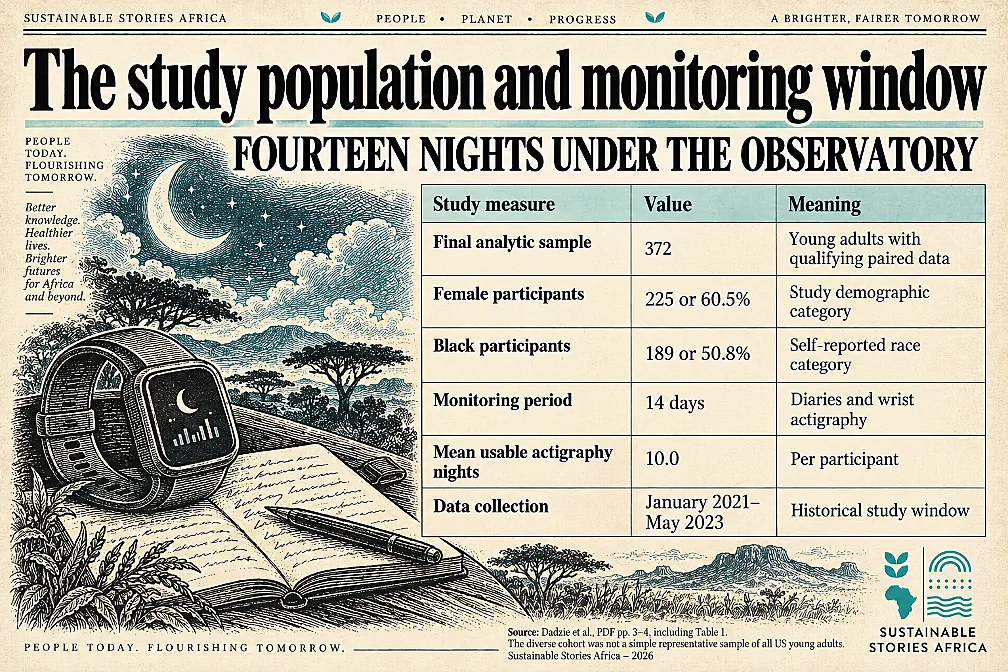
In Daily associations between the physical environment and sleep among a diverse, national sample of young adults, Adwoa Dadzie and colleagues found associations between perceived environmental disruption and poorer sleep quality in 372 participants.
The study appeared online on August 24, 2026, in Sleep Health, ahead of its October journal issue.
- It paired daily diaries with wrist actigraphy, which estimates sleep from movement and related device measurements.
For African and emerging markets, the relevance concerns housing, energy access and environmental management.
- The study offers evidence from a diverse US cohort, not an African population.
- It cannot establish that cooling or noise-control investments will produce the same numerical benefits elsewhere, but it identifies conditions worth investigating in local housing and public-health research.
Hot Nights Disrupt More Than Comfort
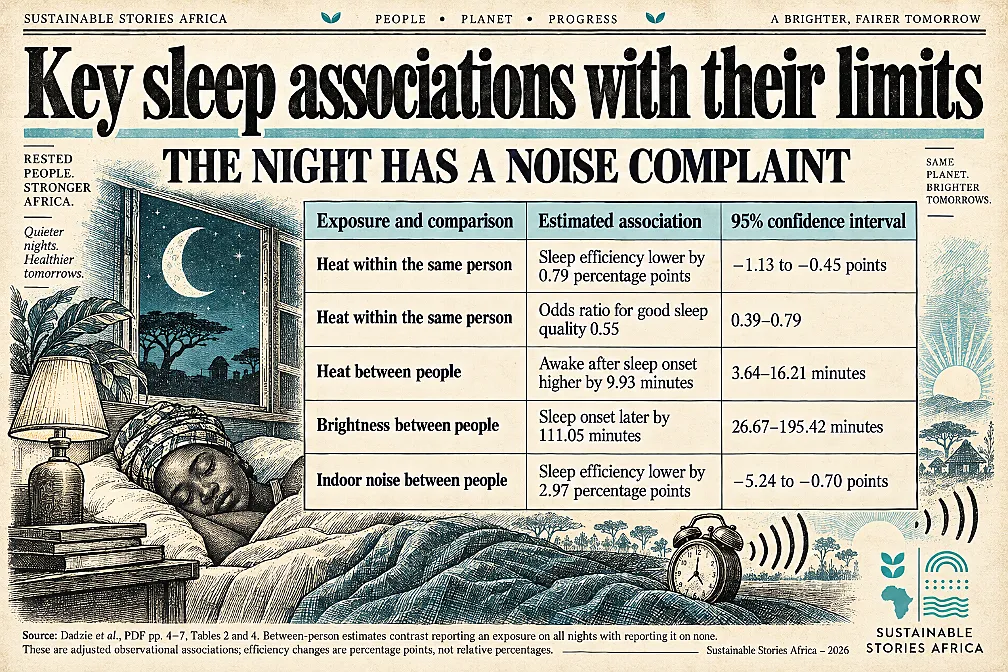
On nights participants described as too hot, sleep maintenance efficiency was 0.79 percentage points lower than their own usual level.
- This measures how much of the main sleep interval was spent asleep.
- The finding survived correction for multiple statistical tests and is one of the study's strongest daily associations.
On those same hot nights, the odds of reporting good sleep quality were 45% lower (odds ratio: 0.55).
- That is a change in odds, not a 45-percentage-point fall in the probability of good sleep.
The distinction matters because a dramatic headline can easily turn a precise statistical result into an exaggerated claim.
A different comparison examined participants who reported heat more frequently across the monitoring period.
- The model's all-nights-versus-no-nights contrast was associated with about ten additional minutes awake after sleep onset and 1.78 percentage points lower sleep maintenance efficiency.
These between-person estimates should not be interpreted as what happens to every individual after one hot night.
Daily Measurements Clarify The Environmental Associations
Participants completed morning diaries indicating whether the previous night's environment was too hot, cold, bright, or noisy.
- The environmental exposures were self-reported.
- The researchers did not continuously measure room temperature, sound levels or bedroom brightness for these predictor variables.
That design has value because the same physical condition may affect people differently. It also creates a limitation:
- Poor sleep could heighten sensitivity to environmental discomfort, and reporting discomfort after waking cannot establish which came first.
- The authors acknowledge possible bidirectional relationships.
Brightness was associated with later sleep timing in the between-person models.
- The all-nights-versus-no-nights contrast corresponded to sleep onset approximately 111 minutes later, with a wide confidence interval.
- There was no significant corresponding within-person timing association.
This is therefore evidence about differences across participants, not proof that a bright bedroom delays everyone's sleep by nearly two hours.
Indoor noise was associated with lower sleep maintenance efficiency and poorer self-reported quality in between-person comparisons.
- Outdoor noise showed no significant association in this dataset.
- Few participants reported outdoor noise disruption, limiting the ability to detect an effect.
The result does not establish that outdoor noise is harmless.
Better Housing Could Support Healthier Rest
The practical opportunity is to consider sleep when designing and maintaining housing.
- Shading, ventilation, appropriate insulation, controllable lighting and noise management could make rooms more comfortable.
The study supports testing these approaches; it does not quantify their benefits in African buildings or establish a clinical treatment.
- An illustrative student in a crowded residence may have limited control over lights or evening activity.
- A renter may be unable to alter a room's ventilation.
- These scenarios explain why advice about individual sleep habits can be incomplete when the environment is shared or poorly maintained.
They are not cases drawn from the study.
Building managers can exercise control that occupants lack.
- The authors specifically discuss heating maintenance, ventilation and air-conditioning systems, light-blocking blinds and sound-attenuating materials
- African applications would need to account for local climate, construction practices, energy affordability and the risk that mechanical cooling adds an unaffordable electricity burden.
The absence of a significant association with sleep duration also deserves attention.
- Quality and timing are separate dimensions of sleep.
- A person can spend a similar number of hours asleep while experiencing more fragmented rest.
- Public-health communication should preserve that distinction instead of implying that every environmental disturbance necessarily shortens sleep.
Measure Housing Conditions Before Scaling Interventions
Housing authorities and universities should begin with local assessment.
- Short diaries can identify recurring complaints, while temperature, humidity, light and noise measurements can establish the physical conditions behind them.
- Pairing those observations with suitable sleep measures would help distinguish perceived disruption from environmental exposure.
Pilot improvements should be evaluated against comparable conditions and across seasons.
- Researchers should also examine crowding, ventilation, work schedules and other factors that could influence both sleep and environmental discomfort.
- The US study adjusted for several demographic and employment variables, but adjustment does not remove every possible explanation.
Property owners can address documented maintenance problems while evidence develops.
- Residents should be able to report persistent noise, excessive lighting and ventilation failures, with a clear route for resolving them.
- The standard of success should include occupants' experience as well as installed equipment.
Financiers assessing housing projects can ask whether designs protect thermal comfort without excessive operating costs.
- A claim of healthier housing should be backed by measurements and follow-up, rather than by an equipment specification alone.
- The immediate editorial task is equally clear: report the associations accurately, retain the study's limitations and avoid turning a promising housing insight into an unsupported guarantee.
Path Forward – For Healthier Sleeping Environments
African housing and public-health programmes should investigate heat, light and noise alongside sleep habits.
Local measurements and carefully evaluated building improvements can establish which interventions help residents most.
The study strengthens the case for treating rest as partly an environmental issue.
Follow-through requires affordable building design, responsive maintenance and evidence that distinguishes sleep quality, timing and duration rather than combining them into a single claim.