Artificial intelligence can strengthen diagnostics, disaster response, agriculture, mobility and communications. But public value will not emerge from algorithms alone.
A 2026 United Nations University report shows that countries need quality data, inclusive infrastructure, skills, safeguards and durable partnerships to turn promising systems into reliable services.
Useful Artificial Intelligence Needs Working Systems
The most persuasive case for artificial intelligence is not a chatbot. It is a faster diagnosis in a clinic, an earlier flood warning, a better map of crop stress or a communications network that uses less energy while serving more people.
“Unlocking AI’s Potential to Serve Humanity,” a 2026 report led by the United Nations University, examines robotics, geospatial AI and communications networks.
Its examples span healthcare, disaster response, biodiversity, energy optimisation, agriculture and mobility.
The report is global, but its conditions for success are particularly relevant to African countries where service gaps and resource constraints raise both the potential value and the cost of failure.
Its central argument is that benefits are not automatic. AI becomes useful when it is embedded in institutions that can collect representative data, maintain infrastructure, train people, protect rights and learn from deployment.
Promising Tools Still Depend On Basics
Geospatial AI can combine satellite imagery, sensors and local records to track drought, soil moisture and land-use change.
Robotics can support surgery and hazardous work, while AI can optimise 5G networks and multimodal models can ease mobility navigation across languages and data formats.
These applications speak directly to African priorities.
- Farmers need field-scale decisions, not continental averages; emergency agencies need maps that work when roads or power fail; health workers need locally calibrated decision support; and cities need mobility tools that include informal transport rather than treat it as missing data.
Communications networks are both solution and constraint.
- AI can help operators forecast traffic and reduce energy use, but optimisation favouring dense, profitable areas could deepen exclusion, making coverage metrics for rural and low-income communities essential.
The danger is an economy of permanent pilots: short-term demonstrations trained on external data and disconnected from public budgets.
A model may succeed in trials yet fail in clinics due to lack of connectivity, farmers unable to afford services, or agencies unable to update data.
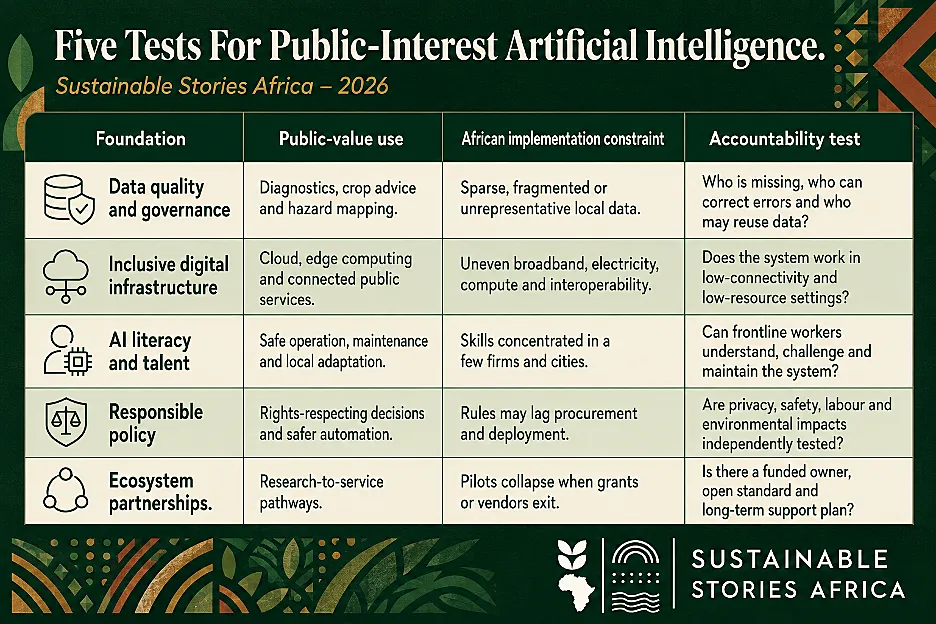
Data Determines Who Technology Can See
AI systems reproduce the boundaries of their data.
- Where rural clinics, informal settlements, minority languages or small farms are poorly represented, predictions grow less accurate precisely.
- Where public need is greatest, a technical flaw can redirect scarce resources away from already underserved people.
Governance therefore begins before model training.
- Institutions need lawful access, clear purpose limits, data-quality standards.
- Mechanisms for communities to challenge harmful outcomes, alongside clarity on data origins, consent, licensing
- Performance variation across gender, geography, language and income.
Infrastructure choices also shape who benefits.
- Centralised computing offers scale but creates dependence on costly connectivity and foreign providers.
- Edge systems work closer to farms and clinics yet still require secure updates and skilled maintenance.
Energy demand, water use and hardware replacement belong in the public-value calculation.
Local knowledge improves accuracy and legitimacy: farmers, health workers and disaster responders should shape problem definition and evaluation, not receive a final consultation after purchase.
Language is a strategic data issue.
- Building African-language datasets demands patient work on consent, annotation and community control, creating skilled employment beyond any single AI product.
Africa Can Build Technology Around Missions
The report's five enabling pathways suggest a different innovation strategy.
- Instead of starting with a model and searching for a use, governments can begin with a public mission
- Reducing maternal referral delays, protecting a watershed, improving crop resilience or making urban transport safer
- Organise data, infrastructure, skills and procurement around that result.
This mission approach creates room for African universities, startups and public laboratories to build reusable components.
Open standards can prevent vendor lock-in, while shared geospatial data, language resources and evaluation facilities lower entry barriers for smaller innovators, and regional cooperation spreads the cost of compute and safety testing.
Public procurement is also an industrial-policy tool.
- Contracts can require local capacity building, interoperability and energy reporting, protecting intellectual property without trapping institutions inside opaque systems.
- Funding shifts from short pilots toward staged deployment tied to verified outcomes.
Scale should be earned through evidence: baselines, comparison groups, service-quality measures and full-cost accounting tied to successful outcomes.
If a simpler non-AI intervention performs better, institutions should be free to choose it.
Govern Artificial Intelligence Across Its Lifecycle
Before procurement, agencies should publish the problem, groups affected, availability of non-AI alternatives, and public benefit expectations.
High-impact systems need risk classification, privacy and security assessment, human-review pathways and clear liability.
Performance should be tested under realistic connectivity, language and resource conditions.
During deployment;
- Institutions must monitor errors, distributional effects, energy use and worker impacts.
- People should know when AI influences a decision and how to seek review. Incident reporting should cover physical harm from robotics as well as cyber, privacy and discrimination risks.
After deployment, an exit plan matters. Data must remain accessible in usable formats, services must continue if a supplier fails, and outdated models must be retired.
Responsible AI is not a certificate awarded at launch; it is a continuing institutional practice.
Path Forward – Public Value Must Outlast Every Pilot
Africa’s AI opportunity will be judged less by the number of demonstrations than by the reliability of services that remain after the funding cycle ends.
The path is demanding but clear: build representative data, dependable infrastructure, skilled institutions, enforceable safeguards and partnerships designed around public missions.
Technology should adapt to African systems, and help improve those systems further.