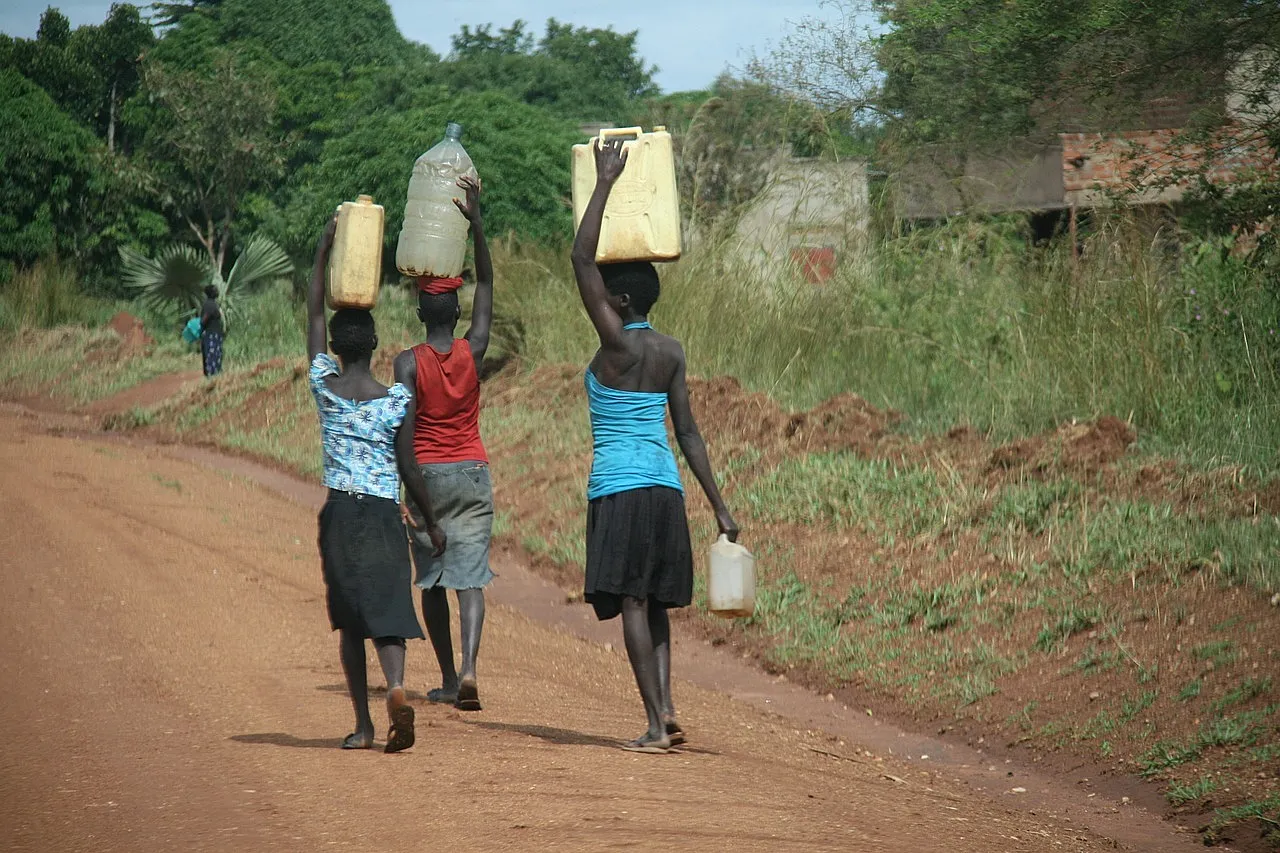
In households without water on the premises, women and girls aged 15 and older are the primary collectors seven out of ten times. Their unpaid journey is one of the highest hidden costs in the global water economy.
Africa’s water policies will remain incomplete until they measure time, safety and reliability, rather than just the distance to an “improved” source.
A Water Point Can Still Be Distant
A household may be recorded as having basic water access even when someone still walks, waits, and carries the water home.
- That person is usually a woman or girl.
- The statistic describes a source; her day absorbs the service gap.
The United Nations World Water Development Report 2026, “Water for All People: Equal Rights and Opportunities,” brings that hidden labour into view.
Worldwide, up to 1.8 billion people live without water on their premises, and about 700 million collect water from improved or unimproved sources.
In seven out of ten such households, women and girls aged 15 or older are the primary collectors.
This is why the question “who fetches water?” belongs at the centre of infrastructure planning.
It reveals whether a system transfers the cost of weak service into unpaid time, physical strain and lost opportunity.
Progress Still Leaves Billions Without Services
Global water and sanitation coverage improved between 2015 and 2024.
- About 961 million people gained safely managed drinking water
- Increasing coverage from 68% to 74%
- About 1.2 billion gained safely managed sanitation
- Lifting coverage from 48% to 58%.
Rural Africa bears a visible burden, with 80% of households relying on distant water sources that lengthen during dry seasons, source failures or insecurity.
National averages can therefore improve while climate-exposed communities face longer journeys and greater competition for water.
However;
- 2.1 billion people still lacked safely managed drinking water in 2024.
- 3.4 billion without safely managed sanitation.
- 1.7 billion without basic hygiene at home.
Sub-Saharan Africa's basic water coverage stood at 58%, sanitation at 47%.
Human consequences remain severe: an estimated 115 people in Africa die hourly from diseases linked to poor sanitation and contaminated water, making reliable water simultaneously health, education, care and economic infrastructure.
National averages also conceal extreme insecurity, with Chad, Niger and Somalia among Africa's least water-secure countries in 2022.
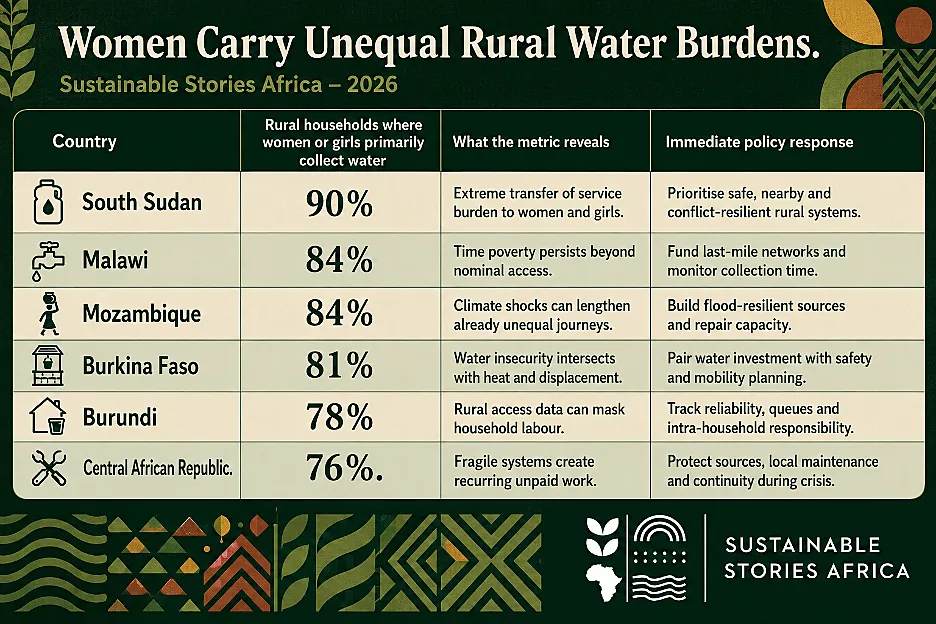
Time Poverty Is An Infrastructure Cost
Women and girls spend an estimated 250 million hours every day collecting water globally.
The figure represents more than inconvenience.
- Collection can reduce time for paid work, school, rest, childcare, farming and civic participation.
- Heavy loads can cause injury, while long or isolated routes can expose collectors to harassment and violence.
In Africa, universal access to basic water could save women the equivalent of 77 million working days each year.
- Evidence cited in the report shows how that time can change lives.
- More reliable piped services in rural Zambia allowed women to spend more time on kitchen gardens.
- Reduced water-fetching burdens in Ghana were associated with improved school attendance for girls.
The benefit is not simply “freeing women” to do more unpaid work.
- Time savings should widen genuine choice.
- That requires complementary investment in safe schools, decent jobs, childcare, transport, land rights and finance.
Sanitation and hygiene deepen the same inequality.
- When toilets are unsafe, inaccessible or absent, women and girls may restrict food and water, travel farther or wait until dark, increasing health and protection risks.
- A service can therefore meet a narrow infrastructure definition while failing the practical tests of privacy, dignity and safety.
Better Measurement Changes Public Investment Priorities
Household access statistics are necessary but insufficient.
- They can obscure which household member collects water, how long the round trip takes, how often the source fails, what it costs and whether the water is safe.
- An “improved” source can still impose hours of waiting or break down for weeks.
Sex-disaggregated and time-use data can make those failures visible.
- Surveys should record collection responsibility by age and gender, queue and travel time, physical risks, affordability, reliability and seasonal change.
- They should also ask about menstrual-health needs, storage, treatment and who controls household water spending.
This evidence can alter project selection.
- A new borehole may appear efficient on cost per connection.
- A piped network may create larger health and time benefits.
Lifecycle data can reveal whether maintenance systems serve remote communities or concentrate repairs in politically visible areas.
Design Services Around Time And Dignity
Governments and utilities should;
- Set service targets covering on-premises water, daily reliability, collection time and affordability, with public dashboards reporting outcomes by gender, income, disability, settlement type and region, alongside funded channels for communities to report breakdowns.
Investment must reflect how Africa uses water.
- Agriculture accounted for 79% of freshwater withdrawals in 2021 and employed over 45% of African workers, meaning domestic access, food production and ecosystem protection cannot be planned separately as climate variability makes allocation and storage more urgent.
That allocation question is gendered.
- Women often cultivate food and manage household water without formal land or water rights, so drought restrictions and irrigation fees can affect their work without an equal voice in decisions.
Local maintenance is essential:
- Training technicians and financing routine repairs protect infrastructure gains, while women's decision-making power in water institutions must not become unpaid labour replacing professional delivery.
Climate-resilient service requires redundancy, such as backup power, protected catchments, drought and flood plans, with reliability standards designed around the worst season, not the easiest day to measure.
Path Forward – Count The Hours Then Remove Them
Africa’s water gap is not measured fully by kilometres of pipe or numbers of sources.
It is also measured in the hours women and girls surrender to make weak systems function.
The path forward is to count those hours, value their consequences and design services that return time, safety and choice to the people who have carried the burden longest.