
Late payments, bad debt and supplier concentration are moving from exceptional events into routine corporate experience, according to Marsh’s 2026 UK trade-credit survey.
The figures are UK-based, but the warning travels: African exporters and businesses linked to global supply chains need to test how quickly one customer or supplier failure could become a cash crisis.
Confidence Can Hide A Fragile Balance
Trade credit is an invisible engine of commerce. A supplier delivers goods or services today and accepts payment later.
The arrangement supports sales and working capital, but it also turns every invoice into an unsecured exposure to another company’s health.
Marsh’s Trade Credit Risk Report 2026 surveyed 1,000 chief executives and finance directors across the United Kingdom.
It is not an African business survey, and its percentages should not be transferred directly to African markets.
However, the findings matter to firms that sell into the UK, depend on global counterparties or operate in economies where foreign exchange, high borrowing costs and delayed public payments already strain liquidity.
The central warning is behavioural: businesses can report confidence as their balance sheets become more vulnerable to late payment, bad debt and concentrated relationships.
Payment Stress Is Becoming Business Routine
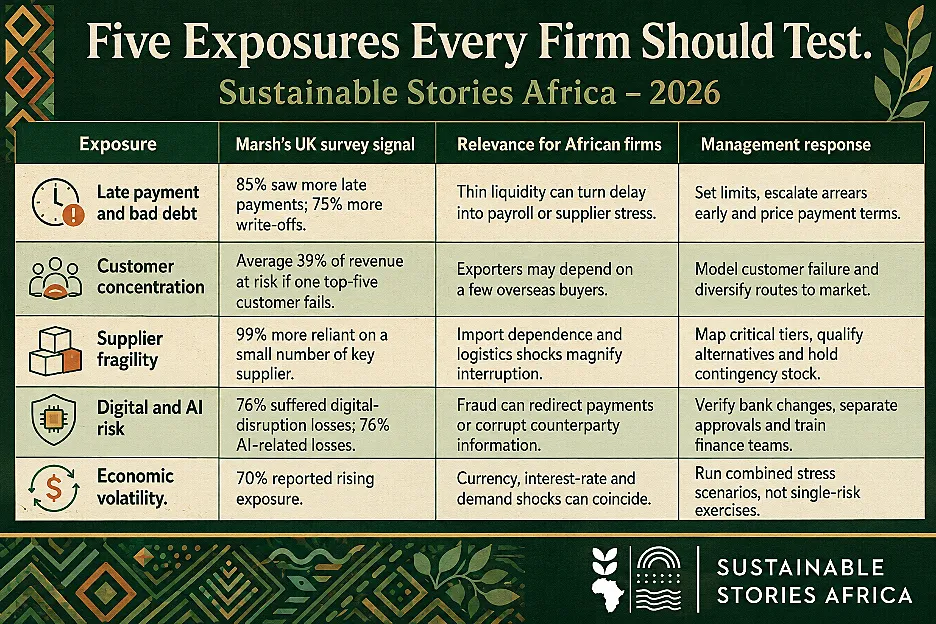
85% of respondents reported increased late payments, while 75% saw more bad-debt write-offs.
76% suffered financial losses due to late payments, and the same share due to bad debt.
- The average annual cost of collections reached £421,800, up 14.5% from £368,400 in 2025.
Exposure was broad:
- 70% reported increased risk from economic conditions
- 69% from supply-chain disruption
- 68% from late payments
- Digital disruption and AI-related risks were each cited by 67%.
These categories connect: a cyber incident can delay orders or impersonate executives, and liquidity shocks can ripple through supplier networks.
For African firms, payment delays bite harder when bank credit is expensive, invoice finance is scarce, or revenue and input costs sit in different currencies.
A profitable order can still destabilise a business if cash arrives late.
Digital risk belongs in that credit conversation.
- 99% of Marsh respondents flagged cyber and digital fraud as credit-risk concerns
- 76% reporting losses from digital disruption
- AI-related risks alike, turning falsified invoices into receivables and liquidity problems.
Concentration Turns One Failure Into Many
Respondents estimated;
- An average 39% of revenue would be at risk if one of their five largest customers failed
- With a quarter exposed above 50%.
- 99% said their business was growing more reliant on a small number of key suppliers, and half flagged supplier insolvency or instability as a leading concern.
Concentration is often a rational short-term choice:
- A large buyer offers dependable volume, a preferred supplier improves quality and cuts transaction costs.
- Risk emerges when management treats a successful relationship as permanent without calculating the time, cash and capacity needed to replace it.
Smaller businesses may lack a treasury department but still need a simple view on exposure.
- A monthly dashboard tracking sales share from top customers, overdue invoices, disputed amounts, currency mismatches and cash runway can turn vague concern into decisions on limits, pricing or finance.
This lesson applies directly to firms exporting through a single distributor, selling to a narrow trader base, or depending on a single government contract, major retailer or imported input, where revenue and supplier concentration can collide in the same shock.
Better Credit Discipline Protects Business Growth
Trade-credit management should not become an excuse to avoid new customers or retreat from regional integration; its purpose is to make growth durable.
Better information helps businesses extend credit selectively, negotiate stronger terms and act before a counterparty failure becomes unrecoverable.
Insurance can support that system but is not the system itself.
Coverage terms, limits, and claims requirements matter, alongside accurate invoices, documented delivery and disciplined collections, plus clarity on whether policies cover political, currency-transfer and contract-frustration risks.
For lenders and DFIs, stronger receivables data could unlock working capital for smaller African suppliers through digital invoicing and verified payment histories, reducing the collateral penalty small firms face.
Public policy can improve the environment without socialising poor decisions.
Prompt-payment rules, insolvency procedures, movable-collateral registries and export-credit support can reduce uncertainty, provided guarantee providers publish additionality and claims data.
Turn Receivables Into A Managed Portfolio
Boards should review customer and supplier concentration quarterly, with named thresholds and contingency actions.
Finance teams should age receivables by risk, not only by date, and add sales incentives to cash collection and booked revenue.
Every material counterparty needs a limit, a review cycle and escalation route.
Stress tests should combine shocks: a top customer pays 90 days late; the currency depreciates; a critical supplier demands cash in advance; and fraudulent bank instructions divert a payment.
The result should translate into minimum liquidity buffers and pre-agreed funding options.
Basic controls remain powerful.
- Changes to bank details should be verified through a known channel.
- Payment approvals should be separated.
- Staff should know how to pause suspicious transfers without fear of delaying business.
- Resilience is created through these repeatable decisions.
Path Forward – Resilient Trade Begins Before Any Default
The UK survey offers a warning, not a forecast for Africa. Its value lies in showing how normalised payment stress and concentrated confidence can coexist.
African firms can use that warning now: measure who owes them, whom they depend on and how much time they have when one relationship fails.
Credit risk is easiest to manage before the invoice becomes a crisis.