IRENA's 2026 cost review shows African utility-scale solar PV costs falling to $837/kW and $52/MWh, while new onshore wind averaged $59/MWh and a 43% capacity factor.
The technology story is increasingly favourable.
The harder question is finance: country and macroeconomic conditions explain 56% of financing-cost variation, making de-risking, stable contracts and stronger grids central to turning cheaper renewables into reliable, affordable power.
Africa's renewable cost curve keeps falling
Africa's renewable power economics improved sharply in 2025, according to the International Renewable Energy Agency's latest cost assessment.
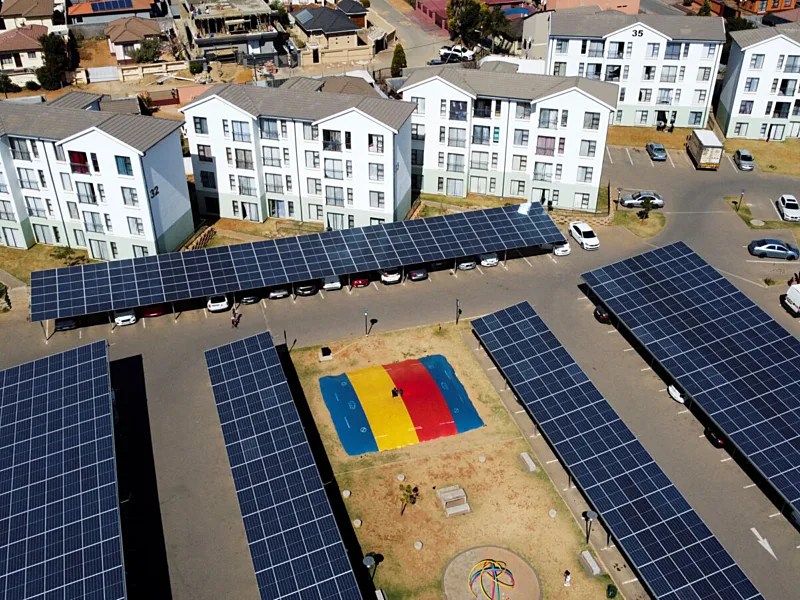
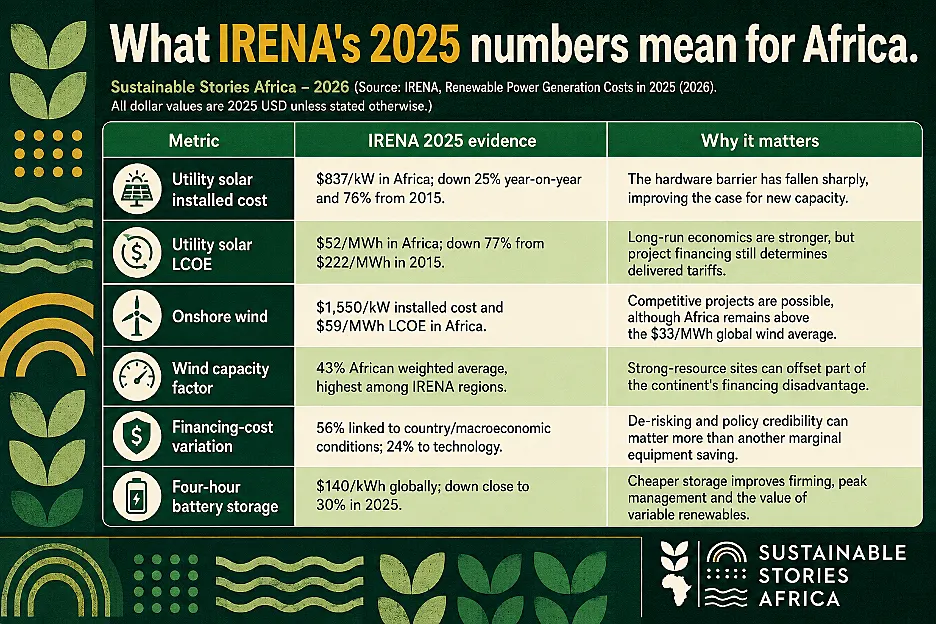
The continent's weighted-average installed cost for new utility-scale solar PV fell 25% in a year to $837 per kilowatt.
- Its levelised cost of electricity, or LCOE, reached $52 per megawatt hour.
- Both measures are dramatically below their 2015 levels.
Onshore wind tells a similarly important story.
African projects commissioned in 2025 averaged $1,550/kW in installed cost and $59/MWh in LCOE, while the continent recorded a 43% weighted-average capacity factor, the highest regional average in IRENA's dataset, influenced by strong-resource sites including Egypt's Gulf of Suez.
However, the report also changes the question investors and policymakers need to ask.
With equipment prices much lower than a decade ago, the binding constraints are increasingly the cost of capital, grid readiness and revenue certainty.
Africa's next renewable gains will depend less on whether the technology works and more on whether projects can be financed and integrated at competitive terms.
Cheaper power is changing investment arithmetic
Globally, renewable power additions exceeded 690 GW in 2025, about 19% above the 582 GW added in 2024.
- Solar PV contributed more than 500 GW and wind roughly 160 GW.
IRENA says renewables also overtook coal in total installed power capacity, underscoring how quickly the economics of new generation have shifted.
The benchmark costs are now difficult for new fossil generation to ignore.
- Global utility-scale solar PV held at $44/MWh in 2025, onshore wind fell to $33/MWh and offshore wind to $78/MWh.
- More than 90% of utility-scale renewable projects commissioned during the year produced electricity below the cost of the cheapest new fossil-fuel alternative in their respective markets.
Since 2010, the global LCOE of solar PV has fallen by 89%, onshore wind by 71% and offshore wind by 63%.
For Africa, the long-run improvement is even more revealing in solar. IRENA's regional weighted average shows utility-scale solar PV installed costs falling from $3,520/kW in 2015 to $837/kW in 2025, a 76% decline.
Over the same period, solar PV LCOE fell 77%, from $222/MWh to $52/MWh. The numbers strengthen the investment case for countries trying to expand electricity supply without adding fuel-import exposure.
African project economics now diverge sharply
Lower hardware costs, however, do not guarantee equally lower cost of electricity.
- IRENA's financing model finds that country-level macroeconomic conditions, including sovereign risk, interest rates and inflation, explain about 56% of the variation in financing costs.
- Technology-specific factors explain 24%, with the remainder reflecting the interaction between country conditions and technology.
Put plainly, where a project is built can matter more to its financing cost than what technology is being built.
That distinction is particularly important for African markets because solar and wind are capital-intensive and buy no fuel once operating.
- A higher financing rate therefore gets embedded in electricity costs for years. IRENA estimates that the real weighted average cost of capital for standardised, fully contracted projects can range from about 3% in deep mature markets to above 10% in the highest-risk economies.
- The same solar panel or wind turbine can consequently produce very different tariffs across borders.
The African averages also need careful reading.
- The average $52/MWh solar PV or a 43% wind capacity factor is not a guaranteed project price or output rate.
- Regional results are shaped by the projects commissioned in that year, site quality, financing structures and grid conditions.
The lesson is therefore not that Africa has solved the potential of renewable affordability, but that technology costs have fallen far enough for non-technology barriers to become more visible and more expensive.
Storage widens the value of renewables
Storage costs are transforming the renewable energy equation.
IRENA reports that four-hour utility-scale battery costs fell nearly 30% in 2025 to about per kilowatt hour, 95% below 2010 levels.
Roughly one-quarter of global utility-scale solar commissioned in 2025 paired with batteries, pushing firm LCOE for high-reliability solar-plus-storage below /MWh at strong sites.
This matters for African power systems balancing variable renewables against weak networks and evening peaks. South Africa illustrates the trend:
IRENA's sample shows projects averaging 4.3 hours of discharge duration, deployed primarily for grid resilience and peak-demand reduction.
Storage cannot replace transmission or system planning, but falling costs unlock greater value from new capacity.
The resilience dividend is substantial too: renewables avoided billion in fossil-fuel costs and 8.4 gigatonnes of emissions globally in 2025, directly strengthening energy security for fuel-importing African economies.
De-risking must become power-sector infrastructure policy
The policy implication is clear: cheaper equipment must be matched by cheaper risk.
- Governments can strengthen investment cases through credible procurement schedules, bankable power-purchase agreements, faster permitting and transparent grid-connection processes.
- Development finance institutions add targeted guarantees and blended-finance structures addressing specific risks rather than subsidising weak economics indefinitely.
Revenue certainty proves especially powerful.
IRENA notes that merchant project financing costs roughly double those backed by long-term contracts, with well-designed contracts reducing LCOE by 30% - 40% through improved financing alone.
For African utilities and regulators, contract design is not an administrative detail; it is embedded in the cost of electricity.
Grid investment must advance in parallel, since cheap generation without transmission capacity or credible off-takers risks curtailment and delays.
The next stage of competitiveness is institutionalisation as much as it is technological: lowering risk, strengthening utilities, and translating falling costs into tariffs consumers actually feel.
Path Forward – Turn lower technology costs into access
Africa's story about renewable costs has moved from technology scarcity to execution.
Policymakers should prioritise bankable contracts, transparent procurement, grid expansion and targeted de-risking so lower equipment costs translate to lower delivered electricity costs.
Financiers and utilities should pair that agenda with storage, stronger off-taker balance sheets and local-currency solutions.
The opportunity is no longer to build more renewables, but to convert better project economics into reliable power, industrial competitiveness, lower emissions and wider energy access.