
Kenya's Artificial Intelligence Bill, 2026 advocates for a dedicated regulator, four risk categories and specific duties for high-risk systems, including human rights assessments, record-keeping, transparency and human oversight.
The Bill also provides room for experimentation through regulatory sandboxes, framing responsible AI as a balance between innovation, public trust and safeguards that can be tested before harm scales.
Kenya proposes a risk-based AI state
Kenya's Artificial Intelligence Bill, 2026 advocates for one of the continent's more detailed attempts to turn AI principles into a regulatory operating model.
Published on 19 February 2026 and first read in the Senate on 2 April, the Bill would establish an independent Office of the Artificial Intelligence Commissioner and give it responsibility for enforcement, risk assessments, conformity audits, post-market surveillance, complaints and guidance.
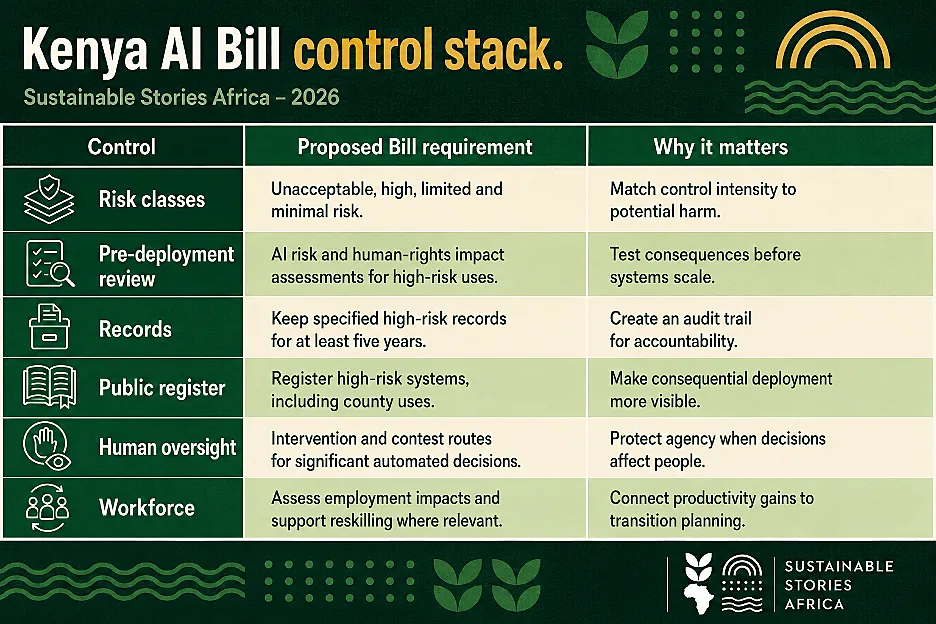
The Bill's organising idea is risk. AI systems would be classified as unacceptable, high, limited or minimal risk.
- Unacceptable risk uses that create severe threats would be prohibited, while high-risk systems would face more intensive controls.
- The Bill identifies critical areas including healthcare, education, agriculture, finance, security, employment and public administration.
As of 6 August 2026, Parliament's official materials continue to present the measure as a Senate Bill rather than an enacted law.
That distinction matters: the provisions describe a proposed compliance architecture.
- Even so, they offer organisations a useful view of where Kenyan AI governance could be heading and which capabilities may be worth building early.
High-risk systems face pre-deployment scrutiny first
Providers and deployers of high-risk systems would be expected to assess risk before deployment, applying mitigation and human oversight, and carry out a human-rights impact assessment.
Public-sector assessments would be subject to review by the Commissioner.
The proposed regulator would also maintain a public register of high-risk systems, including those used by county governments.
This is a lifecycle approach rather than a one-time approval.
- The Bill calls for robustness, accuracy and cybersecurity, as well as conformity audits and post-market surveillance.
- That means a model that performs acceptably at launch may still need monitoring as data, behaviour or operating conditions change.
- For organisations, AI governance therefore becomes part of product management, procurement, internal audit and risk management.
Transparency duties reach data, people, records
High-risk operators would have to preserve records covering inputs, training datasets, outputs and performance for at least five years.
The Bill also requires transparency and traceability, alongside disclosure of a system's nature, purpose and limitations, the role of automation and human intervention, and measures taken to address bias.
The human safeguard is particularly important where automated decisions carry significant consequences.
The Bill links such decisions to rights of human intervention, an opportunity for the affected person to express a view and a route to contest the outcome, in line with Kenya's Data Protection Act.
It also calls for explicit consent and clear AI labelling when synthetic images, voices or likenesses are created in covered circumstances.
These provisions push governance upstream.
- If an organisation cannot explain its training data, record a material model change or identify the person empowered to override an output, it may struggle to meet a risk-based regime.
- Documentation therefore becomes more than compliance paperwork: it is the connective tissue between technical performance and accountability to people.
The same logic applies to third-party AI.
- Buying a model or subscribing to a service does not remove the consequences of deploying it in recruitment, lending, education or public services.
- Procurement teams will need evidence on model limitations, security, bias testing and change management, while deployers retain enough internal capability to monitor outcomes.
Outsourcing technology should not mean outsourcing judgment about risk.
Sandboxes preserve space for responsible innovation
The Bill does not treat regulation and innovation as opposites.
- It would allow regulatory sandboxes under conditions that cover ethics, data protection and risk, with room to prioritise national needs and county-level challenges.
- Well-run sandboxes can let developers test systems in controlled environments while regulators learn how emerging applications behave before rules ossify around assumptions.
That is particularly relevant in Africa, where useful AI applications may need to work with lower-resource languages, fragmented datasets and uneven digital infrastructure.
The Bill also focuses attention on AI literacy, including national and county programmes, and asks the Commissioner to research impacts such as environmental effects and job displacement.
Those provisions widen the innovation conversation from model capability to social capability.
Implementation quality will decide regulatory legitimacy
The hardest question will be implementation.
A regulator overseeing audits, sandboxes, complaints, public registers and market surveillance needs technical depth, procedural fairness and sufficient resources to act consistently.
The Bill proposes that the President appoints a Commissioner with parliamentary approval of Public Service Commission nominees, though institutional design must still ensure independence in practice.
Organisations can prepare without assuming the Bill will pass unchanged.
- They can inventory AI systems, identify high-impact use cases, set human-override rules, document datasets and model changes, integrate privacy impact work, and assess employment consequences.
- The Bill expressly contemplates workforce impact assessments and reskilling where automation may displace roles.
The proposal also creates meaningful enforcement exposure, including fines and possible imprisonment for specified offences, elevating AI from an innovation-team concern to a governance matter for senior management.
Responsible adoption depends on whether boards ask not only what a system can do, but whose rights and safety are affected at scale.
Implementation also requires proportionality: small developers and county projects may lack banks' compliance resources.
However, still deploy high-consequence systems.
Clear templates and accessible sandboxes can reduce compliance costs without weakening safeguards, determining whether the framework broadens innovation or concentrates it among the largest actors.
Path Forward - Protect people while preserving innovation space
Kenya's proposed architecture is strongest where it joins risk classification to practical evidence: assessments, records, oversight and redress.
Those capabilities are useful even before the legislative process is complete.
The path forward is proportionate governance - strict where consequences are high, lighter where risk is low, and experimental where sandboxes can generate learning without transferring avoidable harm to the public.