
Zimbabwe has converted data protection from a broad statutory duty into a more operational compliance system built around licensed data controllers, certified data protection officers and fixed breach-response deadlines.
The governance lesson is wider than appointing a DPO: organisations need independent oversight, evidence of training, auditable processing controls and escalation routines that can operate at regulatory speed.
Zimbabwe turns privacy into operating discipline
Zimbabwe's Cyber and Data Protection Act establishes the legal foundation for fair, lawful and proportionate processing of personal information. Statutory Instrument 155 of 2024 then makes that framework more operational through licensing, data protection officer requirements and breach procedures.
POTRAZ's Data Protection Officer Guidelines, issued as CDPG 1/2024, provide practical directions on who should be appointed, how independence should be maintained and what training is expected.
Taken together, the three instruments move privacy from policy language into a governance system with named owners and clocks.
The Data Protection Authority is POTRAZ. Controllers determine the purposes and means of processing and remain accountable for compliance even when a DPO, processor or other representative performs day-to-day tasks.
For boards, public bodies and businesses, the practical shift is clear.
- Personal data is an organisational asset with duties attached
- Collection must have a legitimate purpose
- Security must be designed into operations
- The organisation must be able to show who monitors compliance when incidents or complaints occur.
DPO duties now carry real deadlines
The Regulations require qualifying controllers to appoint a DPO and notify the Authority.
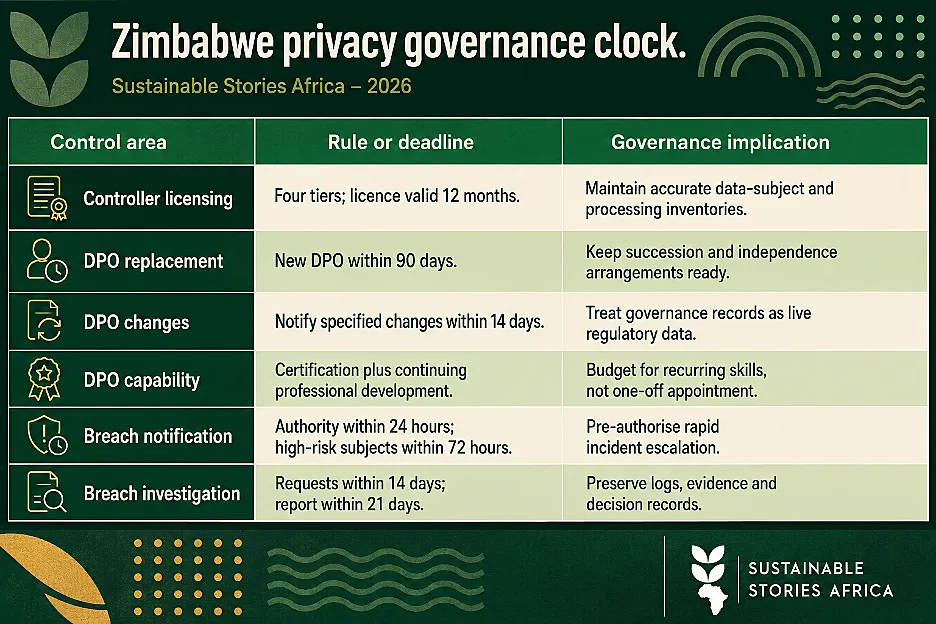
- Changes to DPO contact details, dismissal or resignation must be reported within 14 days
- A replacement is to be appointed within 90 days.
The Guidelines add that DPO contact information should be visible through a website or notice board, so data subjects and the regulator can reach the function directly.
The officer is intended to be more than an administrator.
- The Guidelines describe compliance monitoring, staff training, internal audits, data protection impact assessment support, handling requests and cooperation on breaches.
- They also emphasise independence, access to senior management and adequate resources.
An existing employee can serve, but not where operational responsibilities create a conflict over the purposes or means of processing.
Licensing connects responsibility to enforcement machinery
S.I. 155 establishes licensing for people and organisations that determines the means, purpose or outcome of processing, decides what information is collected or from whom, or obtains commercial or other benefit from processing, subject to specified exemptions.
Four licence categories are linked to the number of data subjects;
- From Tier 1: 50 to 1,000 people
- To Tier 4: above 500,000.
- Licences run for 12 months.
This turns data mapping into an operational requirement.
- An organisation cannot confidently identify its licence category, lawful basis, transfer obligations or breach exposure if it does not know which systems process personal information and why.
- The Act also imposes purpose limitation, accuracy, minimisation and retention principles, with additional rules for sensitive, genetic, biometric and health data.
The framework reaches automated decisions and transfers as well.
- The Act gives data subjects protections against decisions based solely on automated processing that have legal or similarly significant effects, subject to statutory exceptions.
- Cross-border transfers are tied to adequacy and other permitted conditions.
- Privacy governance therefore has to travel through technology procurement, analytics, human resources and third-party contracting rather than sit only with legal teams.
This is where data inventories become valuable beyond registration.
- A useful inventory connects each data set to its purpose, lawful basis, system owner, processor, retention period, sensitivity, transfer destination and deletion rule.
- That record lets a DPO challenge unnecessary collection, spot conflicting purposes and identify which vendor relationships need stronger contractual or security controls.
It also gives incident teams a faster route to determining whose data may be affected.
Independent officers can strengthen organisational trust
The DPO model creates a useful separation between responsibility and oversight.
- The controller retains responsibility for compliance, while the DPO is expected to monitor, advise and escalate independently.
- The Guidelines state that the officer should not be penalised for performing the role and should report to the highest management level.
That design matters because privacy failures often begin as routine operational shortcuts before they become regulatory incidents.
Training is part of the control environment.
- The Regulations require continuing professional development
- The Guidelines call for Authority-approved or accredited certification and annual professional development.
Organisations that treat certification as a one-off credential miss the point:
- The value comes from keeping the DPO close enough to new systems, products and risks to intervene before personal data practices harden into non-compliance.
Boards need evidence, training and escalation
Breach response provides the clearest test of readiness.
- Under S.I. 155, the Authority must be notified within 24 hours after a controller becomes aware of a security breach, with affected data subjects informed within 72 hours where high risk to rights and freedoms exists.
- Information requests require responses within 14 days, and investigations must conclude with a report within 21 days of notification.
These timelines demand more than a written incident plan.
- Security teams must recognise when an event becomes a personal-data breach; executives must know who authorises notifications; processors must escalate quickly.
- The DPO needs access to logs, contracts and decision-makers—organisations should test these dependencies through exercises rather than await a live incident.
A useful board dashboard should be evidence-led:
- Licence status, DPO certification, overdue data inventories, unresolved impact assessments, cross-border transfer controls, training completion and breach rehearsal results.
The objective is demonstrating that privacy protections work under both ordinary and stressed conditions.
Accountability must also extend into procurement.
- Cloud services, payroll platforms and analytics providers move information across boundaries, so contracts should specify processing instructions, security obligations and incident escalation, with the DPO involved early enough to shape terms, not merely approve embedded systems afterwards.
Path Forward – Make privacy governance visible and testable
Zimbabwe's framework rewards organisations that can connect legal duties to operating evidence.
The immediate task is to map processing, confirm licensing and DPO obligations, then test the workflows behind the regulatory deadlines.
Trust grows when people can see who is accountable and organisations can prove that controls are operating.
Privacy should therefore be governed as a recurring management system, not an annual compliance exercise.