AI proofs of concept often succeed because teams control the data, questions and edge cases.
Production removes those protections, exposing silent errors that can look authoritative long after a broken system would have raised an alarm.
For sustainability teams, the risk is unusually high: emissions, disclosure and regulatory decisions must be explainable.
The lesson for African enterprises is to engineer trust, data controls and human accountability before scaling automation.
Production turns AI confidence into risk
The hardest part of enterprise AI may begin after the successful demo.
In a July field note, Pulsora chief technology officer Inderjeet Singh describes how four production sustainability products behaved differently once customers brought incomplete data, ambiguous questions and sector-specific conventions that had never appeared in controlled tests.
The pattern is familiar beyond any one vendor.
- A proof of concept asks whether a model can perform a task under selected conditions.
- A production system must perform repeatedly across changing users, messy source data, integrations, rules and audit expectations.
The first question is technical feasibility; the second is institutional reliability.
That distinction matters for African organisations digitising sustainability, finance and compliance processes.
Data may sit across spreadsheets, subsidiaries, consultants and legacy systems.
When AI is used to interpret disclosure requirements, emissions factors or benchmarks, a polished answer is not enough.
Decision-makers need to know what evidence was identified, what assumptions were made and when a human should intervene.
Real users expose invisible system assumptions
Singh's most consequential example emerged from a sustainability-regulation product.
- During demonstrations, the system correctly classified companies clearly inside or outside regulatory thresholds.
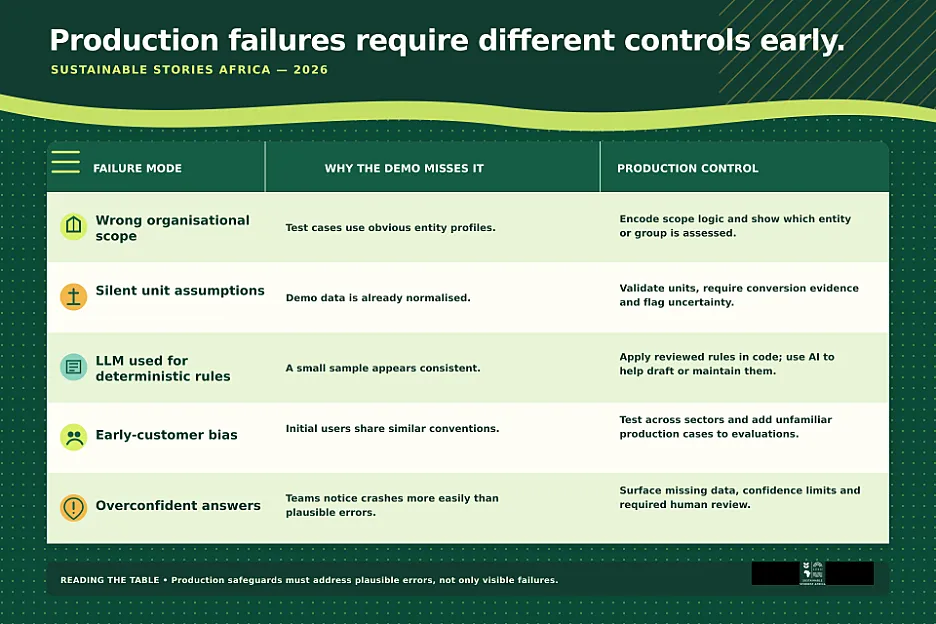
- In production, however, when asked whether the EU Corporate Sustainability Reporting Directive would apply the following year, it examined standalone figures with the answer as No, overlooking that the company's EU subsidiary acquisition required a consolidated group assessment.
The model understood the rule but applied it to the wrong organisational scope, producing output that remained fluent and professionally convincing despite being wrong.
The same pattern surfaced in benchmarking.
- Waste figures needed material-specific conversion before comparison with peer tonnage, while training data mixed per-employee hours with unnormalised aggregates.
- A system silently supplying plausible conversions or dividing incompatible metrics can generate a clean ranking that is analytically false.
In sustainability reporting, such errors carry heightened stakes: a mistaken applicability call could affect filing decisions, a silent emissions-factor error could distort reported performance, and an invalid benchmark could reach management or board level.
The operational risk lies precisely between sounding correct and being traceably correct.
Silent errors create governance liabilities quickly
Pulsora's experience challenges a common AI shortcut: routing every decision through a language model.
While some sustainability questions are probabilistic and interpretive, others remain deterministic; matching emission factors to defined activities, flagging missing fields, or checking whether values cross specified thresholds should yield consistent results when underlying facts stay unchanged.
Applying language models to these rule-bound decisions risks inconsistency, with identical inputs producing different outputs depending on phrasing.
Singh proposes a more controlled architecture instead: let AI generate and maintain rules, have humans review them, then execute approved rules through deterministic code.
This separates the model's synthesis strength from the system's need for repeatability.
Such architecture strengthens accountability.
Auditors, regulators or board committees can inspect the applied rule, source and exception rather than accept an explanation amounting to "the model decided."
For African companies navigating multiple disclosure regimes, lender requirements and customer questionnaires, this traceability matters as much as automation speed.
The governance implication is clear:
- AI risk management must extend beyond the model layer to cover data quality, transformations, ownership, escalation, logging, version control and human override authority.
Hybrid controls make AI more dependable
The positive case for AI remains strong precisely because its failure modes can be engineered around.
Pulsora recommends building evaluation sets from real customer inputs as soon as they emerge, including missing fields, unusual units and unanticipated questions, so production usage expands the test suite rather than sitting outside it.
This reframes what launch means.
- The first weeks of real usage become a second discovery phase, as teams observe where users misunderstand interfaces, where data breaks validation, and where systems produce confidence without adequate evidence.
- Each failure converts into a reusable evaluation case and, where appropriate, a new deterministic control.
For organisations with constrained technical teams, this discipline prevents wasted investment.
A narrow proof of concept may demonstrate model capability; however, production readiness requires clarity on workflow ownership, verification of high-risk outputs, and protocols for system uncertainty; questions best resolved before expensive scaling.
African enterprises can turn this discipline into an advantage.
- Many are building digital and sustainability processes simultaneously, offering a rare opportunity to embed audit trails, validation and data standards before weak practices harden into legacy systems.
The goal is not to automate every judgement, but to automate the right work with evidence strong enough to trust.
Production discipline starts before launch day
Teams should test AI systems against the messiest, realistic customer rather than the cleanest pilot, using evaluation sets that reflect representative industries, corporate structures, data formats and user behaviours.
High-risk decisions require explicit evidence and a human checkpoint whenever inputs are incomplete, or confidence is weak.
Product owners must also ask whether a problem is genuinely an AI problem.
If a rule should produce consistent answers, deterministic software may serve as the safer execution layer, with AI supporting interpretation and edge-case identification while repeatable controls govern final decisions.
Success metrics must move beyond demo accuracy to track error severity, unhandled cases, review rates and correction time; a fast system that creates more checking work is operationally negative.
The real threshold is trust under variation: surviving new contexts without forcing them into earlier patterns is what turns a proof of concept into infrastructure.
Path Forward – Engineer Trust Before Scale
African enterprises deploying AI for sustainability and compliance should build production evaluations on real data, make uncertainty visible and reserve deterministic rules for decisions that must be repeated consistently.
Human ownership and escalation should be designed before launch.
The test is not whether an AI demo can answer correctly.
It is whether the operating system can explain, reproduce, and safely challenge its answer when real users, incomplete records and high-stakes decisions arise.