Africa's solar expansion is solving an urgent electricity challenge, but IRENA warns that today's panels are also tomorrow's material stream.
Sub-Saharan Africa already has an estimated 10,000 - 12,000 tonnes of end-of-life off-grid solar products.
The next phase of the energy transition therefore requires more than deployment.
It needs repair, reuse, collection, recycling, producer responsibility, and data systems designed before solar waste scales.
Africa's Solar Success Creates Future Waste
Solar power has become one of the most practical routes to cleaner electricity and wider energy access across Africa.
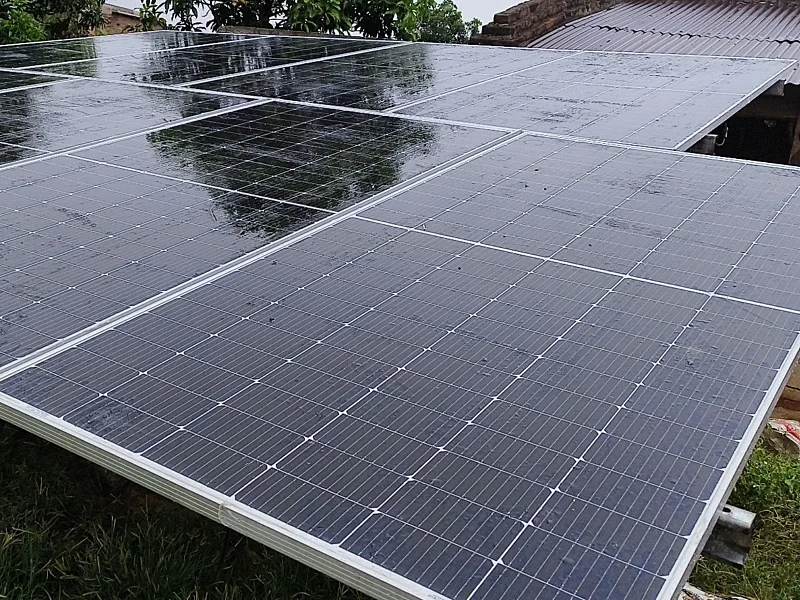
From large utility plants in South Africa to mini-grids and household systems across rural communities, photovoltaic technology is filling gaps that conventional grids have struggled to close.
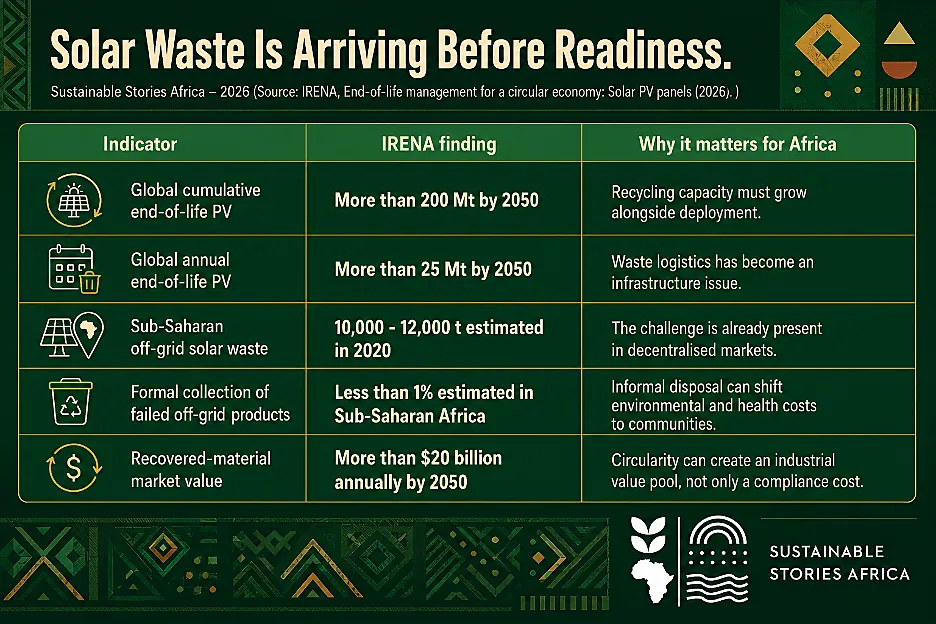
A new International Renewable Energy Agency report adds a second question to the deployment story: what happens when the equipment stops working? IRENA's End-of-life management for a circular economy: Solar PV panels projects that global cumulative end-of-life solar panels will exceed 200 million tonnes by 2050 under its 1.5°C Scenario.
For Africa, the challenge arrives through two channels at once.
- Utility-scale solar will eventually produce large volumes of waste.
- Off-grid products are already failing in markets where repair networks, formal collection and recycling infrastructure remain uneven.
That makes circularity an energy-access issue, an environmental issue and an industrial opportunity.
Solar Waste Is Arriving Before Readiness
The global numbers are large enough to change how policymakers think about solar infrastructure.
IRENA expects annual end-of-life PV volumes to rise above 3 million tonnes by 2035, 7.8 million tonnes by 2040 and 25 million tonnes by 2050.
By mid-century, solar panels could account for more than 21% of the world's e-waste by weight, compared with less than 1% today.
The value inside that waste is equally important.
- IRENA estimates that recycling could recover about 920,000 tonnes of materials annually by 2030, 7.6 million tonnes by 2040 and 24 million tonnes by 2050.
- The annual market value of recovered glass, aluminium, silicon, copper, silver and other materials could exceed $20 billion in 2050.
For a continent seeking both energy security and industrialisation, this changes the framing.
A discarded panel is not only waste; properly managed, it is also a future stock of secondary materials, repair activity, logistics demand, technical employment and manufacturing input.
Africa's Off-Grid Solar Legacy Raises Stakes
The African story is distinct because off-grid solar has been central to energy access. IRENA says more than 110 million small off-grid solar appliances in Sub-Saharan Africa are likely no longer functional.
- In 2020 alone, the region generated an estimated 10,000 - 12,000 tonnes of end-of-life off-grid solar products.
- In Kenya, thousands of tonnes may have been generated in the early 2020s, with an estimated 65% of non-functional items kept in homes.
That pattern points to a hidden waste stream.
- Quality-verified products can often be repaired or refurbished, extending service life and protecting household investment.
- Lower-quality products may last only two or three years.
When formal collection is absent, broken systems can lead to informal dismantling, open dumping or burning, exposing workers and communities to pollution risks.
The utility-scale curve is also approaching.
- IRENA projects that annual solar-panel waste in Brazil, South Africa and Turkiye will reach roughly 92,000-106,000 tonnes in each market by 2040 and 370,000-440,000 tonnes by 2050.
- South Africa added more than 2.2 GW of solar capacity in 2025 and already hosts about half of Africa's deployed PV capacity, meaning its circular-economy choices can become a continental reference point.
Cross-border trade complicates the picture further.
- Used panels shipped from richer markets can make electricity more affordable; however, equipment with unclear history or weak performance can transfer future waste liabilities to countries with less treatment capacity.
- Testing, certification and traceability are therefore as important as reuse itself.
Circular Solar Could Retain More Value
IRENA's preferred hierarchy begins before recycling.
- "Reduce" means designing modules and systems to use fewer materials, last longer and become easier to dismantle.
- "Reuse" means repair, refurbishment, testing and certification so panels and components can remain productive.
- "Recycle" comes after those options, recovering materials when continued use is no longer practical.
That hierarchy fits African market realities.
- Repair already happens because replacement can be expensive and access to new equipment uneven.
- Formalising the repair economy, through training, manuals, spare parts, safety standards and testing infrastructure, could keep systems operating longer while creating skilled local work.
Recycling then becomes the backstop and the value-recovery engine.
- Existing technologies can recover more than 90% by weight from crystalline-silicon panels, according to IRENA, although economics depend on transport, feedstock volumes, technology and material prices.
Africa's dispersed off-grid systems make collection particularly difficult, so viable models may require aggregation hubs, take-back partnerships and producer-funded reverse logistics rather than copying centralised systems from larger industrial markets.
Policy Must Connect Producers and Recyclers
Some African markets are already moving on solar waste management.
- South Africa's extended producer responsibility (EPR) rules have covered solar panels since May 2021, while Kenya folded EPR into its Sustainable Waste Management Act in 2022.
- IRENA also flags Ghana, Kenya, and Rwanda as developing formal frameworks for off-grid solar waste.
The next challenge is implementation depth.
- Governments need reliable registers tracking installed products, retirement dates, and waste volumes, a gap Nigeria illustrates clearly, with IRENA noting persistent data shortfalls on solar products in use and e-waste generated.
Financiers and development institutions also have a role to play.
- Solar projects can embed end-of-life plans and take-back obligations at procurement; manufacturers can support reverse logistics; recyclers can publish recovery data; and regulators can set quality standards for second-hand panels while protecting informal workers.
The principle is simple:
- Africa must avoid privatising clean-energy benefits now while socialising disposal costs later.
- Circularity needs designing into the market before the waste curve steepens.
Path Forward – Building Circular Solar Markets Before Waste
Africa's solar transition should now pair deployment targets with repair capacity, EPR enforcement, product traceability, reuse standards and investment in collection and recycling.
Those measures can protect communities while retaining more material value locally.
The opportunity is to build the circular system early.
If policymakers, financiers and industry act before volumes surge, end-of-life panels can become inputs to new value chains rather than another unmanaged e-waste burden.