Carbon dioxide removal is gaining policy attention as the world struggles to cut emissions fast enough, but the technologies vary sharply in cost, permanence and environmental risk.
For Africa and other emerging markets, the opportunity is not simply to host carbon projects.
It is to shape finance, land safeguards, measurement and community benefit before removal becomes another climate market built around weak accountability.
Carbon removal shifts into policy focus
Carbon dioxide removal is moving from the margins of climate policy into a harder discussion about how the world manages the emissions already accumulated in the atmosphere.
A July Brookings analysis argues that removal will be needed alongside mitigation and adaptation as the world remains off track for the Paris Agreement's 1.5 degrees Celsius ambition.
The distinction matters.
- Carbon dioxide removal, or CDR, takes carbon dioxide out of the atmosphere and stores it durably.
- Carbon capture usually intercepts emissions at a point source before they reach the air.
The technologies can complement each other, but they do not solve the same problem.
That difference is especially important for African markets.
- Countries need investment for industrialisation, electricity, land restoration and climate resilience at the same time.
- Carbon-removal finance could help fund new infrastructure and nature-based projects.
However, only if it delivers genuine climate value without displacing development priorities or weakening pressure to cut emissions at source.
Two trillion tonnes frame the urgency
Humans have released nearly two trillion tonnes of carbon dioxide since the Industrial Revolution, according to the evidence reviewed by Brookings.
- That stock problem is why emissions reduction alone does not erase the warming influence of carbon already in the atmosphere.
- The challenge, however, is to avoid turning that logic into permission for continued high emissions.
Brookings groups the options across natural and engineered pathways.
- Forest restoration, afforestation and agroforestry use photosynthesis to store carbon in vegetation and soils.
- Carbon capture and storage capture concentrated emissions and places the carbon underground.
- Marine approaches seek to increase ocean uptake.
Bioenergy with carbon capture and storage combines biomass energy with sequestration, while direct air capture uses engineered systems to pull carbon directly from ambient air.
Their economics are far from uniform.
- IPCC estimates cited by Brookings put afforestation and reforestation at a potential 0.5 to 10 gigatonnes of carbon dioxide a year at up to $240 per tonne once fully deployed.
- Bioenergy with carbon capture and storage is estimated at 0.5 to 11 gigatonnes annually at $15 to $400 per tonne.
- Direct air capture carries very large theoretical potential but is estimated at roughly $100 to $300 per tonne at full development.
Those ranges are not price lists.
- They depend on assumptions about scale, energy, land, storage, technology maturity and accounting.
They nevertheless make one point clear.
- A tonne removed is not a standard commodity simply because every project labels its output in tonnes.
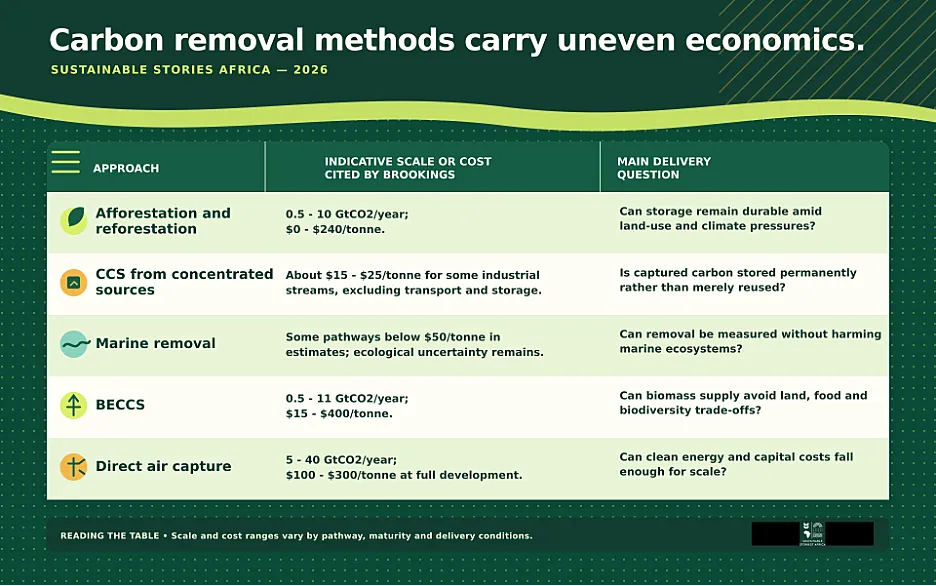
Different technologies carry different tradeoffs today
A critical analytical error treats capture, removal and utilisation as interchangeable climate outcomes.
- Capture reduces new emissions from facilities but leaves legacy atmospheric carbon untouched.
- Utilisation converts captured carbon into products, yet its climate value depends entirely on permanence and what it displaces.
Permanence proves central to this distinction.
- Carbon stored underground for centuries differs fundamentally from carbon embedded in fuel burned shortly after production.
- Nature-based removal offers accessibility and ecosystem co-benefits, though forests remain vulnerable to fire, clearing and shifting climate conditions.
- Ocean-based approaches promise scale, but measurement challenges and ecological effects remain uncertain.
For African policymakers, these trade-offs transform climate technology into a governance imperative.
- Forest-rich, land-constrained nations require rules protecting customary land rights, food systems and biodiversity.
- Industrial economies pursuing carbon capture need transport-storage infrastructure, clear liability frameworks and credible monitoring.
- Coastal states exploring marine solutions must safeguard fisheries and communities dependent on ocean health.
The true development test extends beyond tonnes captured: projects claiming carbon value while worsening water stress, displacing food production or creating poorly governed liabilities risk transferring danger from the atmosphere to communities and public balance sheets.
Scale depends on trust and economics
Brookings argues that costs in the roughly $50 to $100 per tonne range would make removal and capture more viable as a major climate tool.
Reaching that zone will require research, demonstration projects, learning by doing, and policy support.
Carbon pricing, subsidies and compliance markets can all create demand, but they also create incentives that must be carefully governed.
That is where monitoring, reporting and verification becomes economic infrastructure.
Buyers, governments and citizens must know how much carbon was actually removed, how long it will remain stored and whether the removal would have happened without the incentive.
Brookings notes that MRV maturity varies by method: forests are relatively developed, direct air capture is progressing, while marine removal remains difficult to measure.
This has direct relevance for African carbon markets.
- Credible measurements can help projects attract higher-quality capital and reduce reputational risk.
- Weak measurements can do the opposite, leaving governments and communities with contested credits, uncertain revenue and assets that do not deliver the climate benefit promised
The same applies to local acceptance.
- Pipelines, wells, forests and coastal interventions occupy real places, and climate legitimacy cannot substitute for consultation, permitting and benefit sharing.
Policy must price permanence and risk
Governments must separate climate ambition from technological enthusiasm, prioritising the avoidance of emissions reduction.
- Removal should target residual emissions and accumulated carbon stock, not serve as an accounting shortcut delaying cleaner power, transport, industry and land use transitions.
- Where carbon dioxide removal proceeds, policy should reward measurable, durable outcomes over project labels.
Public finance can support early research where private investors avoid technology risk, while carbon markets require rigorous baselines, additionality tests, permanence rules and transparent reversal treatment.
African governments face a strategic choice about value retention.
- Projects relying on African land, geology, ecosystems or renewable energy should build domestic technical capability, data ownership, jobs and infrastructure rather than exporting high-value services; climate finance becomes more developmental when it strengthens institutions alongside carbon performance.
The opportunity is real, but scaling markets demand clarity on risk-bearing, revenue distribution and accountability for reversals.
Path Forward – Scale Removal With Integrity
African policymakers should treat carbon removal as a complement to rapid emissions cuts, with strong standards for permanence, additionality, community consent and transparent MRV.
Public support should favour approaches that demonstrate climate value and wider development benefits.
Investors and project developers should price land, energy, ecological and liability risks before claiming scale.
The durable market will be the one that can prove not only how much carbon was removed, but also who benefited and what risks remained.