Geopolitical instability remains the defining short-term business risk in the 2026 Oxford-GlobeScan survey, while artificial intelligence is simultaneously becoming a larger source of disruption and the strongest perceived opportunity.
For African leaders, the data points to a corporate affairs mandate built around governance, trust and better measurement, especially as misinformation risks accelerate faster than organisational readiness.
Corporate affairs enters a harder era
Corporate affairs teams are being asked to operate in an environment where political risk, technological acceleration and institutional trust increasingly overlap.
The Oxford-GlobeScan Global Corporate Affairs Survey 2026, based on responses from 294 senior professionals across 51 countries, captures that convergence.
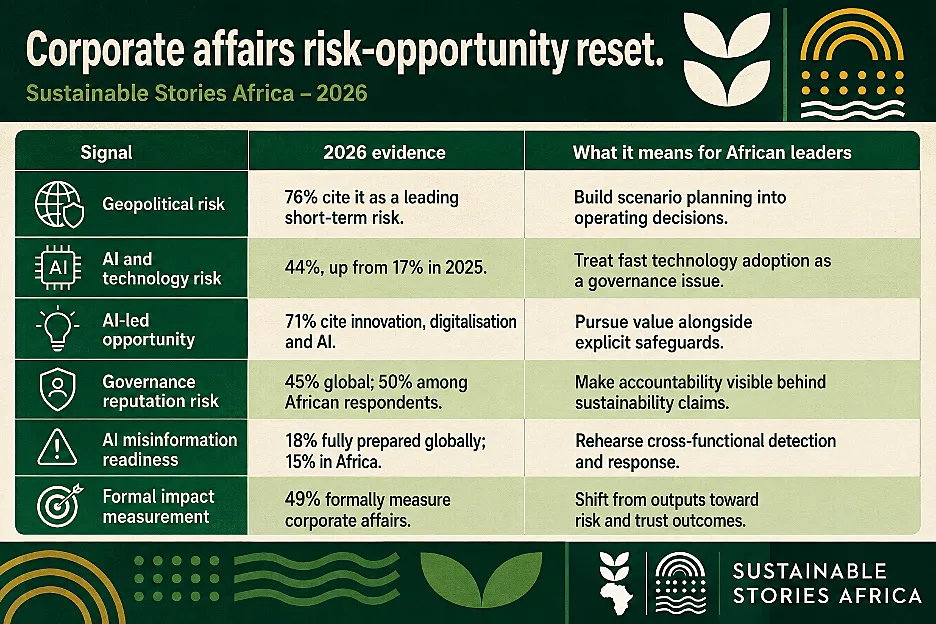
Geopolitical risk was identified by 76% of respondents as a leading short-term risk to global business, maintaining a seven-year run at the top of the survey.
Artificial intelligence creates a sharper paradox.
- Some 71% of respondents named innovation, digitalisation and AI as the greatest short-term opportunity, yet 44% also identified AI and technology as a risk.
- That risk score was 17% in 2025, a 27-percentage-point increase in a single year.
The African sample is smaller than the global base, representing 9% of respondents, so its regional findings should be read as directional rather than exhaustive.
Even so, the pattern is useful: leaders see technology as a route to growth while governance and information integrity are becoming central to reputation management.
Geopolitics now dominates the operating agenda
The survey suggests that geopolitical fragmentation is no longer a specialist concern confined to government relations or country-risk teams.
Trade restrictions, diversified alliances, conflict, regulation and political volatility can reshape supply chains, investment decisions and stakeholder expectations.
Corporate affairs therefore becomes a coordinating function:
- It must translate external shifts into decisions that operating teams, boards and investors can act on.
That role matters for African companies with international capital, export markets or cross-border supply chains.
- A policy decision taken far from the continent can change financing costs, market access or technology availability locally.
The response is not prediction for its own sake.
- It is scenario planning, stakeholder mapping and clear escalation when a political development could alter an organisation's licence to operate.
AI brings opportunity and misinformation exposure
AI is now both the survey's strongest opportunity signal and one of its fastest rising risks.
- That combination makes simple pro-technology or anti-technology positions increasingly unhelpful.
Organisations need to capture productivity and insight gains while building controls for synthetic content, manipulation, model error and the speed with which false information can travel.
Preparedness appears weak.
- Only 18% of respondents globally said their organisations were fully prepared for AI-driven misinformation
- The corresponding figure among African respondents was 15%.
These are self-assessments, but the gap is telling: risk awareness has transformed faster than institutional capability.
For corporate affairs, the practical implication is to treat responses to misinformation as operating resilience.
- Teams need verified information channels, clear decision rights and rehearsed escalation across communications, legal, technology and leadership.
A slow approval chain can become a material vulnerability when false narratives can scale in minutes.
Governance credibility can become strategic capital
Governance is rising in the reputation agenda.
- Globally, 45% of respondents ranked governance as the ESG pillar posing the greatest reputational risk, ahead of environmental issues at 27% and social issues at 26%.
- Among African respondents, the survey recorded governance at 50%, environmental risk at 27% and social risk at 23%.
The result does not diminish climate or social priorities; it shows that the credibility of decision-making increasingly conditions how every sustainability claim is received.
The broader ESG ranking tells a similar story.
- Climate mitigation and adaptation remained the leading issue at 40%, but that was 11 percentage points lower than in 2025, while governance and ethics rose to 34%.
- Companies therefore face a compound test: deliver environmental and social outcomes while demonstrating who is accountable, how trade-offs are made and whether public commitments can withstand scrutiny.
This also changes how sustainability teams and corporate affairs teams should work together.
Climate commitments, community programmes and transition plans create external expectations; governance determines how those expectations are converted into capital allocation, incentives and disclosure.
When the two functions operate separately, a company can communicate ambition faster than it builds the controls needed to deliver it.
Integrated review can surface that gap before stakeholders do.
Measurement must catch up with influence
Corporate affairs are widely valued but inconsistently measured.
- The survey found 94% associate the function with reputation capital, trust and overall reputation.
- 69% connect it to policy and risk.
- Only 49% formally measure its impact.
Where metrics exist, media performance leads at 75%, followed by reputation and stakeholder sentiment measures each at 65%, while investor perception signals trail at just 31%.
This gap creates a management problem.
- If corporate affairs shapes risk, licence to operate, and growth but reports mainly communication outputs, boards receive an incomplete picture.
African organisations can shift toward outcome measures:
- Regulatory friction avoided, stakeholder commitments delivered, crisis response time and policy scenarios embedded in investment decisions.
The survey also finds that 74% believe the function needs some revision, with 17% calling for radical change, less about renaming departments than joining intelligence, governance, communication and measurement into one operating discipline.
A practical starting point is a small set of measures tied to enterprise priorities rather than a sprawling dashboard:
- For politically sensitive market expansion, measure stakeholder acceptance and scenario readiness; for AI adoption, measure misinformation readiness and response speed.
Path Forward – Build corporate affairs for compound risk
The path forward is to design corporate affairs around interconnected risks, rather than separate news cycles.
Geopolitical intelligence, AI governance, sustainability evidence and stakeholder trust need common escalation routes and board visibility.
For African leaders, resilience will come from combining faster sensing with harder proof: know what is changing, decide who owns the response, measure the outcome and communicate only what the evidence can sustain.