Airports Council International expects passenger demand to continue rising sharply and says airports need policy frameworks that allow them to invest in capacity, digital systems, safety, decarbonisation and climate resilience together.
For Africa, the agenda exposes a double infrastructure challenge: expand connectivity without locking airports into high-carbon, climate-vulnerable assets that will be costly to retrofit later.
Airport growth now meets climate reality
Global passenger traffic is estimated at 9.8 billion in 2025, above pre-pandemic levels, and Airports Council International expects long-run demand to rise to about 18.8 billion passengers by 2045.
Its World Policy Agenda 2030 argues that handling that growth will require more than terminals and runways. Airports need investment models, digital passenger systems, safety capacity and a credible route to lower emissions and stronger climate resilience.
ACI organises the agenda around four priorities:
- Airports as businesses, capacity enhancement, safety and security operations, and sustainable growth and decarbonisation.
The connecting idea is that airports are strategic infrastructure with unusually long asset lives.
Decisions made in the current investment cycle can shape costs, emissions and resilience for decades.
For Africa, that long horizon is particularly important.
- Many markets still need more capacity and connectivity, while financing costs and climate exposure can be high.
- Sustainable growth therefore cannot be a retrofit conversation that begins after expansion.
- Resilience, energy and access need to lie within the capital plan from the start.
Passenger demand is outrunning infrastructure capacity
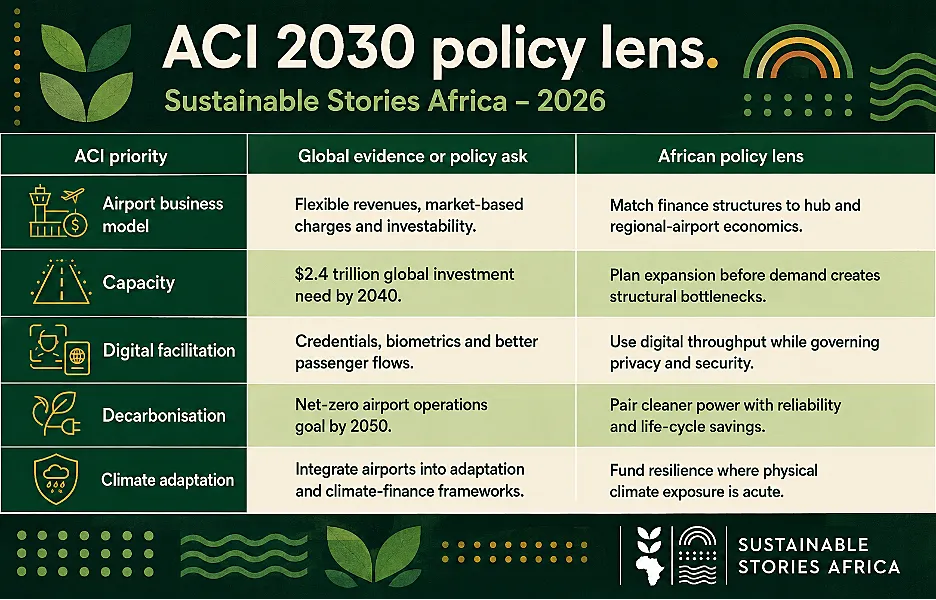
ACI estimates the global airport sector needs about $2.4 trillion in capital investment by 2040, including roughly $731 billion for greenfield infrastructure.
- Without sufficient investment, it warns that airports could lose the capacity to accommodate up to 5.1 billion passengers by 2040.
- Those figures are global; however, the underlying constraint is familiar across emerging aviation markets: demand can grow faster than terminals, airside infrastructure and surface access.
The economic stakes extend beyond airlines and tourism.
- ACI estimates that everyone million passengers who cannot be accommodated is associated with 10,500 direct jobs and $346 million in GDP foregone.
These are advocacy estimates from the airport industry, rather than forecasts for any single African country.
However, they make the case for treating airport capacity as part of national development and trade infrastructure.
Africa faces finance and resilience constraints
ACI argues that airports should operate as businesses and strategic assets, using market-based and dynamic charging, non-aeronautical revenue and financing structures tailored to regional and emerging airports.
This flexibility matters because passenger volumes, route economics and public budgets vary widely; no single financing model fits a continental network, whether major hubs or smaller regional gateways.
Climate risk complicates the finance question. Extreme heat, flooding, storms and water stress can damage assets and disrupt operations, with resilience investments competing against capacity projects for capital.
ACI advocates airport inclusion in national adaptation frameworks and improved access to climate finance, particularly for vulnerable regional airports.
For African airports with relatively low historical emissions but high physical exposure, adaptation may prove as urgent as decarbonisation. Financing decisions should examine drainage, heat tolerance, backup power and emergency access alongside terminal expansion.
Resilience assessment must also consider surrounding systems, including access roads, utilities and communications, since airports function as logistics and emergency nodes.
Mapping these dependencies can reveal modest investments protecting far larger airport assets.
Green airports can strengthen wider economies
ACI maintains a net-zero carbon goal for airport operations by 2050 and estimates airports account for about 2.05% of aviation-related carbon emissions.
Airport-controlled emissions are therefore only part of the sector's footprint; however, airports can influence the wider transition by electrifying ground operations, procuring renewable power and enabling infrastructure for sustainable aviation fuels, lower-carbon fuels and potentially hydrogen.
Energy investment can also improve operating resilience.
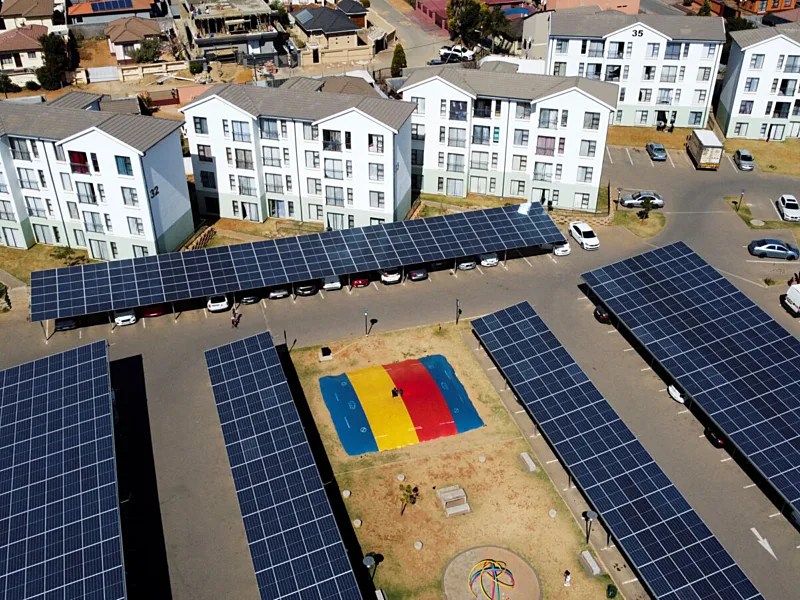
- On-site generation, storage and modernised distribution may reduce exposure to unreliable grids while supporting electrified vehicles and equipment.
- The strongest projects will avoid treating green technology as a standalone sustainability feature: they will connect energy performance to service reliability, life-cycle cost and future aviation requirements.
Regional airports deserve a distinct lens.
Lower traffic volumes can make major capital upgrades harder to finance; however, these facilities may be essential for tourism, access to medical services, trade or disaster response.
Blended finance and development-bank participation can be especially relevant where the public value of connectivity exceeds the revenue captured by the airport operator.
Climate criteria can help direct that capital toward assets designed for future conditions.
Policy must align capital, energy, access
ACI places digitalisation and passenger facilitation inside the capacity discussion.
Digital travel credentials, biometrics and better data flows can increase throughput without relying solely on physical expansion, provided privacy and cybersecurity are managed, for African hubs, efficient processing protects scarce terminal capacity while supporting smoother regional connections.
Policy coordination remains the recurring need.
- Airport operators build assets, but governments shape land use, surface access, border processes, charges and energy policy.
- Development banks and climate-finance institutions can help close investment gaps where projects combine connectivity benefits with adaptation or decarbonisation outcomes.
The practical question is at the portfolio level:
- Which investments unlock passenger capacity, protect operations from climate disruption, cut energy costs, or accomplish several goals simultaneously?
- A disciplined portfolio makes the transition more investable by linking sustainability to operational value rather than treating them separately.
Sequencing matters since airports cannot rebuild everything at once.
No-regret measures, such as efficiency upgrades, updated climate design standards, and digital improvements, can proceed as larger runway or terminal projects are financed, with a published pipeline helping regulators and lenders understand near-term versus long-term trade-offs.
Path Forward – Finance resilient airports before demand compounds
Airport demand grows cumulatively, while infrastructure takes years to plan and finance.
African policymakers therefore need capacity pipelines that incorporate climate scenarios, cleaner energy and digital throughput before bottlenecks become structural.
The opportunity is to build the next wave of connectivity as durable infrastructure: commercially viable where possible, publicly supported where necessary, and designed to remain useful in a warmer, more digital aviation system.