
Low prices usually benefit consumers; however, Nigeria's competition framework treats below-cost pricing by a dominant firm differently when the strategy is capable of excluding rivals and weakening competition.
A Udo Udoma & Belo-Osagie briefing shows why the compliance question is not simply about how cheap a price looks, but market power, the right cost benchmark, internal evidence and whether claimed efficiencies can be substantiated.
Low prices can hide exclusionary intent
Competition policy normally welcomes lower prices because they can signal efficiency, innovation and rivalry.
Predatory pricing is the difficult exception: a dominant firm accepts losses or prices below an appropriate measure of cost in a way designed to eliminate or deter competitors, potentially making it easier to raise prices or weaken choice later.
The legal problem is separating aggressive competition from conduct that damages the competitive process.
A 2026 briefing by Nigerian law firm Udo Udoma & Belo-Osagie explains how the Federal Competition and Consumer Protection Act and the Abuse of Dominance Regulations 2022 approach that distinction. Dominance by itself is not prohibited.
The concern is abuse, including forms of below-cost pricing that can exclude rivals.
That makes evidence important.
- A low headline price, promotion or temporary loss does not automatically establish predation.
- Investigators may examine market position, costs, duration, strategic documents, barriers to entry and the ability of an equally efficient competitor to survive the pricing strategy.
Dominance comes before the predation question
The analysis begins with market power.
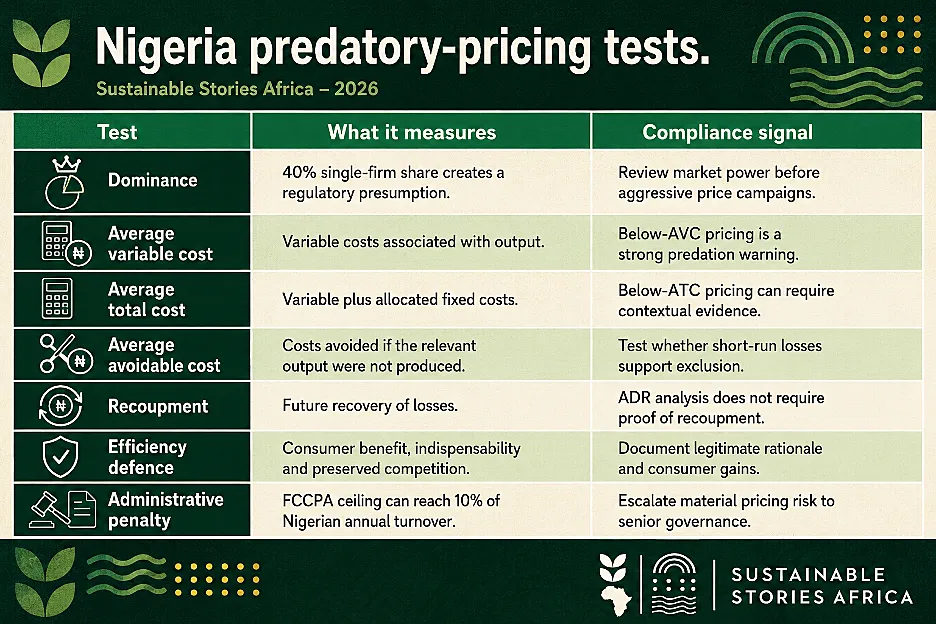
- The 2022 Regulations provide presumptions for dominance, including a single undertaking with at least 40% market share.
- Collective thresholds can also apply, including 50% for three or fewer firms and two-thirds for five or fewer.
Those thresholds do not replace a full market assessment; however, they contribute to larger firms when pricing decisions deserve especially careful competition review.
Market definition is therefore consequential.
- A company may look powerful in a narrow product or geographic market and far less so in a broader one.
- The competition authority can also look beyond share to barriers, buyer power, access to inputs, network effects and other conditions that determine whether a firm can act independently of competitors or customers.
Cost benchmarks separate competition from exclusion
Cost tests help distinguish a sustainable low price from one that may sacrifice short-term economics to exclude rivals.
- Average variable cost focuses on costs that change with output; pricing below that level is a particularly strong warning signal because each additional unit can deepen the operating loss.
- Average total cost includes allocated fixed costs as well, so prices below that benchmark may have more legitimate explanations.
- Average avoidable cost asks which costs would have been avoided if the relevant output had not been produced.
The UUBO briefing describes this as an important benchmark under Nigeria's Abuse of Dominance Regulations, particularly for short-run predation analysis.
Discounts and rebates can also matter when their economic effect pushes the relevant price below cost.
The framework does not require the competition authority to prove that a predator will later recoup its losses before finding abuse, according to the briefing's reading of the Regulations.
That raises the value of contemporaneous evidence.
- Pricing files should explain the commercial rationale, cost base, expected duration and competitive context before a campaign begins, not reconstruct those reasons after scrutiny arrives.
Cost accounting itself can become contested.
- Multi-product firms share warehouses, technology, staff and marketing across services, so the choice of which costs are attributed to the challenged product can materially change the benchmark.
- Finance and legal teams should agree to a defensible methodology before a high-risk discount launches and preserve the underlying data.
A pricing decision is easier to explain when the accounting logic is consistent with ordinary management reporting rules.
Clear pricing governance protects healthy rivalry
Not every below-cost sale is harmful.
- Inventory clearance, perishability, launch promotions or temporary market conditions can create rational low pricing.
The FCCPA also provides an efficiency defence where conduct improves production, distribution, promotes technical and economic progress, gives consumers a fair share of resulting benefits, is indispensable to those gains and does not eliminate substantial competition.
For dominant companies, documenting those conditions protects legitimate rivalry.
- A pricing committee can record the cost benchmark used, why the promotion is necessary, its duration, affected customers and expected efficiencies.
- Legal and finance teams should review exclusionary language in internal emails or presentations because statements about disciplining, eliminating or blocking a rival can change how an otherwise ambiguous price is interpreted.
Dominant firms need documented pricing discipline
The financial stakes are material.
- The FCCPA permits administrative penalties up to 10% of annual turnover in Nigeria, with competition exposure also affecting contracts, reputation and commercial strategy.
- Boards of dominant firms should treat pricing governance as a recurring control rather than an exceptional legal review.
The UUBO briefing notes it had not identified a published FCCPC decision specifically finding predatory pricing at the time of review.
The Commission has examined adjacent pricing concerns in aviation, cement and telecommunications.
This reflects the public enforcement record reviewed by authors, not a prediction that scrutiny will remain rare.
For challengers and smaller firms, the framework matters too.
- A rival's low price alone cannot prove exclusion; complaints need evidence on dominance, duration, cost economics and market foreclosure, since competition law protects the process of competition rather than individual competitors from healthy price rivalry.
Digital markets complicate the analysis a little further, as services may be subsidised, advertising-funded or priced at zero for one user group.
Legal principles still require evidence of dominance and exclusion; however, costs and market boundaries are less obvious.
This makes disciplined internal economic analysis essential for platform businesses that implement cross-subsidies or rapid entry discounts.
Path Forward – Compete hard without weaponising market power
The practical rule for dominant firms is to make pricing decisions explainable before they are challenged.
Cost evidence, commercial rationale, duration and efficiency benefits should be documented in the ordinary course of business.
That discipline preserves room for genuine discounting while reducing the risk that market power is used to make competition unsustainable.
Cheap can remain good for consumers when the pathway to rivalry stays open.