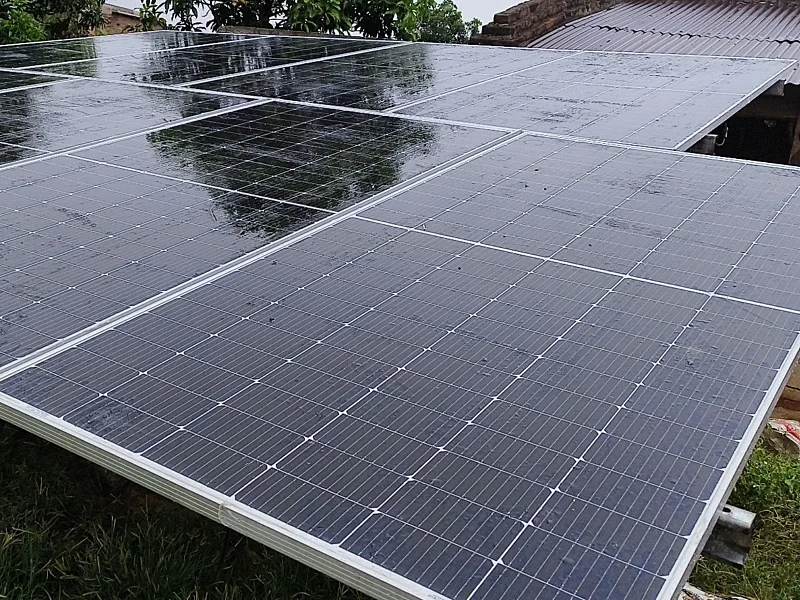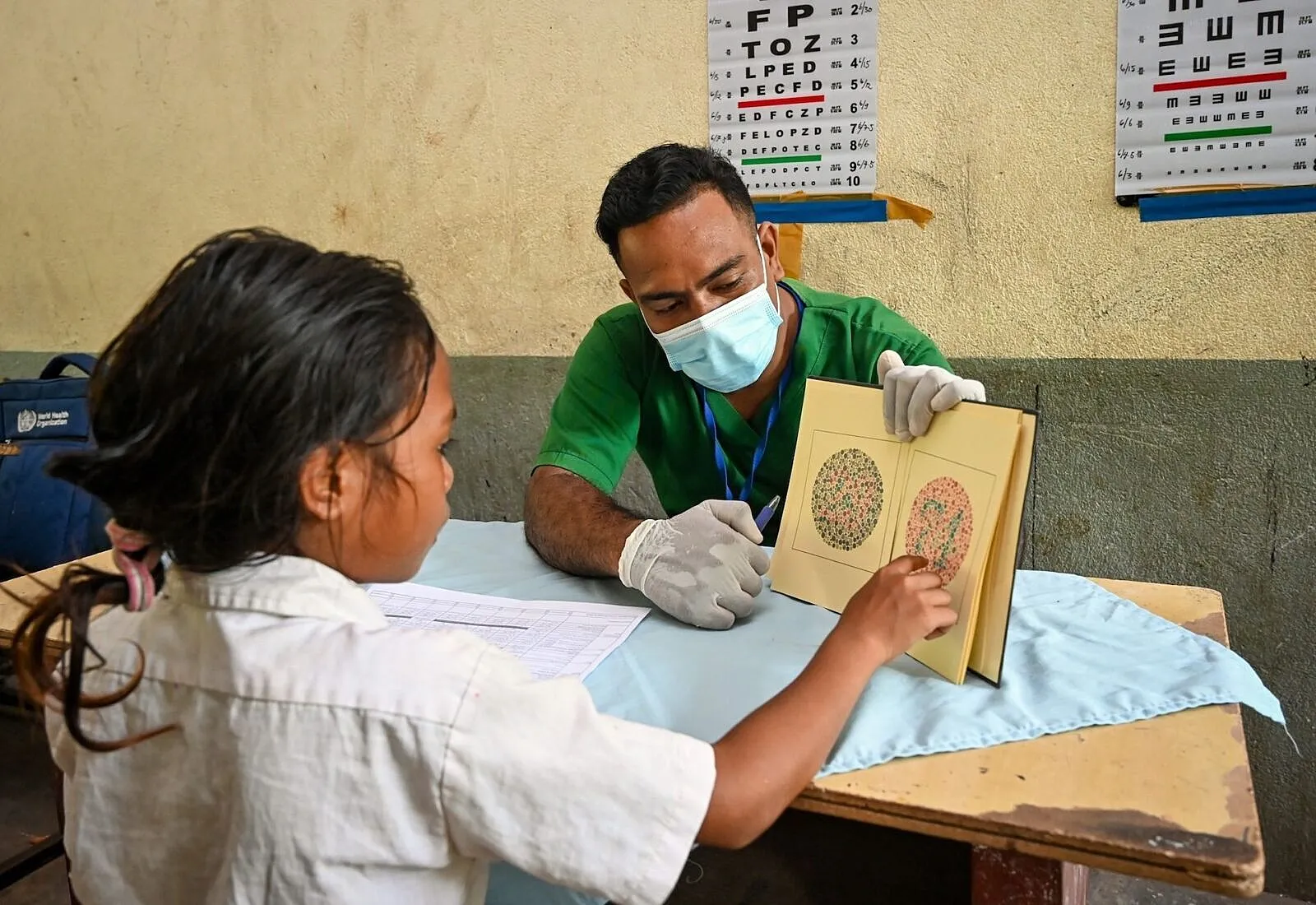
Climate finance protects roads, power systems and buildings, but often overlooks the people who care for children, older persons and people with disabilities when those systems fail.
A Brookings study using Bangladesh as its case shows why care services should be planned as climate-adaptation infrastructure, and why wages and staffing matter more than buildings alone.
Climate Shocks Reorganise Everyday Care Work
When floods close a childcare centre, a parent misses work.
- When extreme heat worsens an older person’s health, a family member provides more unpaid care.
- When power or water fails, care workers spend longer completing basic tasks. These are not secondary social effects.
They determine whether households can adapt and whether local economies can continue to function.
A 2026 Brookings paper by Caren Grown, Jerome De Henau and Ipek Ilkkaracan argues that comprehensive care services belong inside climate-adaptation plans.
The authors model early childhood education and care, long-term care and climate-resilient facilities in Bangladesh.
Their country case is not an African estimate; however, the framework is relevant to African countries facing rapid demographic change, climate exposure and heavy unpaid care burdens.
The central insight is simple: adaptation infrastructure must include both physical assets and the paid workforce that makes care reliable.
Care Demand Is Rising Before Systems
Globally, the number of people needing care is expected to reach 2.3 billion by 2030, including 100 million more older people.
However, 43% of pre-primary-age children with employed mothers lacked formal access to childcare, with nearly 80% of those 350 million children living in low- and middle-income countries.
Climate shocks intensify that gap.
Early 2026 floods in Mozambique damaged or destroyed about 12,000 homes, 126 schools, and 13 health facilities, displacing roughly 100,000 people.
Emergency shelters often excluded older people and persons with disabilities, shifting care burdens onto already stressed households.
The burden is economically significant even unpaid.
Bangladesh's model values unpaid care at $213 billion by 2035, equivalent to 26% of projected GDP, revealing hidden productive labour rather than suggesting families owe payment.
For African policymakers, the starting point is not importing Bangladesh's ratios but asking equivalent questions:
- How many people need support
- Which households absorb the work
- Which facilities fail during crises
- What staffing and transport keep services reachable.
Wages And Staffing Drive Real Costs
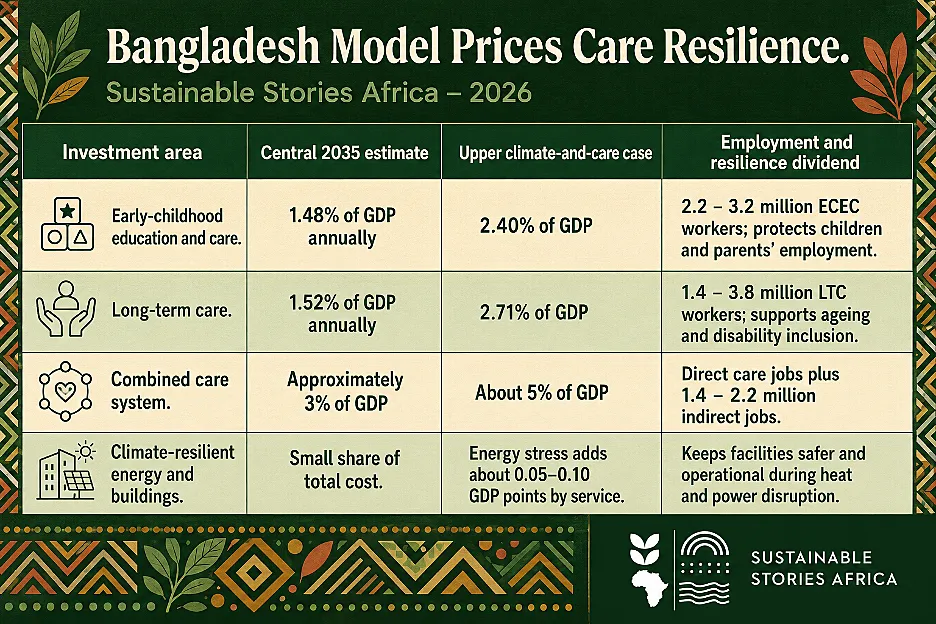
The model's most important result is not the headline GDP share but the composition of that investment.
- Labour accounts for about 72% of the central early-childhood-care estimate, ranging between 68% and 80% across scenarios
- Staffing similarly dominates long-term care.
- Unlike a road counted once construction ends, care infrastructure creates value daily through skilled, fairly paid work.
This matters for budget design.
- Donors and development banks often favour financing buildings, equipment and solar systems over long-term wage bills, risking pilot centres without durable workforces.
- A climate-resilient building without carers is not a care service.
Care workers also need protection from climate hazards.
- Heat standards, water, rest periods, protective equipment, transport and psychosocial support should be treated as continuity requirements, since resilience plans depending on unrecognised sacrifice will fail as shocks intensify.
The paper also challenges assumptions that greener facilities threaten affordability.
- Doubling energy prices and demand adds only about 0.05 percentage points of GDP to early-childhood care and 0.1 points to long-term care, making workforce funding the larger fiscal choice.
Care Investment Produces Multiple Economic Dividends
Well-designed care systems can redistribute time, expand employment and strengthen resilience together.
- Public investment in care across emerging-market scenarios has been estimated to raise employment by roughly 6% and GDP by up to 11% after five years
- The ILO projects universal childcare and long-term care could generate 299 million jobs globally by 2035.
These returns arise because care is labour-intensive and enables other employment: workers spend income locally, parents gain time for paid work, and older or disabled people participate more fully in community life.
Governments also recover costs through taxes and reduced crisis-driven spending.
Gains are not automatic. Poorly paid, informalised care work can reproduce gender inequality, services may remain urban-concentrated or exclude people with disabilities, and climate finance could fund energy upgrades while leaving fees unaffordable.
The desired system is universal, accessible and progressively financed, combining early childhood development, disability support, long-term care, health and social protection while recognising that redistributing care can widen women's choices in education, work and public life.
Put Care Systems Inside Adaptation Budgets
African governments can begin by mapping care needs alongside climate hazards.
- National adaptation plans should identify where floods, heat, drought or displacement are likely to disrupt childcare, health and long-term care.
- Facility standards should cover water, cooling, energy, accessibility and safe evacuation.
Finance ministries should separate capital and recurrent costs but evaluate them as one service.
- A new centre requires a funded staffing pathway, training standards and maintenance plan.
- Social-protection systems can support households when care interruptions force adults out of work.
Development partners should adapt their instruments.
- Grants and highly concessional finance can help establish systems whose returns appear as healthier children, sustained employment and reduced unpaid work rather than a direct revenue stream.
- Procurement and labour rules should protect carers from becoming the adjustment variable when budgets are tight.
Budget appraisal also needs to recognise avoided losses. Reliable care can reduce parents’ work absences, prevent avoidable hospitalisation and make evacuations safer.
Those returns may accrue to households, employers, health systems and tax authorities rather than to the agency that funds the service.
Cross-government assessment can capture benefits that a narrow departmental business case will miss.
Path Forward – Resilience Begins With Reliable Human Support
The Bangladesh figures are not a ready-made budget for Africa.
They are evidence that governments can cost care, test climate scenarios and expose the labour choices hidden inside adaptation plans.
If a society cannot care through a shock, its infrastructure is not resilient.
Care services should therefore be planned, financed and measured as part of the systems that keep communities functioning.