
FinPolNomics captures a growing shift: before AI, finance teams spent hours gathering data and reconciling accounts; after AI, automation frees capacity for insight, forecasting, and business partnering.
The opportunity is not fewer humans for its own sake. It is a better use of human judgment, ethics, control, communication, and commercial insight.
Finance Work Rebalances At Speed
Finance functions across Africa and beyond are undergoing a quiet but consequential transformation.
A before-and-after model from FinPolNomics Green Finance and FinPolNomics Analytica illustrates how artificial intelligence is redistributing where finance professionals spend their time, moving effort away from repetitive execution and toward judgment-driven strategy.
The stakes are immediate for African firms, many of which operate with lean teams, fragmented legacy systems, and demanding reporting cycles.
Where automation is introduced without adequate data governance, the promised efficiency gains can evaporate into new forms of risk.
Where it is implemented deliberately, finance teams gain room to move from being reactive record-keepers to proactive advisers shaping commercial decisions.
This is the tension at the heart of the FinPolNomics infographic: automation changes the nature of finance work, but it does not remove the need for skilled professionals. It simply relocates their value from data handling to interpretation, oversight, and strategic partnering.
Automation Exposes The Old Bottleneck
Before AI, according to the FinPolNomics model, finance departments spent disproportionate time on data gathering, reconciliations, and routine reporting rather than higher-value thinking.
That imbalance carried a real cost: insight consistently arrived late, after key decisions had already been made without the benefit of finance's analytical input.
The graphic's "before" panel shows large teams anchored in manual execution—idea generation exists; however, it is crowded out by volume-heavy tasks like data reconciliation and routine reporting.
For African finance departments juggling multiple reporting standards, currency volatility, and legacy IT infrastructure, this bottleneck is especially familiar.
Reporting packs are compiled manually, variance commentary is written after the fact, and forecasting often relies on static spreadsheets that go stale before they reach decision-makers.
Data Shows A Sharper Contrast
The FinPolNomics comparison table quantifies the shift across five core finance activities, showing how each function evolves once automation is applied.
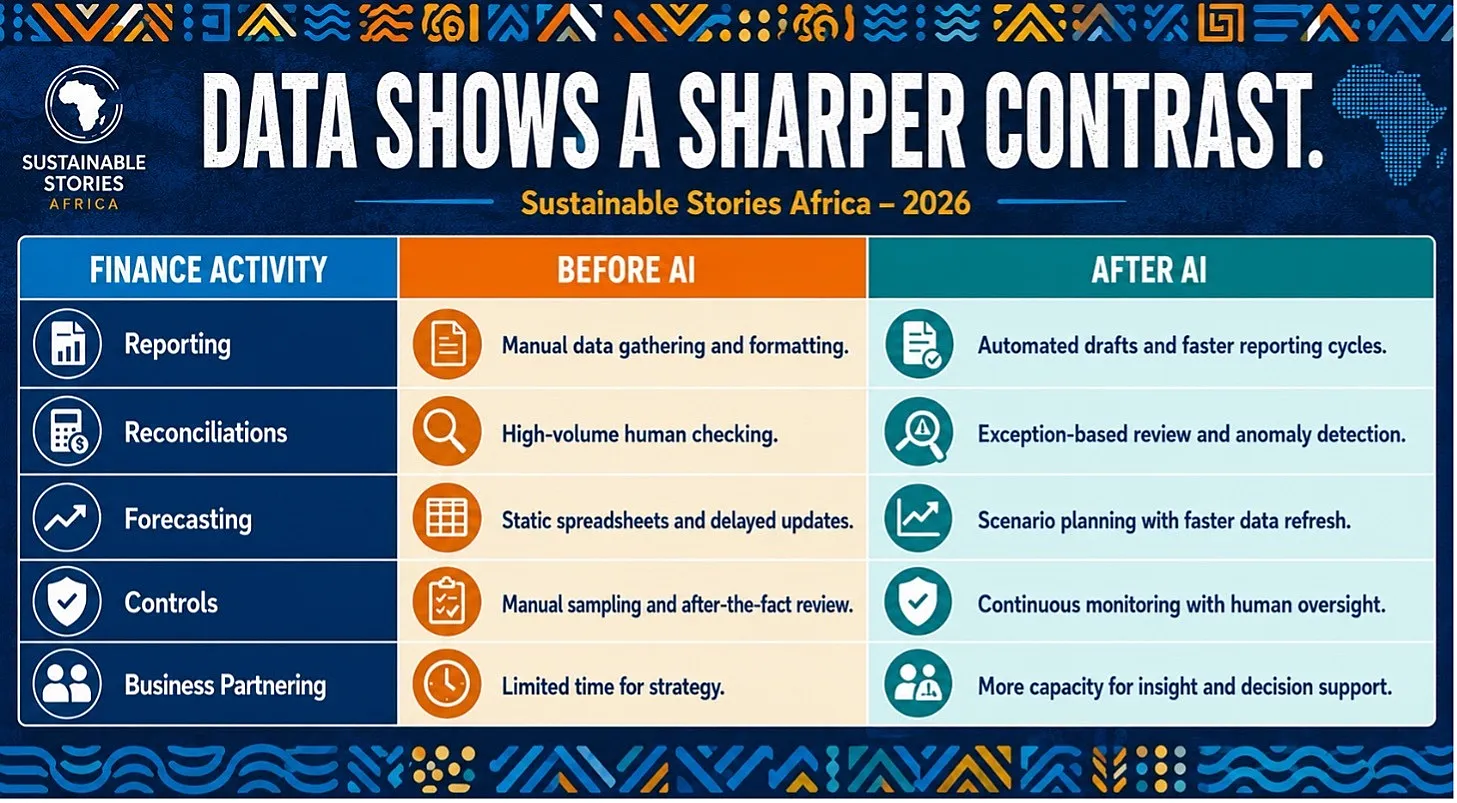
The pattern across every row is consistent: automation absorbs volume-heavy, repeatable tasks, while human attention consolidates around exceptions, interpretation, and forward-looking analysis.
This is not a story about elimination; it is a story about how finance professionals spend the hours they already have.
What Firms Stand To Gain
If African organisations get the transition right, the payoff extends well beyond faster reporting.
Finance teams could shift from reactive bookkeeping to becoming genuine strategic partners, flagging margin drivers, identifying which customers create real value, locating trapped cash, and stress-testing scenarios before decisions are locked in.
The FinPolNomics "finance nugget" captures the underlying philosophy directly: AI does not eliminate the need for finance professionals; it changes the work they do.
Human judgment stays central precisely because models can be wrong, biased, incomplete, or misapplied in contexts models were never trained on, a particular risk in African markets with thinner historical datasets.
Finance professionals who can interpret AI outputs, challenge assumptions, and connect numbers to commercial reality become more valuable, not less.
Conversely, delaying adoption risks leaving teams stuck in low-value execution. At the same time, competitors and multinational peers redirect their people toward insight and strategy, widening a capability gap that compounds over time.
Governance And Skills Must Move Together
Realising these gains requires deliberate, sequenced action rather than wholesale automation. The FinPolNomics model points to five concrete moves: automate routine tasks, elevate judgement and insight, strengthen controls and governance, upskill teams for analysis and AI use, and create more value with fewer bottlenecks.
For African companies, the recommended path is use-case-driven rather than transformational overnight.
Practical starting points include invoice coding, reconciliations, variance commentary, reporting packs, cash forecasting inputs, and anomaly detection, tasks that are repetitive, rules-based, and low-risk to automate first.
Governance cannot be an afterthought here: AI deployment needs approval workflows, audit trails, access controls, model documentation, exception review, and mandatory human sign-off for judgment-heavy decisions, given that poor data quality can easily drive poor insight; it can also drive good insight.
Regulators, boards, and finance leaders each have a role;
- Boards must demand documented AI governance frameworks
- Regulators should clarify expectations for automated financial controls
- Finance leaders must invest in upskilling before expanding automation scope.
Path Forward – Automate Tasks, Elevate People
The direction FinPolNomics sets out is clear: automate routine execution while deliberately strengthening human judgment, governance, and business partnering capacity.
African firms that pair AI adoption with strong data quality, robust controls, and upskilled finance teams stand to make faster decisions without sacrificing the trust that underpins financial reporting.
The message for finance leaders is less about technology adoption for its own sake and more about disciplined sequencing: automate what can be automated safely, then reinvest the freed capacity into the judgment, ethics, and commercial insight that no algorithm can replace.