Chika Onyekwere’s ESG for Manufacturers: A Beginner’s Guide: Part 3 argues that the hardest part of ESG is no longer measurement.
It is execution: deciding which projects to fund, how fast to move, and where returns are strongest.
For African manufacturers, that question now carries real commercial weight. The guide’s Nigerian case studies show that disciplined implementation can cut emissions, improve resilience, unlock export opportunities and pay back faster than many boards assume.
Execution becomes African manufacturing’s ESG edge
African manufacturing has reached a more demanding stage of the ESG conversation.
Parts 1 and 2 established the metrics, the footprint and the value-chain burden.
Part 3 moves to the harder question: what happens when a company starts to act?
Chika Onyekwere’s answer is practical and numbers-led. A credible strategy is not a slogan. It is a sequence of investments, governance choices, trade-offs and measurable outcomes.
The anchor case remains NutriPackN Foods in Ogun State, Nigeria, first introduced in Part 2 with a baseline footprint of 4,847 tonnes CO₂e and a 30% reduction target by 2028.
Part 3 translates that ambition into an execution plan: target emissions of 3,393 tonnes CO₂e, a reduction requirement of 1,454 tonnes, and an 18-month roadmap anchored on energy, process efficiency, refrigerants and Scope 3 supplier actions.
That matters well beyond one company. For African markets, the real test of ESG is whether firms can convert disclosure into productivity, resilience and market access without stalling operations. Part 3 suggests many can.
The projects with the fastest payback are already visible
The most striking message in Part 3 is that many of the best ESG interventions are not distant moonshots.
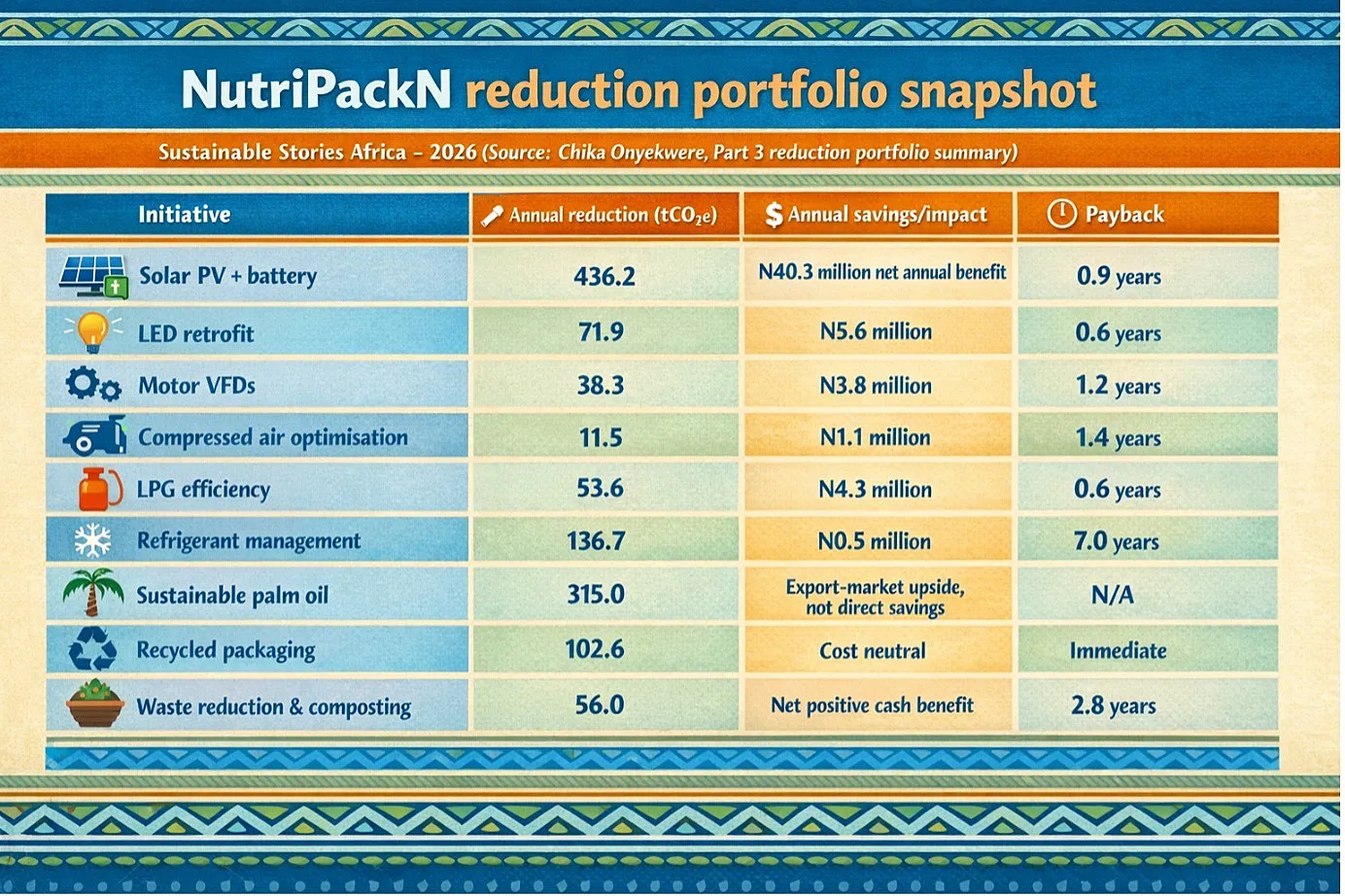
They are near-term operational upgrades with measurable returns. NutriPackN’s proposed portfolio totals N51.5 million in investment, delivers 1,221.8 tonnes CO₂e in annual reductions, generates N53.6 million in annual savings, and carries an average payback of roughly one year.
That gets the company to about 25% of its emissions-reduction pathway, close to its 30% target.
Even more telling, the guide explicitly rejects one seemingly obvious option.
Replacing diesel generators with a natural gas genset increases emissions by 164.5 tonnes CO₂e due to lower efficiency.
The recommendation is to skip it and focus on solar and grid optimisation instead. That kind of honesty is rare and useful: not every “transition” measure is a real climate win.
What the reduction portfolio really says
The reduction strategy is built around a few high-impact moves.
The biggest single winner is a 400-kW rooftop solar installation with 200 kWh battery storage.
The guide estimates 580,000 kWh of annual generation, 436.2 tonnes CO₂e in avoided emissions, N40.3 million in net annual benefit and a payback of just 0.9 years.
In a Nigerian industrial setting shaped by unreliable grid supply and heavy dependence on generators, that is not just decarbonisation. It is energy-risk management.
Then come the energy-efficiency upgrades. Replacing 500 lights with LEDs saves 112,500 kWh a year, cuts 71.9 tonnes CO₂e and pays back in 0.6 years.
Installing variable frequency drives on 10 major motors saves another 60,000 kWh, reduces 38.3 tonnes CO₂e and pays back in 1.2 years.
Compressed-air optimisation adds 11.5 tonnes CO₂e in reductions. Together, the efficiency package removes 121.7 tonnes of CO₂e per year with an N9.5 million investment, and N10.5 million in annual savings.
Process improvements matter too. Upgrading LPG burners and insulation reduces emissions by 53.6 tonnes of CO₂e per year with a 0.6-year payback.
Refrigerant management is slower financially but strategically important: replacing R-404A with lower-GWP R-448A and reducing leakage from 15% to 3% cuts 136.7 tonnes CO₂e annually, though payback stretches to seven years and is driven more by compliance than pure ROI.
Scope 3 remains central. Switching to RSPO-certified sustainable palm oil reduces emissions by 315 tonnes CO₂e a year, though at an added annual cost of N3.4 million.
Using 30% recycled content in plastic packaging cuts another 102.6 tonnes CO₂e at broadly cost-neutral terms.
Waste reduction and composting add 56 tonnes CO₂e in reductions, modest cash returns, and stronger circularity benefits.
Why this matters beyond carbon
Part 3 is strongest when it widens the lens from emissions to strategic value. The sample-company summary says the portfolio delivers a 1.3-year payback on N51.5 million of investment, a N39.5 million net annual benefit and a 75% internal rate of return over a 10-year horizon.
It also improves export readiness, energy security and access to sustainable finance.
The plastics manufacturer transformation case makes the broader point even more vividly. Over 18 months, the company achieved a 42% reduction in emissions intensity, 70% waste diversion, 45% lower water intensity, 25% renewable energy in the mix, zero lost-time injuries, full workforce training, over N10 million in annual operating savings, and more than N130 million in added revenue from expanded contracts and new export customers. Total investment was N35 million; first-year ROI reached 400%.
That is the real promise for African manufacturers. Well-run ESG programmes do not only shrink footprints. They can also improve negotiating power with buyers, reduce exposure to volatile energy costs, strengthen workforce culture and make firms look more bankable.
What boards, managers, and financiers should do now
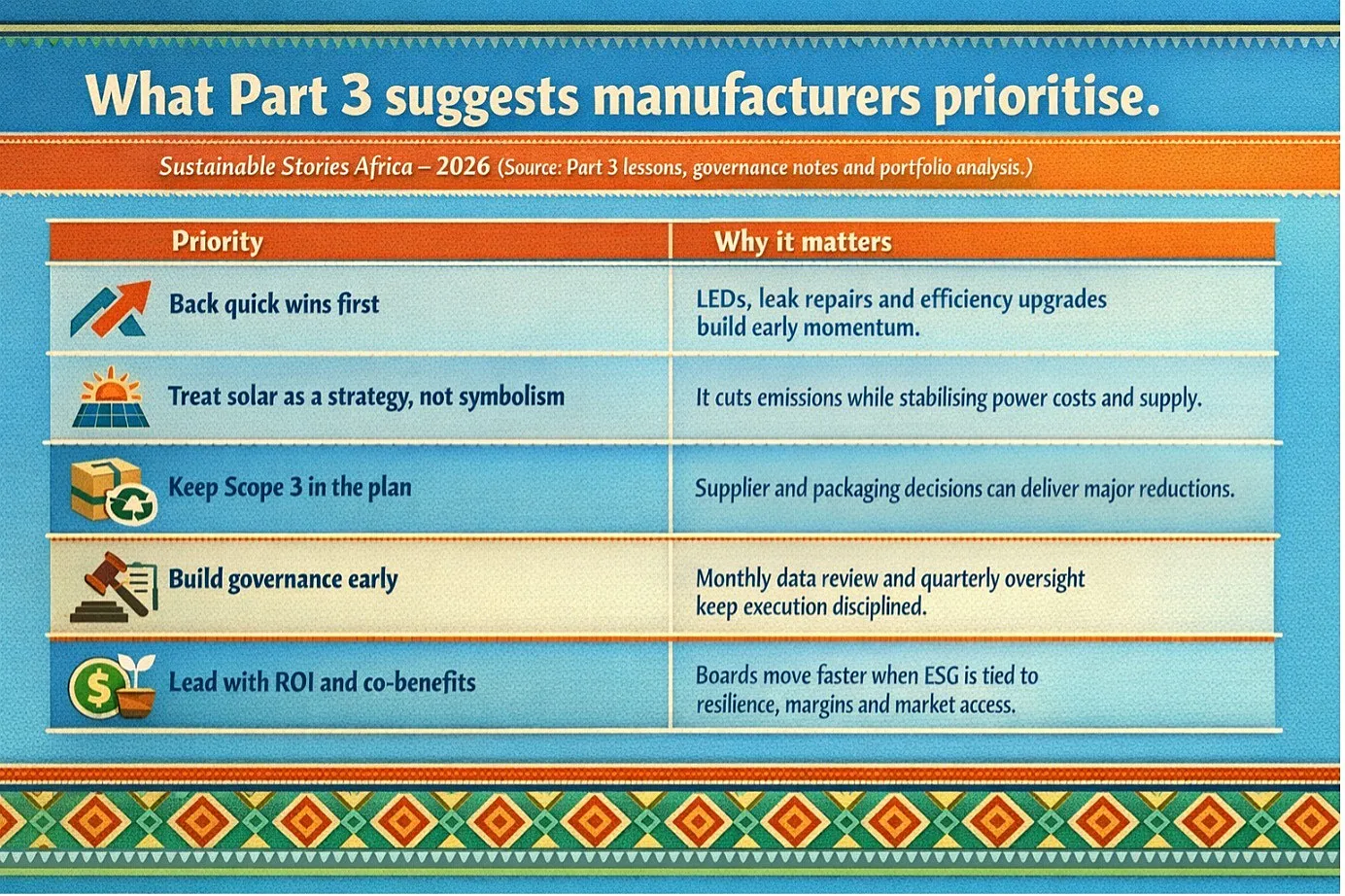
The guide’s practical lesson is to build ESG execution as a management system, not a one-off project.
It calls for an implementation team with monthly meetings, a steering committee with quarterly board-level reviews, monthly data collection, annual verification and continuous improvement.
It also stresses critical success factors: executive commitment, sub-metering and monitoring, cross-functional collaboration, early supplier engagement and quick wins that build confidence in three to six months.
It also warns against familiar traps: waiting for perfect data, underestimating Scope 3, ignoring the financial case, treating GHG management as a temporary project, and communicating poorly inside and outside the firm.
For African manufacturers trying to scale ESG under tight budgets, those warnings may be as valuable as the investment cases themselves.
What Part 3 suggests manufacturers prioritise
Path Forward – Execution now decides the winners
Part 3 leaves a clear conclusion: African manufacturers that move from baseline measurement to disciplined implementation will be better placed on cost, compliance, energy resilience and export credibility.
The final message of Chika Onyekwere’s three-part guide is simple. ESG becomes valuable when it is built into operations, financed intelligently, measured continuously and scaled with confidence.
ESG in Manufacturing Industry Part 3