Drawn from Chika Onyekwere’s January 2025 guide, this first part shows why ESG is no longer a side conversation for African manufacturers, but a core operating discipline.
From carbon and water use to safety, training and supplier checks, the metrics reveal where factories are losing money, risking exports and leaving competitiveness on the table.
Why factory metrics now decide competitiveness
African manufacturers are entering a harder commercial era. What used to sit inside sustainability reports is moving onto the factory floor, into procurement reviews, export documentation, bank conversations and buyer audits.
Chika Onyekwere’s ESG for Manufacturers: A Beginner’s Guide frames that shift clearly: ESG now matters not just for compliance but also for competitiveness, efficiency and long-term profitability.
The immediate stakes are especially clear in Nigeria and similar African markets, where industrial emissions are rising, water stress is uneven but real, and manufacturers increasingly face external pressure from carbon pricing, EU border requirements, investor scrutiny and supply-chain due diligence.
Part 1 of this three-part metrics insights series focuses on the basics that matter most: environmental footprint, workforce performance, supply-chain labour risk and the business case for acting early.
The central question is no longer whether manufacturers should measure ESG. It is whether they can afford not to.
The numbers moving ESG into operations
Manufacturing already contributes 23% of global greenhouse-gas emissions, and the guide says Nigeria’s industrial-sector emissions are growing by 3% – 5% annually.
That matters because carbon exposure is no longer abstract. For African manufacturers, it can shape access to export materials, financing terms and buyer confidence.
The document reduces the issue to three environmental pressure points:
- Emissions
- Water
- Waste.
Together, they tell a simple but uncomfortable story. Many factories are not just producing goods; they are also producing hidden costs, avoidable inefficiencies and commercial vulnerabilities that better measurement can expose.
Seven metrics that explain the real story
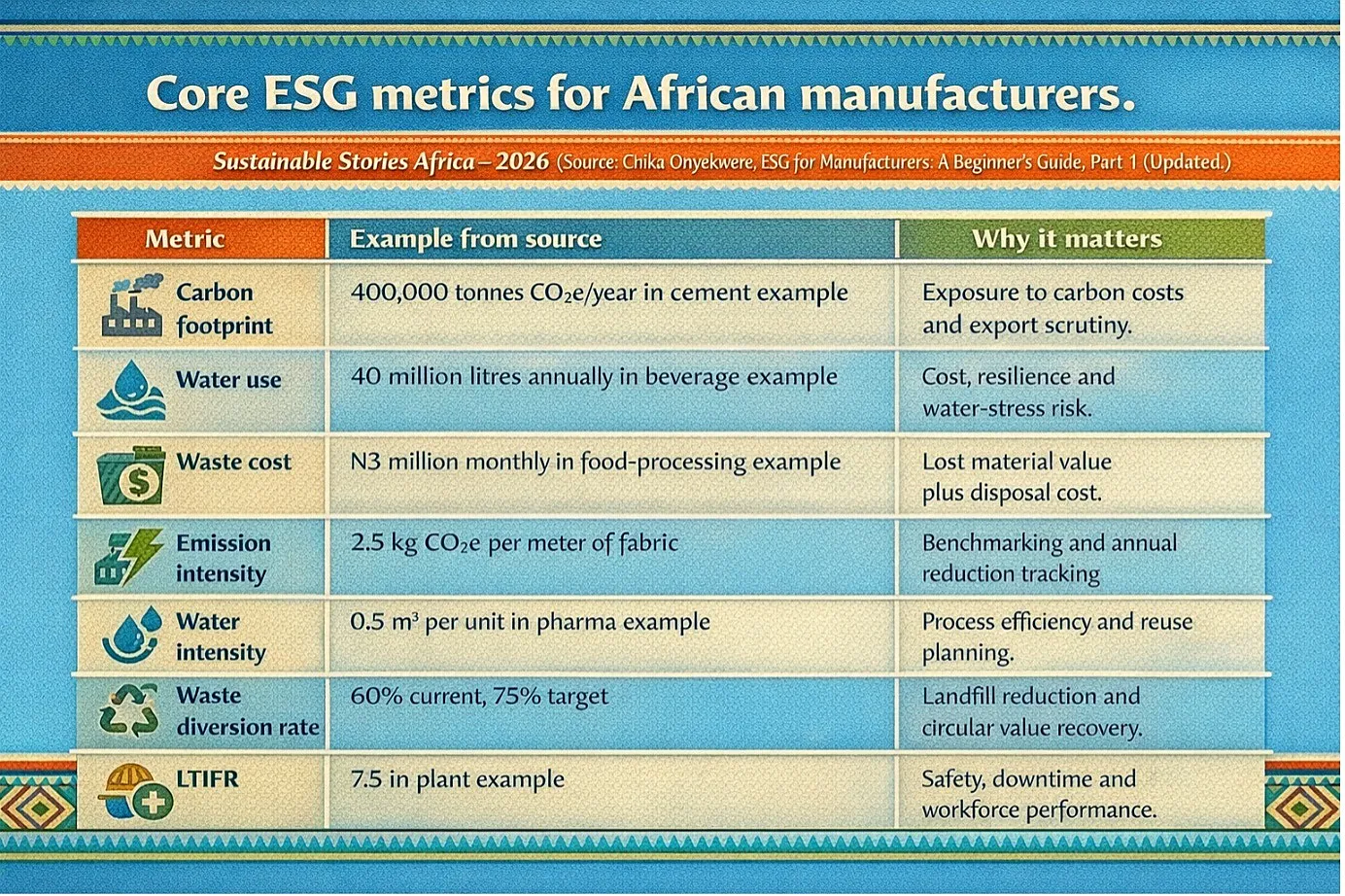
- The guide opens with a carbon footprint, using a cement plant producing 500,000 tonnes to show how fast emissions build. At 0.8kg kg of CO2 per kg, emissions reach 400,000 tonnes of CO2e, roughly equal to 86,000 cars. In Africa, that signals carbon costs and trade pressure.
- Water consumption is the second pressure point. Manufacturing uses 20% of global freshwater, with northern Nigeria especially exposed. In the beverage example, 10 million litres of output require 40 million litres at a 4:1 ratio. Cutting that to 2:1 saves 20 million litres and cuts costs.
- Waste generation is the third metric, treated as both risk and lost value. In the food-processing example, 15% of 1000 tonnes of raw material become waste each month. At N20,000 per tonne, that equals N3 million each month. The lesson is blunt: waste is money leaking from operations.
- The next three indicators are emissions intensity, water intensity and waste diversion rate. A textile plant records 2.5 kg of CO2e per metre, better than the 3.0 industry average but above the 1.8 benchmark. A pharmaceutical plant uses 0.5m3 uses a unit, while an electronics assembler diverts 60% of waste, below the 75% target.
- The seventh measure is worker safety, captured through LTIFR. A plant with 200 workers and three lost-time injury records, an LTIFR of 7.5, far above world-class performance below 2. ESG’s social side shapes downtime, productivity and legal exposure.
Training reinforces that point. Onyekwere estimates that a small manufacturer investing N250,000 a year in staff training could see 15% productivity gains, a 30% reduction in workplace accidents, a 20% drop in material waste and a first-year return of 5x.
That is a useful African-market insight: capability building is not charity spending; it is efficiency spending.
What manufacturers gain by acting early
The guide’s strongest message is that ESG can protect revenue as much as reputation.
Its Nigerian food-processor case shows how an investment of N10 million in cold-chain efficiency can generate N3 million in annual energy savings, cut spoilage by N2 million, unlock N20 million in additional export revenue and pay back in two years.
That business case extends beyond a single plant. According to the document, export markets in the EU and the US increasingly expect ESG compliance, large buyers such as Unilever and Nestlé audit suppliers on ESG, and banks can offer better rates to compliant companies.
For African manufacturers, this turns ESG into a form of commercial insurance: protect efficiency, protect access, protect margins.
What should African manufacturers do now?
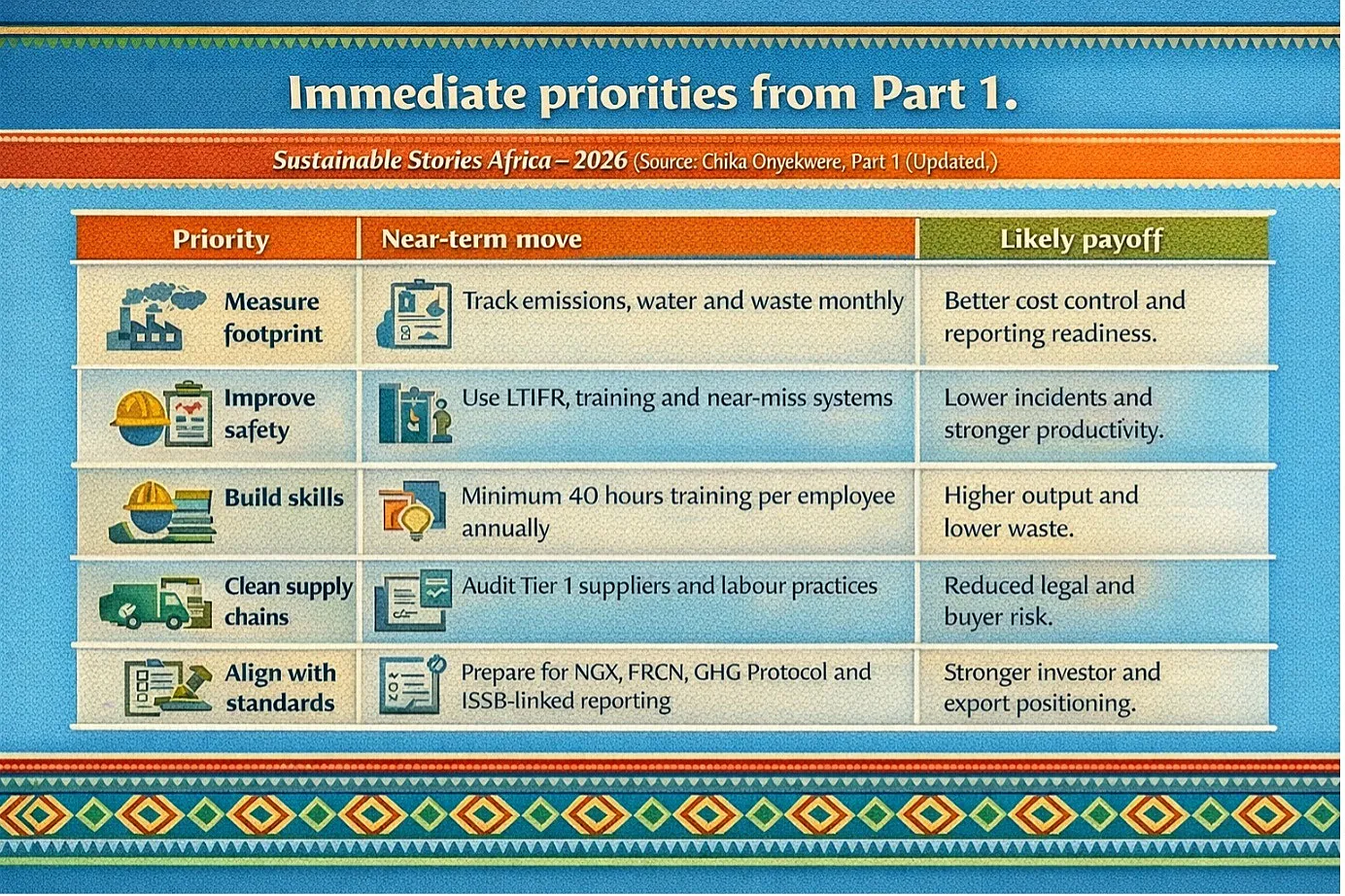
- First, measure what matters. Start with emissions, water, waste, as well as injuries, then convert them into intensity, and then rate-based metrics that management teams can track monthly.
- Second, strengthen workforce systems through safety training, PPE compliance, near-miss reporting and equipment maintenance.
- Third, move upstream by mapping Tier 1 suppliers, checking safety certifications, monitoring labour conditions and creating clearer pathways for women and youth employment.
- Fourth, align early with the standards most likely to shape capital and market access. The guide points manufacturers to ISSB’s IFRS S1 and S2, CSRD and ESRS, the GHG Protocol, GRI, TCFD, TNFD and CDP globally, and to NGX ESG disclosure requirements, FRCN sustainability reporting, NESREA regulations, SON rules and NAFDAC oversight in Nigeria.
For African boards, that is the operating map.
Path Forward – Measure first, then scale with confidence
African manufacturers do not need to solve every ESG issue at once. The more practical route is to begin with measurable operating risks, build internal discipline, and align gradually with the standards shaping buyers, banks and export markets.
Part 1 makes the case clearly: good ESG starts as factory math before it becomes boardroom strategy. The firms that learn early will be better positioned for deeper compliance and governance questions.