ACI World’s five-step roadmap turns apron electrification into an infrastructure, governance and financing decision.
Electric baggage tractors and aircraft service vehicles can cut apron emissions and improve working conditions, but buying vehicles is the easy part.
ACI World’s 2026 guidance argues that airports must plan power, sites, safety, ownership and finance together, an especially important sequence for African hubs managing constrained grids and scarce capital.
Electric Aprons Require More Than Vehicles
The smell of diesel around baggage halls and aircraft stands is a daily reminder that aviation’s climate footprint does not begin and end in the air.
Ground support equipment moves bags, pushes aircraft, supplies power, loads cargo and supports catering. Replacing those machines with electric alternatives promises quieter aprons, cleaner local air and lower direct emissions; however, it also transfers a material part of airport operations onto the electricity system.
That transfer is the central insight in ACI World’s Electric Ground Support Equipment Implementation Guidance for Airports 2026.
The publication treats electrification as an operational transformation rather than a procurement exercise.
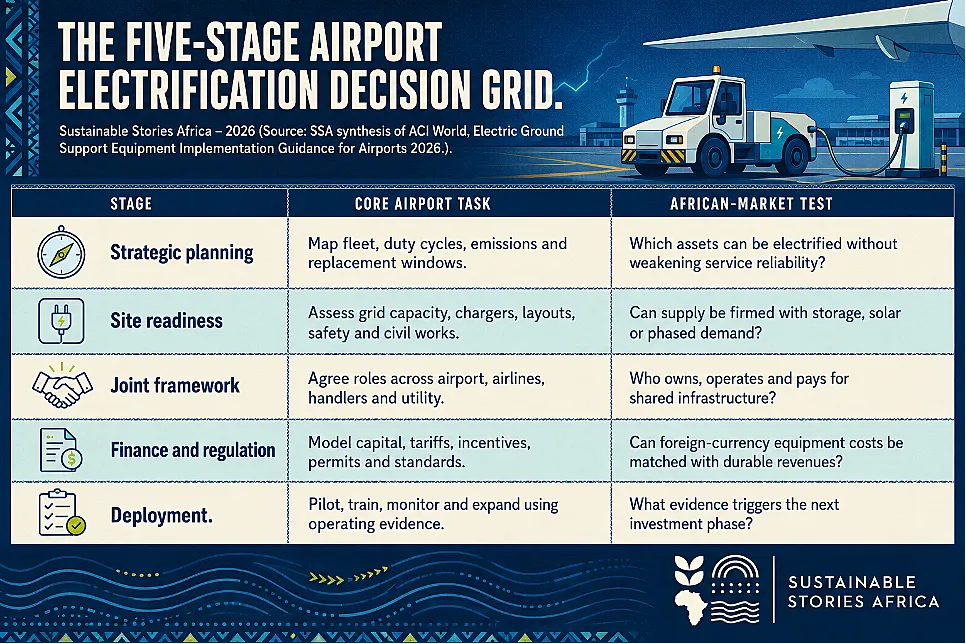
Its roadmap covers five connected stages: strategic planning, site readiness, a joint implementation framework, financial and regulatory preparation, and deployment.
For African airports, the distinction matters.
- A fleet order can be announced quickly; reliable charging, safe circulation, dependable electricity and workable commercial arrangements take longer.
- Where grid supply is unstable, or expansion is slow, an airport may need embedded generation, storage, demand management or phased charging before a large electric fleet can operate without disrupting passengers and airlines.
Five Steps Turn Ambition Into Operations
Strategic planning begins with the equipment actually used, its duty cycles, ownership, remaining life and location.
Airports need a baseline fleet inventory and an emissions profile. Still, they also need to know when vehicles return to base, how long they can charge and which machines are operationally critical.
Those facts determine whether chargers should be slow, fast, mobile, fixed or shared.
Site readiness then tests the physical system. Electrical capacity, substation headroom, cable routes, drainage, fire protection, ventilation, traffic movement and the distance between chargers and equipment parking all affect cost.
A charger placed without an apron operating plan can create congestion or safety risks; a charger installed without a power study can become an expensive stranded asset.
ACI World’s joint implementation stage recognises the airport’s fragmented commercial reality.
Airlines, independent ground handlers, concessionaires, utilities, regulators, equipment manufacturers and emergency services may all control part of the solution.
A common architecture is needed for technical standards, access rights, data, maintenance, emergency response and cost recovery.
Shared Infrastructure Changes: The Economics of Airports
A coordinated approach to airport electrification can reduce duplication and cost. Isolated charger installations by individual handlers risk incompatible systems, poor utilisation, and unnecessary civil works.
In contrast, shared charging improves economics but raises governance questions: peak-time priority, electricity metering, maintenance-inclusive tariffs, and risk allocation if demand grows slower than projected.
The opportunity extends beyond carbon accounting. Ground crews near combustion engines could see reduced pollution and noise, while operators gain shelter from diesel price volatility and cut maintenance costs tied to internal-combustion drivetrains.
Renewable electricity access strengthens this operational and climate case further.
These benefits are not guaranteed. Business cases must account for battery replacement, charging losses, imported equipment, technician skills, and end-of-life management; reporting only avoided fuel use risks overstating economics.
Credible models compare total cost of ownership, infrastructure lifespan, power quality, downtime, and residual value across deployment scenarios.
Tariff design will determine whether shared models endure, with fixed access fees supporting infrastructure recovery and metered charges allocating use fairly, particularly for smaller handlers.
African Airports Face Distinct Power Constraints
Many African hubs face expansion pressures alongside high electricity costs, voltage instability, and constrained capital budgets, making sequencing decisive.
Initial electrification should target equipment with predictable routes, high utilisation, accessible parking, and clear fuel savings, with contained pilots revealing actual energy use and maintenance needs before larger grid commitments.
Procurement must also build local capability.
- Contracts requiring technician training, diagnostic tools, spare parts plans, battery warranties, and open charging interfaces prevent dependency on distant suppliers; workforce development and interoperability should be treated as resilience investments rather than optional benefits.
Regulators can clarify electrical standards, concession rules, customs treatment, and cost-recovery mechanisms.
Development finance institutions structure blended finance for enabling infrastructure, though concessional capital cannot replace a bankable operating model.
Regional collaboration reduces learning costs, as airports with similar constraints share specifications and benchmarks, though each must still validate its own grid and operational requirements.
Boards Must Sequence Capital And Coordination
Airport boards should ask for a single integrated plan that joins fleet replacement, power capacity, civil works, commercial agreements and carbon targets.
Approval gates should be tied to evidence: completed load studies, signed stakeholder responsibilities, verified safety cases, realistic tariffs and pilot performance.
The most useful performance dashboard will combine operational availability, charger utilisation, energy cost per operating hour, avoided fuel, safety incidents, maintenance downtime and emissions.
That prevents sustainability claims from being separated from service quality and financial discipline.
Management should also disclose the boundary of claimed reductions. If grid electricity is carbon-intensive or diesel generation supports charging, tailpipe emissions may fall faster than total emissions.
Transparent accounting allows the airport to improve both fleet efficiency and electricity sourcing over time.
Path Forward – Build Power Before Procurement
African airports should begin with fleet and load studies, then use pilots to test chargers, operating routines and commercial rules.
Shared infrastructure must have explicit ownership, access and maintenance arrangements.
The objective is not the largest electric fleet announcement. It is a reliable system that protects workers, keeps aircraft moving and expands only when power, skills and finance can support it.