Written By Florence Oluwaseun
Africa is attracting increasing investment in clean energy, climate finance and sustainable development; however, one critical resource remains in short supply: skilled people.
As demand for ESG expertise accelerates, the continent’s ability to translate sustainability ambitions into economic growth will depend on how quickly it develops the workforce needed to deliver them.
The Talent Gap Behind Africa’s ESG Future
Africa’s sustainability story is often told through the lens of finance.
Governments seek climate funding. Development institutions announce renewable energy investments.
Businesses compete for green finance, while policymakers discuss carbon markets and energy transition strategies.
These conversations are important, but they overlook a fundamental question: Who will implement Africa’s ESG ambitions?
Environmental, Social and Governance (ESG) has evolved beyond a corporate reporting framework.
It now influences investment decisions, business strategy, supply chain management and corporate governance across industries. However, while expectations continue to rise, Africa’s pipeline of ESG professionals has not kept pace.
The continent’s greatest ESG challenge may no longer be access to capital; it may be access to talent.
The Demand for ESG Skills Is Rising Faster Than Supply
The global labour market is changing.
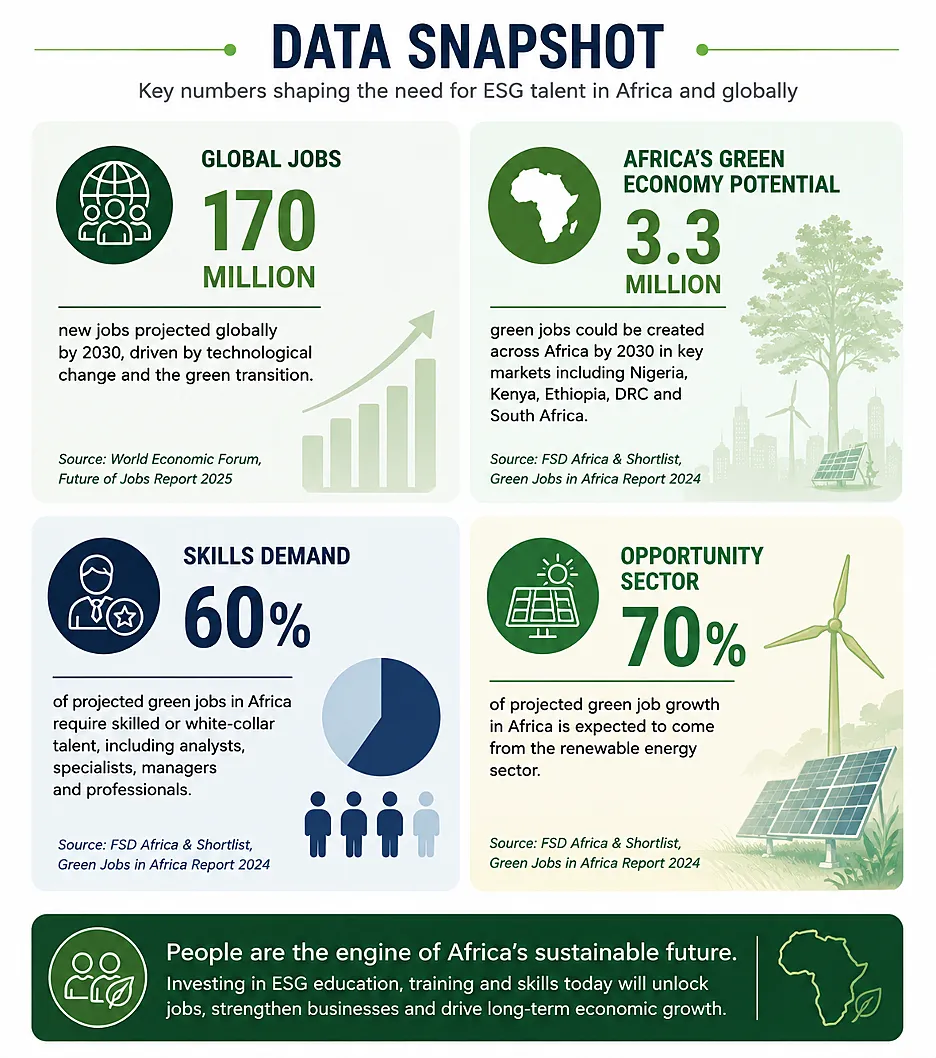
According to the World Economic Forum’s Future of Jobs Report 2025, technological change and the green transition are expected to create 170 million new jobs globally by 2030, while displacing 92 million others, resulting in a net gain of 78 million jobs.
Sustainability Specialists, Environmental Engineers and Renewable Energy Engineers are among the world’s fastest-growing professions.
The report also identifies environmental stewardship as one of the fastest-growing skills employers expect to need over the coming years, reflecting the increasing importance of sustainability across sectors.
For Africa, these trends represent more than employment opportunities.
They represent an opportunity to build a workforce capable of supporting industrialisation, attracting responsible investment and accelerating sustainable economic growth.
However, only if the right skills are developed.
Africa’s Green Economy Needs More Than Green Finance
The continent’s economic potential is significant.
Research by FSD Africa and Shortlist estimates that Africa’s green economy could create 3.3 million jobs by 2030 across countries including Nigeria, Kenya, Ethiopia, the Democratic Republic of Congo and South Africa.
Approximately 60% of those jobs are expected to be skilled or white-collar roles, with renewable energy accounting for around 70% of projected employment growth.
Those figures tell an important story.
Africa’s green transition is not simply about installing solar panels or financing renewable energy projects.
It is equally about building professionals who can design ESG strategies, assess climate risks, prepare sustainability disclosures, structure green finance transactions and implement responsible governance systems.
Without these capabilities, investment opportunities may outpace the continent’s ability to execute them effectively.
Nigeria illustrates both the progress and the challenge.
Interest in ESG has grown rapidly among financial institutions, renewable energy companies and multinational organisations.
Sustainability reporting, climate finance and responsible investment are becoming more prominent within boardrooms and executive discussions.
However, ESG education remains relatively limited within many university programmes.
While professional certifications and private training initiatives are expanding, employers frequently invest in additional training to bridge skills gaps in sustainability reporting, climate governance and ESG implementation.
This disconnect between market demand and workforce readiness risks slowing down the pace of sustainable development.
Why Human Capital Matters
Without these professionals, sustainability ambitions remain policy documents rather than measurable outcomes.
- ESG is often described as a framework.
- In reality, it is a capability.
- Every successful ESG strategy depends on people.
- Engineers develop resilient energy infrastructure.
- Finance professionals integrate climate risks into investment decisions.
- Lawyers strengthen governance and regulatory compliance.
- Data analysts measure sustainability performance.
- Corporate leaders embed ESG into business strategy.
The success of Africa’s green economy will therefore depend not only on infrastructure and investment, but also on whether its workforce is prepared for a rapidly changing business environment.
Closing Africa’s ESG Capacity Gap
Building Africa’s ESG workforce requires coordinated action.
- Universities should integrate sustainability, climate finance and corporate governance into business, engineering, accounting and public policy curricula.
- Professional bodies should expand practical ESG certifications that respond to African market realities.
- Businesses should treat ESG training as a strategic investment rather than a compliance cost, equipping employees with skills in sustainability reporting, stakeholder engagement and climate risk management.
- Governments and development partners should strengthen collaboration between academia and industry to ensure graduates possess skills aligned with emerging green economy opportunities.
The objective is not simply to create ESG professionals.
It is to build a workforce capable of strengthening African businesses and making the continent more competitive within a rapidly evolving global economy.
Path Forward – Africa’s Competitive Advantage Is Its People
Africa’s renewable energy potential is immense.
Its greatest opportunity, however, is its young and growing workforce.
Capital can finance projects. Technology can accelerate innovation. But only people can turn sustainability ambitions into lasting economic value.
Investing in ESG skills today will determine whether Africa participates in the global green economy or helps lead it.