Africa’s green transition could generate up to 7.9 million jobs by 2030 and 84.5 million by 2050, but the biggest opportunity may not sit in large power plants.
A new report argues that the continent’s green workforce will be service-led, decentralised, and heavily informal, meaning clean cooking agents, recyclers, solar technicians, e-mobility operators, and micro-enterprises may determine whether the transition becomes truly inclusive.
Africa’s Green Transition Needs Workers First
Africa’s green transition is no longer only a climate finance story. It is becoming a labour market story, an inclusion story, and a test of whether the continent can turn climate investment into dignified livelihoods.
This article is based on “Unlocking Africa’s Green Transition: Opportunities Towards a Green and Inclusive Workforce,” a June 2026 report commissioned by FSD Africa, Shell Foundation, and Shortlist, and produced by Genesis Analytics.
The report was researched and written by Marcela Tarazona, Daipayan Ghosh, Ursula Larraquy, Seth Nyawacha, and Vimbai Chasi, building on the 2024 Forecasting Green Jobs in Africa study.
Its central message is direct: Africa’s clean economy can create millions of jobs, but only if governments, investors, training institutions, and businesses design the transition around who can access those jobs, especially women, young people, informal workers, and low-income communities.
Millions of Green Jobs Are at Stake
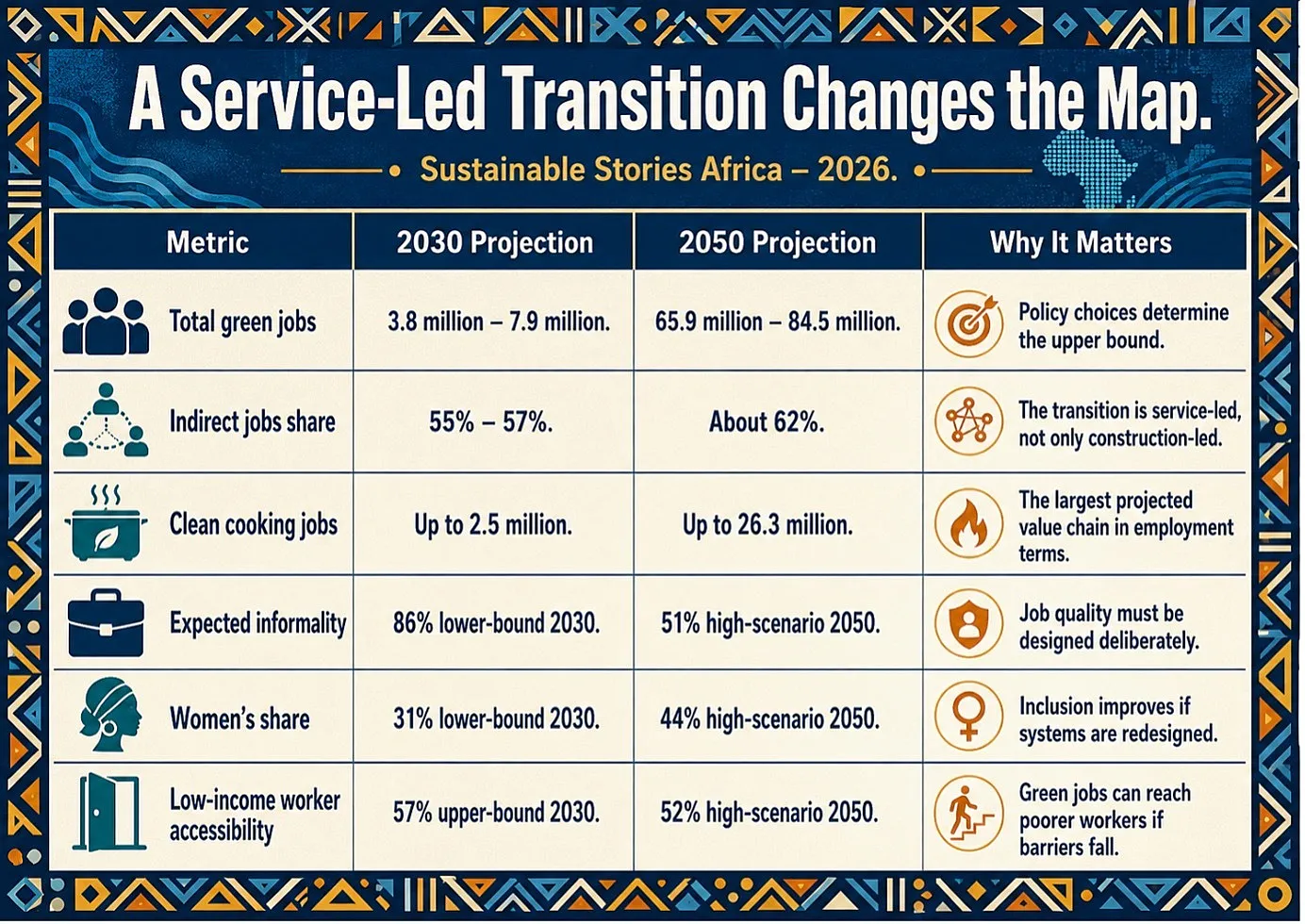
Africa's green transition could generate 3.8 – 7.9 million jobs by 2030 and 65.9 – 84.5 million by 2050 across 13 value chains.
This wide-range estimate is no footnote; it reflects how policy, finance, skills, and inclusion will shape whether growth is broad-based or narrowly captured.
The stakes are increased by the reality of Africa's labour market.
Sub-Saharan Africa grew 3.7% in 2024, with 4% projected for 2025; however, formal job creation lags: over 10 million youths enter the labour market every year, but only 3 million formal jobs are possible. The region needs 15 million new jobs annually to absorb entrants.
The green transition, then, is about more than emissions; it's a chance to link climate action with livelihoods and inclusion, provided workforce planning keeps pace with capital investment.
A Service-Led Transition Changes the Map
The report upends a common assumption: that green jobs will mainly stem from large construction sites, factories, or utility-scale renewable projects.
Instead, Africa's employment dividend will likely come from decentralised service ecosystems, installation, distribution, maintenance, repair, last-mile delivery, and community enterprise.
Indirect jobs are projected to account for between 55% and 57% of green employment by 2030, rising to 62% by 2050.
Clean cooking is set to become the largest green value chain by 2030, ahead of utility-scale solar, generating 1.4 – 2.5 million jobs through micro-distributors, technicians, and community agents.
Waste recycling, solar home systems, and electric two- and three-wheelers follow suit: labour-intensive, distributed, and open to workers often excluded from formal markets.
This matters for investors and governments. Strategies borrowed from high-income markets may over-emphasise formal manufacturing while under-investing in workers carrying the transition into homes and informal settlements.
Skills gaps compound the challenge. Africa's renewable workforce is just 324,000, 2% of the global total, despite holding 60% of the world's best solar resources; only 6.5% of youth have completed TVET training.
Inclusive Green Work Can Build Resilience
Africa's green transition can become a powerful engine for inclusion if designed intentionally.
The value chains generating the most jobs (clean cooking, waste recycling, solar home systems, and e-mobility) are also among the most accessible to women, youth, and low-income workers.
This accessibility matters because Africa's labour market is already unequal. Young people cluster in informal entry-level roles; women are often pushed into lower-value, care-adjacent work with limited paths to technical roles or ownership; and low-income workers outside major cities face barriers linked to geography, digital exclusion, and lack of capital.
However, participation is not the same as inclusion.
The report warns that without redesigned labour systems, women may enter green value chains mainly through poorly paid, informal, or weakly protected roles, counted as part of the green workforce, but lacking social protection, credentials, or progression pathways.
Country contexts differ sharply.
- Nigeria's 2030 green workforce is projected to be 87% informal, dominated by nano-enterprises.
- South Africa's is roughly 70% formal, shaped by regulated procurement and a capitalised just transition plan.
- Kenya sits between both, with strong renewable electricity, emerging e-mobility, and devolved governance requiring county-level skills integration.
Capital Must Follow Skills and Inclusion
The report is clear that capital deployment alone will not be enough. Africa received only 3.3% of global climate finance flows in 2021 to 2022, and current flows meet only 23% of the estimated annual investment needed to implement NDCs and meet 2030 climate goals.
Climate finance must at least quadruple annually until 2030, but the report notes that almost none of it is directed toward workforce development, skills systems, or social protection infrastructure.
That is the missing link. The continent can mobilise climate finance for solar farms, grid upgrades, battery systems, clean cooking, recycling, and e-mobility.
However, without trained workers, recognised credentials, apprenticeships, market-making infrastructure, and labour protections, green investment may produce assets without building capability.
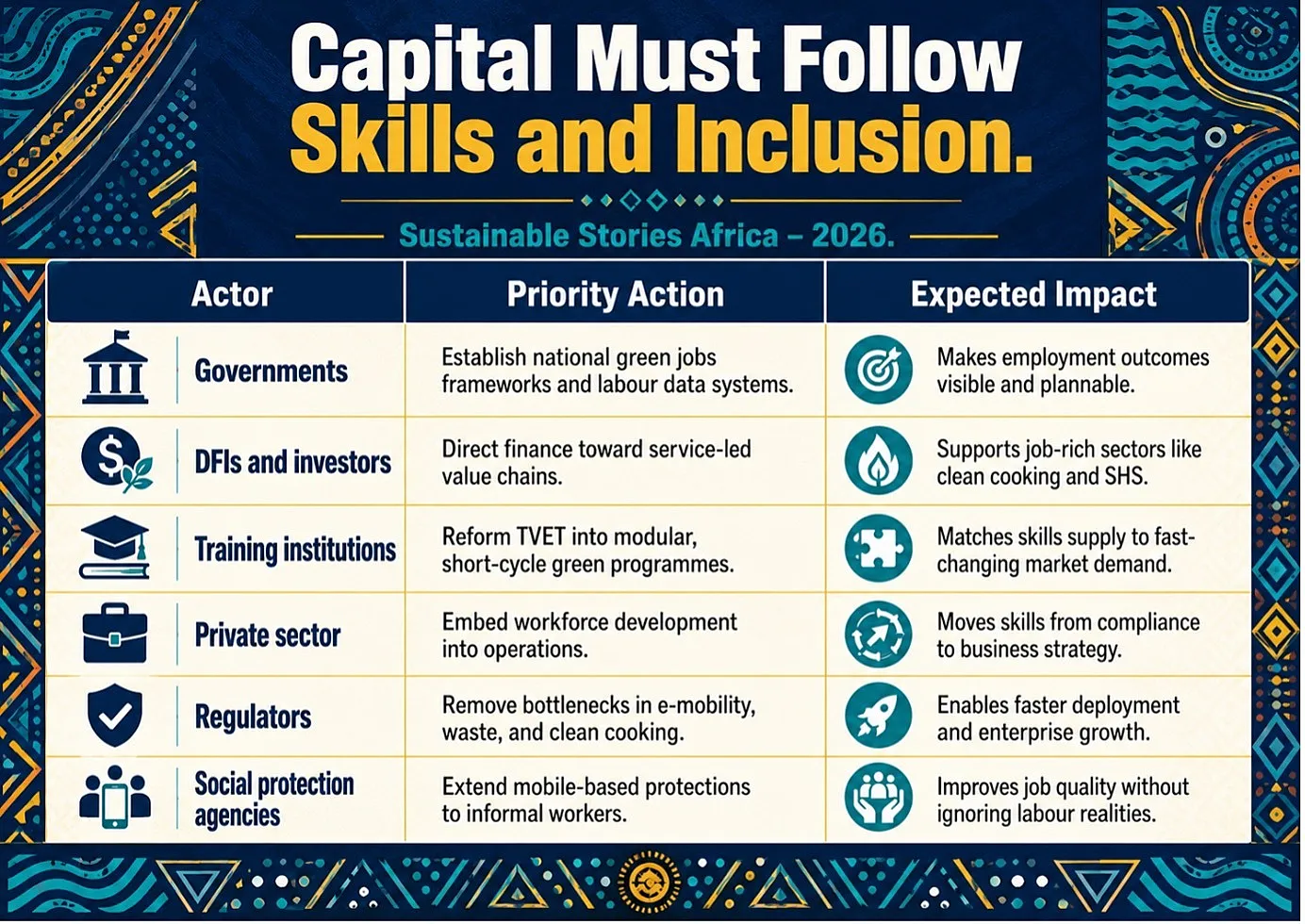
The report recommends ten actions, including directing public and development finance toward service-led value chains, embedding workforce and inclusion criteria into green infrastructure financing, linking green finance to employment quality, closing labour market data gaps, investing in underserved market infrastructure, formalising on-the-job training, reforming TVET, extending social protection to informal workers, establishing national green jobs policy frameworks, and removing regulatory bottlenecks.
For Sustainable Stories Africa’s ESG lens, the key takeaway is practical: green finance must not only measure megawatts installed or emissions avoided.
It must also measure who is employed, under what conditions, with what income pathway, and with what opportunity to move from survival work to decent work.
Path Forward – Make Africa’s Green Jobs Count Now
Africa’s green transition can become a jobs revolution if finance, policy, skills, and inclusion are planned together.
The priority is to make workforce development central to climate investment, not an afterthought.
The continent’s opportunities are already visible in clean cooking, waste recycling, solar home systems, e-mobility, and nature-linked sectors.
The next test is whether governments, investors, and employers can turn that opportunity into fair work, stronger enterprises, and resilience for the people most exposed to climate and economic shocks.