Africa holds forests, minerals, biodiversity and carbon sinks that support the global economy, yet much of that value remains outside GDP, debt analysis and credit ratings.
An AfDB-published policy paper argues that measuring natural capital could improve investment decisions, strengthen access to climate finance and help African economies move from raw extraction to green productivity.
Africa’s Hidden Wealth Must Now Count
Africa’s economic story has long been told through deficits: debt burdens, currency pressure, infrastructure gaps and narrow export baskets. But a new policy argument from the African Development Bank Group reframes the continent from another angle: Africa is not poor in assets; it is poorly measured.
The paper, Measuring the Green Wealth of Nations: Natural Capital and Economic Productivity in Africa, argues that conventional GDP undervalues African economies because it needs to adequately capture forests, biodiversity, carbon sequestration, water systems and other ecosystem services that sustain both local livelihoods and global climate stability.
Africa is presented as a living economic system of forests, wildlife, minerals, renewable energy and ecological services, rather than just a map of extractive commodities.
For policymakers, investors and citizens, the stakes are practical. If the continent’s natural wealth is properly valued, it could reshape debt sustainability, improve sovereign risk perception, expand access to green finance and support more sustainable development planning.
Why GDP No Longer Tells Enough
Africa's economies are being systematically undervalued. That is the central argument advanced by the African Development Bank, which contends that conventional economic tools fail to account for the continent's most significant assets: its natural capital.
Former AfDB President Dr Akinwumi Adesina frames the problem directly: Africa cannot remain "nature rich and cash poor." When forests absorb carbon, watersheds sustain agriculture, and biodiversity supports resilience, excluding these services from national accounts understates true economic strength.
Global momentum is shifting beyond GDP, but the stakes are highest for Africa. The continent has the Congo Basin, the world's second-largest rainforest, alongside dominant shares of global platinum, cobalt, manganese, and gold production
However, most economies export raw or semi-processed materials, forfeiting value that beneficiation and green manufacturing could capture. The result is a persistent paradox: extraordinary endowments, weak value addition, high borrowing costs, and constrained fiscal space.
Natural Capital Becomes Africa’s Economic Argument
Natural Capital Accounting offers a structured bridge between ecological value and economic policy. When conventional GDP overlooks environmental quality, resource depletion, and ecosystem degradation, the System of Environmental-Economic Accounting, particularly the SEEA Central Framework and SEEA Ecosystem Accounting, provides an integrated statistical pathway to correct that gap.
The urgency is real. Deforestation, mining discharges, overfishing, and agricultural runoff are quietly eroding Africa's long-term economic base.
A country can record growth while systematically depleting the natural systems that make future growth possible.
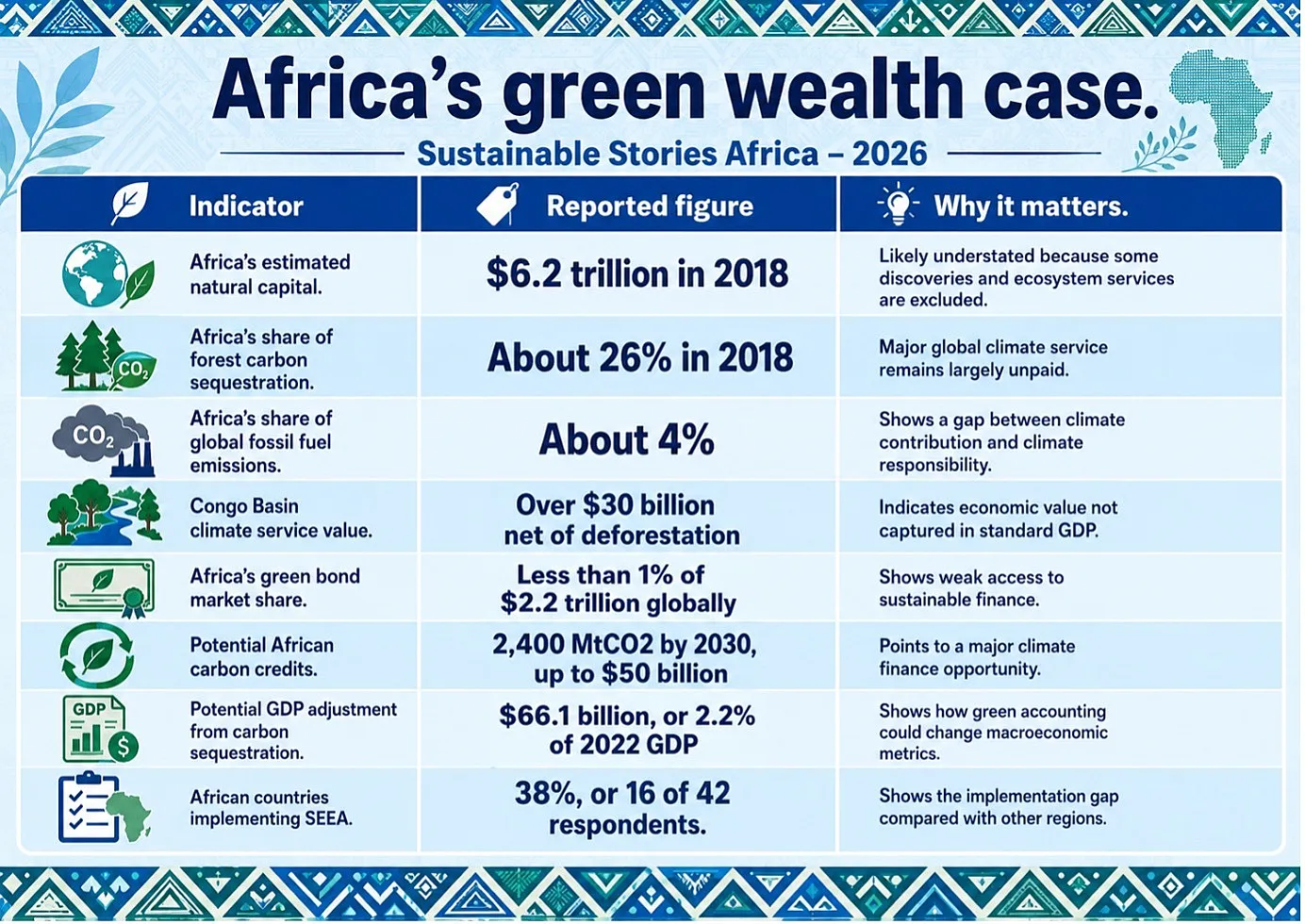
The carbon numbers make the argument concrete. Africa contributed roughly 26% of global forest carbon sequestration in 2018; however, it accounted for only 4% of global fossil fuel emissions, a contribution largely invisible in current finance systems.
The Congo Basin's annual sequestration value illustrates the pricing gap starkly: estimated at up to $77 billion under the EU Emissions Trading System pricing, compared to $5.5 billion under voluntary carbon markets.
That difference reframes the conversation entirely. African nations preserving forests are not requesting climate aid; they are seeking fair compensation for a measurable, high-value global public service.
What Green Accounting Could Unlock Next
Natural capital accounting offers Africa more than better statistics; it unlocks better finance, stronger planning, and smarter incentives.
By incorporating ecosystem services into national wealth profiles, countries can improve creditworthiness, reduce perceived investment risk, and expand fiscal space for green infrastructure, renewable energy, and climate-resilient agriculture.
Ethiopia, Zambia, and Uganda demonstrate what this looks like in practice. Zambia's forest and land accounts have directly informed climate policy and SDG reporting, while its forests are estimated to support over one million rural jobs.
Uganda has used environmental-economic accounting to shape biodiversity and forest resource planning.
The stakes extend to ordinary citizens. Forests sustain livelihoods, water security, food systems, and tourism. When these services go uncounted, governments underinvest in conservation.
The risk of inaction is equally stark. Without green accounting, African nations continue to borrow against undervalued balance sheets, exporting raw materials cheaply, and receiving inadequate compensation for ecosystem services that benefit the entire planet.
How Leaders Can Turn Wealth Into Finance
The action agenda begins with statistics; however, it cannot end there.
The AfDB paper says Africa still lags in implementing SEEA. A 2023 global assessment found that only 38% of African countries were implementing SEEA, compared with 93% in Europe and North America. National accounts also remain uneven: 38 of 54 African countries use the 2008 System of National Accounts, while 13 still compile accounts under the 1993 system, and some use older frameworks.
GDP rebasing is another weakness. An AfDB survey from June 2023 found that only Kenya, Rwanda, South Africa and Uganda met the internationally recommended five-year cycle for rebasing GDP.
38 countries used base years that were five to 15 years old, while 11 used base years older than 15 years. The same survey indicated that GDP rebasing raises GDP data by an average of 15%, underlining how outdated statistics can distort investment decisions, policy choices and global rankings.
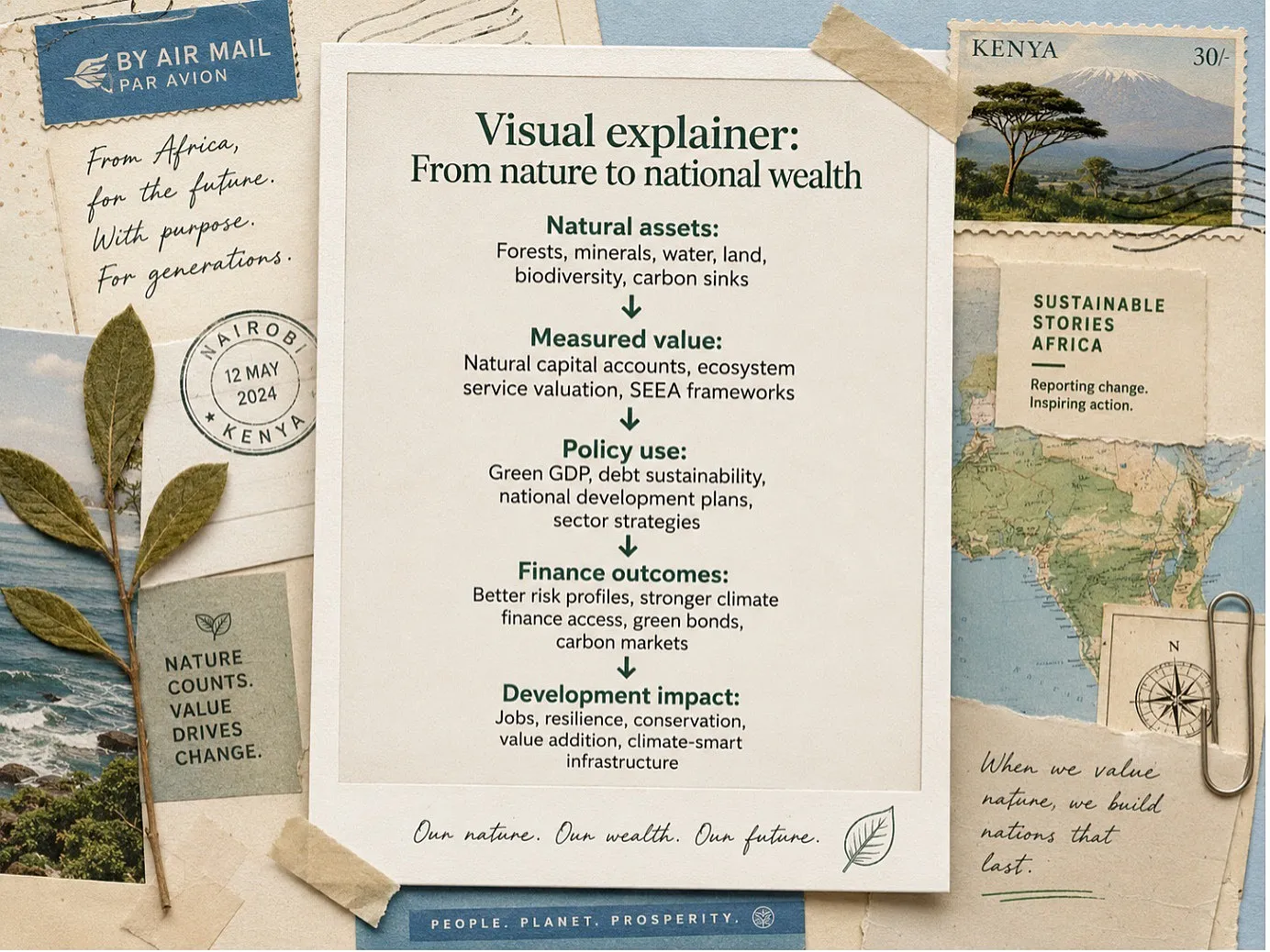
To make this work, governments need dedicated NCA units in national statistical offices and relevant ministries, including finance, environment, climate change and green economy portfolios.
The paper also calls for national steering committees, technical working groups, better data systems, standardised protocols, stronger regional coordination and expanded support for the Africa NCA Community of Practice.
For financiers and credit rating agencies, the shift is equally important. The paper argues that sovereign credit methodologies should reflect natural capital.
African countries should be supported in transforming their credit risk profiles by integrating the true value of their natural assets.
That would not remove fiscal discipline, but it could make debt analysis more complete.
For the AfDB, the paper positions the institution as a continental convener. It highlights initiatives such as Natural Capital for African Development Finance, the Africa NCA Community of Practice, and country-level support in Ethiopia, Botswana and South Africa as part of a broader effort to translate natural wealth into financial capital and sustainable development.
Path Forward – From Green Assets To Better Futures
Africa’s green wealth will not automatically transform economies. It must be measured credibly, protected deliberately and linked to finance, industrial policy and local livelihoods.
The priority now is implementation: update national accounts, build statistical capacity, value ecosystem services, improve carbon market integrity and ensure natural capital supports both debt sustainability and inclusive growth.
Green wealth should become a tool for African development, not another undervalued export.