
Africa’s next development contest may not be over commodities alone. It may be over who can build the systems, skills and infrastructure to turn data and frontier technologies into productivity, jobs and industrial depth.
The central tension is clear: Africa has strategic advantages, from critical minerals to solar potential and a young population; however, much of its data is still stored and monetised elsewhere.
The question now is whether the continent will become a producer of digital value or remain mainly a market for it.
Innovation Needs More Than Adoption
Africa’s 2026 growth debate is shifting from how fast economies can expand to what kind of expansion can endure.
The UN Economic Commission for Africa’s Economic Report on Africa 2026, Chapters 3 and 4, argues that the continent’s long-running pattern of factor-driven growth has not delivered enough structural transformation, and that data and frontier technologies now offer one of the clearest routes to change that trajectory.
The report’s core message is not simply that Africa needs more technology. It is that frontier technologies only become economically transformative when skills, infrastructure, governance and finance match them.
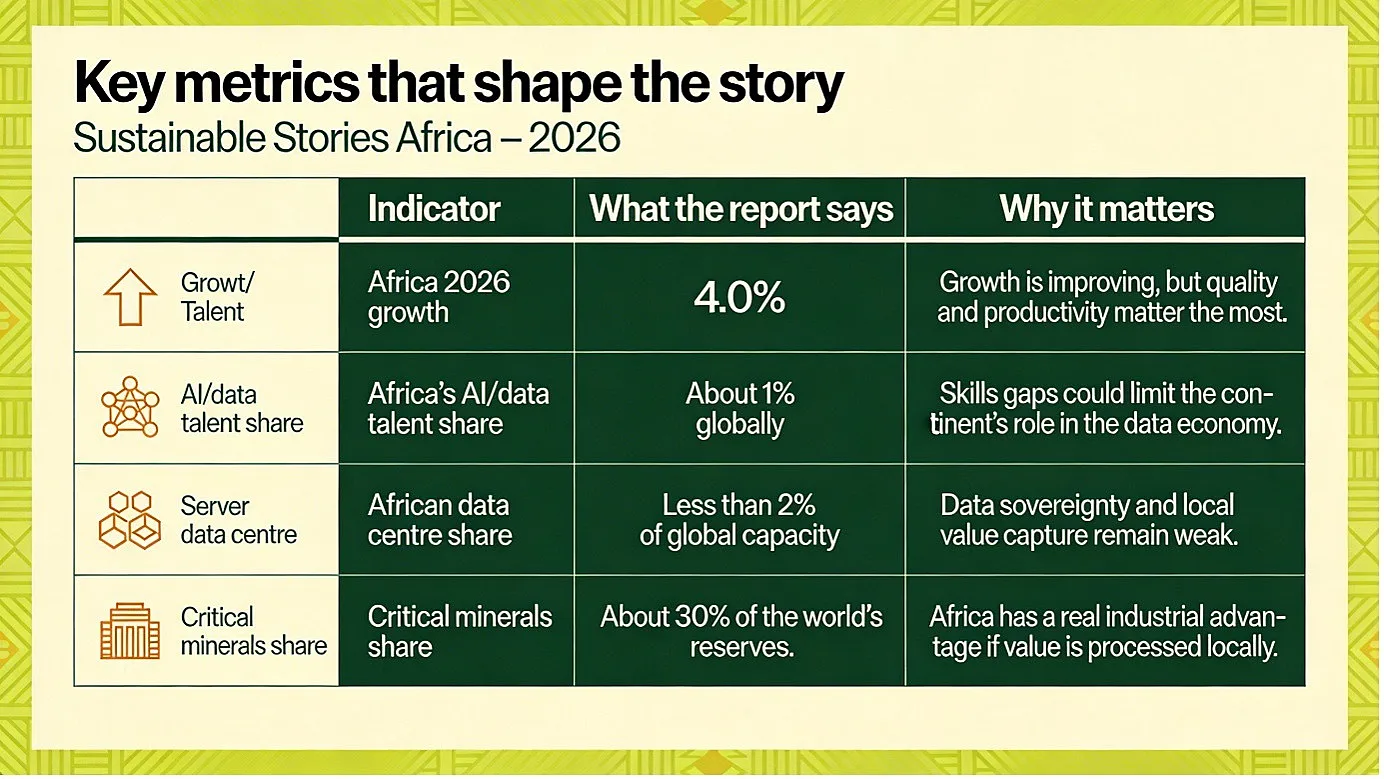
That matters because Africa’s economy is expected to grow by 4.0 per cent in 2026, but the report makes clear that stronger headline growth alone will not solve deep productivity gaps.
Africa’s Digital Advantage Needs Industrial Strategy
The big claim in Chapters 3 and 4 is that frontier technologies and data are no longer side stories in Africa’s development conversation.
They are central to industrial policy, public service delivery and competitiveness. The report says data now functions as a factor of production, comparable in importance to land, labour and capital, while frontier technologies can help countries move up value chains, diversify exports and reduce vulnerability to commodity cycles.
That makes the stakes immediate. Africa holds about 30% of the world’s critical mineral reserves and 60% of its best solar resources, giving it a genuine comparative advantage in the emerging technology economy.
However, the report warns that without deliberate policy action, the continent risks remaining a consumer rather than a producer of digital value.
Africa’s Frontier Tech Gains Real Scale
Chapter 3 shows that Africa’s frontier technology opportunity is no longer theoretical. It is already taking shape across sectors that are directly addressing the continent’s most urgent social and economic gaps.
Artificial intelligence offers the clearest example. Healthcare accounts for 24% of AI startups in Africa, followed by finance at 20%, agriculture at 19% and education at 18%.
That pattern suggests innovation is being directed less toward novelty and more toward solving structural development challenges.
The broader digital stack is also expanding. Between 2023 and 2030, licensed cellular IoT connections in sub-Saharan Africa are projected to rise from 27 million to 51 million, while internet users are expected to increase from 320 million to 527 million.
Over the same period, mobile’s economic impact is forecast to triple from $20 billion to $62 billion. Blockchain is also moving beyond hype into practical use. African blockchain ventures raised $122.5 million across 30 deals in 2024.
The case studies make that shift tangible. Rwanda’s IremboGov platform has processed more than 25 million applications, handled about $300 million in transactions, saved over 100 million working hours and reduced average service delivery time from five days to 24 hours.
Chapter 4 deepens the argument by showing that data is the system behind this transformation.
Africa had 230 data centres as of August 2025, up from 120 in October 2024; however, it remains below 2% of global capacity. South Africa led with 56, followed by Kenya with 20 and Nigeria with 19, showing clear growth but also a major infrastructure gap.
Innovation Drives Resilience, Jobs, and Competitiveness
The report is at its strongest when it shows that this is not only a technology story. It is about resilience, jobs and a story of competitiveness.
Manufacturing, it argues, is the most consistent beneficiary of frontier technologies, while services gain rapidly from digitalisation in telecoms, fintech, logistics and e-commerce.
Agriculture can benefit too, though it needs more climate-smart reform, irrigation and finance to avoid being left behind.
The upside is broader than GDP. Better data systems can improve governance, target public policy more effectively, strengthen transparency and lower transaction costs across trade and service delivery.
The AfCFTA, the report argues, could provide the scale needed to embed innovation in regional value chains.
Africa’s Digital Push Faces Structural Bottlenecks
The report makes clear that Africa’s digital ambitions face deep structural barriers. The continent holds only about 1% of the global AI and data science talent pool.
Foundational education is also weak: just 13 per cent of children can read a simple story by age 10, 15% of upper-secondary students are in technical and vocational training, and tertiary enrolment stands at 9%, compared with 42% globally. These gaps will shape whether technology adoption delivers real transformation.
Infrastructure remains another major constraint. Data centres require reliable electricity, while data costs remain high, with Africa’s average cost per gigabyte 1.3 times the global rate in 2023.
The report urges broader policy action, including governance reform, R&D support, infrastructure investment, financial reform, and human-capital development.
Path Forward – Build Systems Before Scale Arrives
Africa’s technology opportunity is real, but it will not be captured by apps, pilots or slogans alone.
It will be captured by countries that build sovereign data infrastructure, reliable power, skilled workforces and rules that let innovation scale safely.
The report’s message is ultimately pragmatic: growth through innovation is possible, but only if Africa links frontier technologies to industrial policy, regional markets, and public institutions strong enough to turn data into value created at home.