Voluntary carbon and biodiversity markets are growing, but not fast enough to close nature-finance gaps.
The missing ingredients are clearer guidance, stronger integrity and better ways to turn ecological value into investable assets.
A new report suggests high-integrity nature-based credits could attract serious capital, but only if buyers trust the claims, communities share in the value, and governments help build the market architecture.
Nature markets are entering adulthood
A new report, Connecting nature, climate, and capital, makes a pragmatic case for why nature-based credit markets matter now.
Produced by Deloitte New Zealand, The Nature Conservancy and the Bank of New Zealand, it argues that conservation and restoration finance is still falling short, even as ecological decline, climate risk and biodiversity loss intensify.
In that gap, high-integrity nature-based credits are being positioned as one practical route to draw more private capital into measurable environmental outcomes.
The report focuses on New Zealand, but the underlying question is global: how do markets assign value to ecosystem services without sacrificing integrity, fairness or long-term outcomes?
That is especially relevant for Africa, where natural capital underpins agriculture, exports, water systems, tourism, climate resilience and community livelihoods.
Its central message is not that markets will solve everything. Rather, markets are described as one part of the solution, alongside policy, science, community stewardship and public finance.
That balance is important because the credibility of nature finance now depends on whether capital supports real restoration, rather than just better marketing.
Nature Finance Faces Scale And Trust
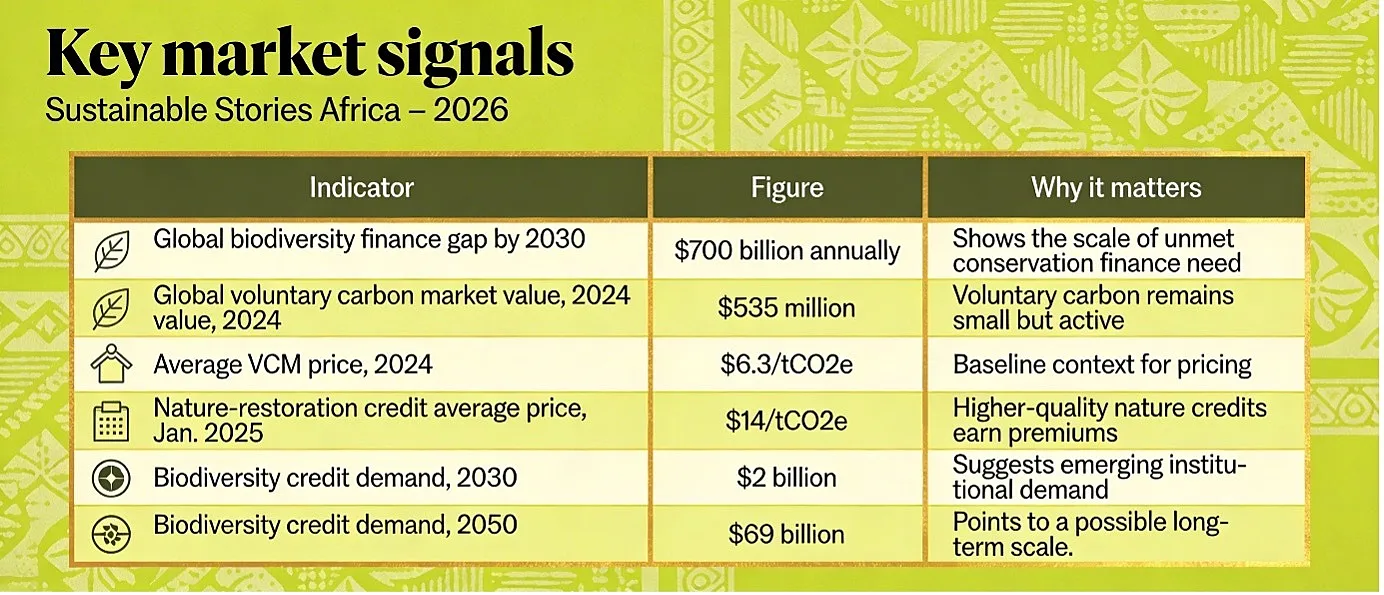
The report’s strongest hook is the scale mismatch. It estimates a global biodiversity finance gap of $700 billion a year by 2030, while current conservation and restoration spending remains below one-third of what is needed.
That gap is becoming more urgent as ecosystems are increasingly recognised as economic assets, not just environmental background.
Against that backdrop, the report says the global primary carbon credit market, including voluntary and compliance credits, could reach $5 billion to $20 billion by 2030, while biodiversity credits could grow to $2 billion.
These remain small relative to the climate and nature challenge, but they show that markets are moving from concept to commercial relevance.
The report also stresses that integrity concerns, fragmented standards, regulatory uncertainty and technical gaps are still undermining investor confidence.
The core constraint is not just limited buyer interest, but weak market capacity to produce credits that buyers can trust.
Nature Markets Reward Quality And Trust
The report divides the emerging market into two related but distinct segments: carbon credits and biodiversity credits. On carbon, voluntary markets remain small beside regulated compliance systems.
In 2024, global voluntary carbon market transactions reached 84.4 MtCO2e, estimated at $535 million, with an average price of $6.3 per tonne.
By contrast, the EU ETS alone recorded 11,148 MtCO2e in transaction volumes estimated at €845 billion. The comparison shows that voluntary carbon markets remain at early stages, despite growing interest.
Within that market, nature-based credits are becoming increasingly important. In the first quarter of 2025, 31.5% of retired carbon-credit volume came from nature-based reductions, while 11.9 per cent came from nature restoration credits, including removals.
Pricing also signals that quality matters. While the average global carbon credit price stood at approximately $3.5 per tCO2e, nature-restoration credits traded at approximately $14 in January 2025, and CCB-certified credits with biodiversity benefits reportedly attracted a premium of about 30%. That suggests buyers are already rewarding credibility and co-benefits.
Biodiversity credits remain even less mature. The report puts total sales between 2022 and 2024 at approximately $325,000 to $1.9 million, though future projections are far larger.
One scenario points to $2 billion in demand by 2030 and $69 billion by 2050, while another sees the broader market rising from $1.42 billion in 2024 to $10 billion by 2033.
A major cross-cutting insight is the role of Indigenous Peoples and Local Communities. The report says strong IPLC involvement improves ecological durability, trust, cultural relevance and buyer appeal, with such projects attracting premiums of 15% to 300%.
Nature Credits Could Finance Real ResilienceTop of Form
The report’s optimistic case is simple: if markets reward integrity properly, nature-based credits could attract more private capital into restoration, conservation and community resilience.
That matters because well-designed credits can support more than carbon or habitat pricing. They can help finance watershed protection, resilient agriculture, forest recovery, species protection and local livelihoods.
The report stresses that the real value lies in co-benefits, including biodiversity, climate resilience, soil stability, social outcomes and cultural value. For many African economies, the broader ecosystem value matters more than tonnes alone.
It also argues that local origin can carry commercial value, as buyers may favour credits that deliver visible impact, reputational gains and supply-chain resilience.
For African businesses, nature credits could increasingly become strategic instruments, rather than just offsets.
Clear Rules Can Scale Nature Markets
The report’s recommendations are practical.
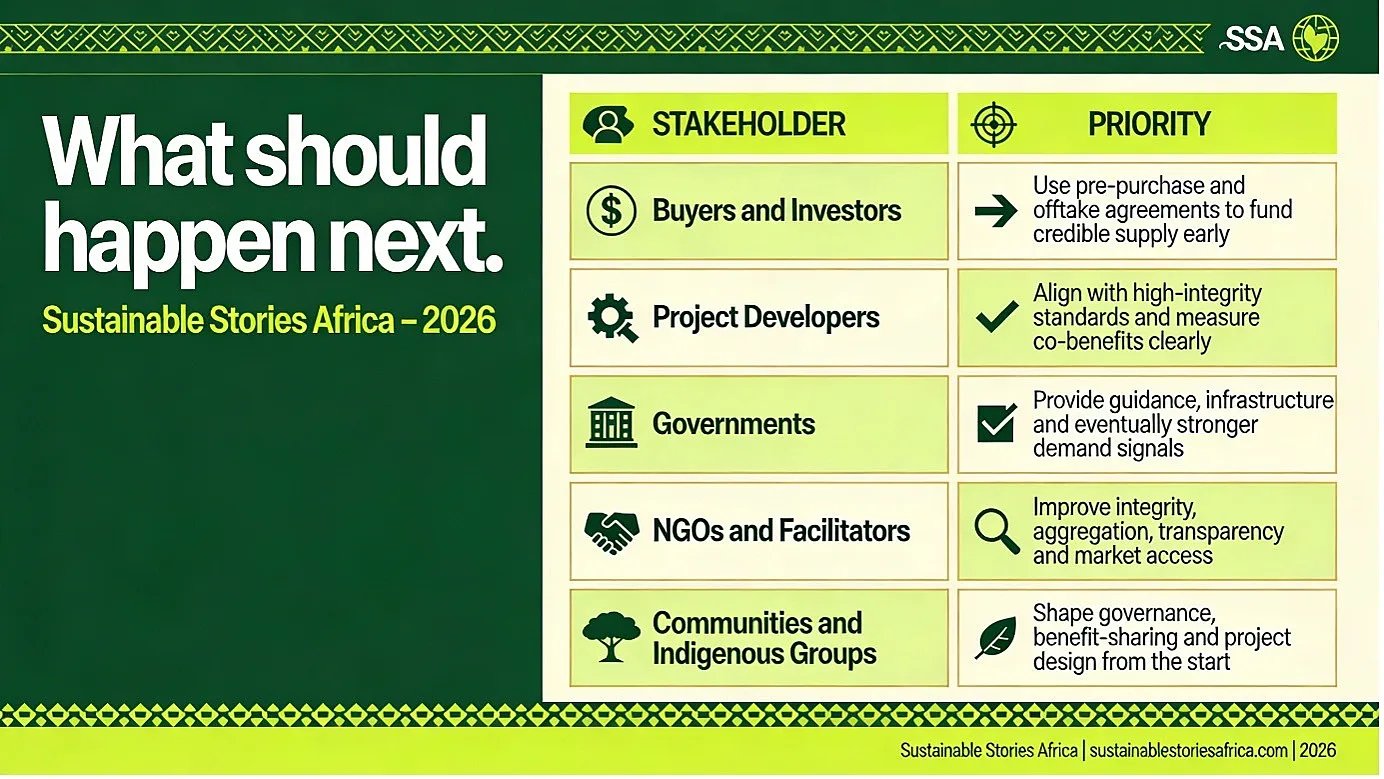
- Buyers and investors are encouraged to provide early financial support through pre-purchase and offtake agreements, giving developers the upfront funding needed to build high-integrity projects.
- Project developers and intermediaries are urged to use internationally recognised standards, quantify co-benefits and ensure equitable benefit-sharing with Indigenous groups and local communities.
- NGOs are asked to push for clearer corporate guidance and integrity alignment, while market facilitators are encouraged to aggregate smaller projects, improve listing access and strengthen data platforms.
- Government, meanwhile, is assigned a market-building role: clearer guidance, seed funding, consistent infrastructure and, over time, the possible expansion of compliance schemes.
The examples cited in the report show what this can look like. The UK’s Biodiversity Net Gain scheme creates guaranteed demand through regulation, while New South Wales uses a market-driven model backed by government purchasing mechanisms.
Both point to the same lesson: nature markets scale faster when standards, registries and demand signals are clear.
Path Forward – Africa’s Nature Markets Need Credible Rules
Nature-based credit markets will not scale on ecological promise alone. They need trust, traceability, equitable governance and clearer rules on how credits fit within climate and nature strategies.
For African markets, the opportunity is substantial: turn natural capital into credible finance without compromising local rights or ecological integrity.
The next phase will depend on building markets that reward real stewardship, not just scarce narratives.