Africa’s oil and gas economy is facing a harder question: has extraction delivered development, or only exported wealth?
A new report by Oil Change International and Power Shift Africa argues that fossil fuels have deepened vulnerability, weakened local economies and left millions without modern energy access.
Oil Wealth Meets Africa’s Development Test
A new May 2026 report, Pipe Dreams: How Oil and Gas Fail to Deliver Economic Development in Africa, has challenged one of the strongest arguments used to defend fossil fuel expansion on the continent: that oil and gas are necessary for African development.
The report, produced by Oil Change International and Power Shift Africa, examines 13 African oil and gas-producing countries and concludes that fossil fuels have not delivered sustained or inclusive growth.
Instead, it says the sector has concentrated wealth, exported profits, weakened other productive sectors and exposed economies to volatile global markets.
For African governments, investors and communities, the findings land at a sensitive moment.
Energy prices, food costs, inflation, debt distress and climate transition risks are converging. The report’s central warning is direct:
Africa cannot build broad-based prosperity on an extractive model that often leaves domestic energy needs unmet.
A Price Shock Exposes Energy Fragility
The report’s most urgent argument starts with today’s energy shock. It says global oil and gas prices have surged in the wake of attacks on Iran and disruption around the Strait of Hormuz, pushing energy, transport and food costs higher across African economies.
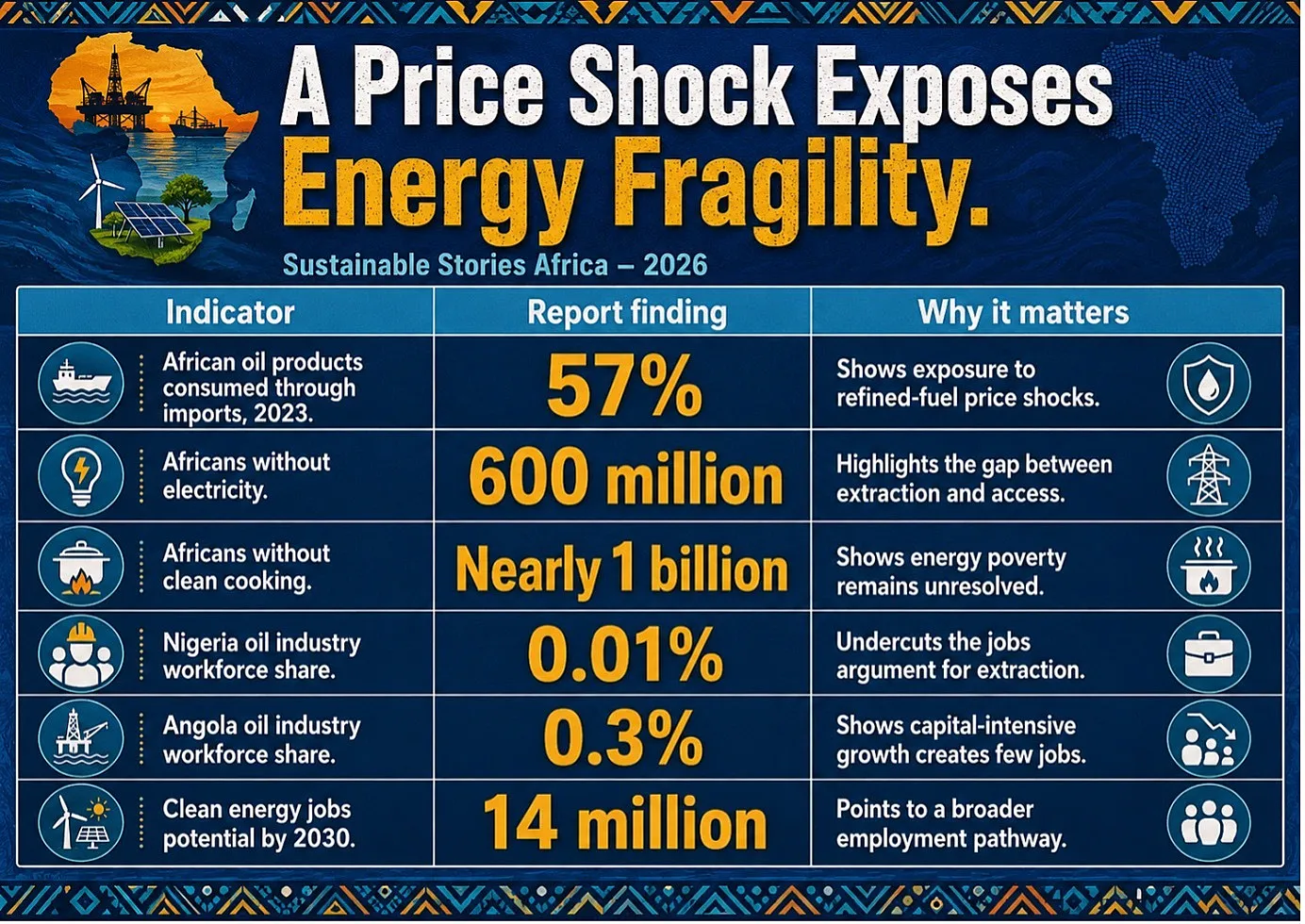
That matters because Africa’s relationship with fossil fuels is more complicated than the phrase “resource-rich continent” suggests. The continent exports crude oil, but its refining capacity remains limited. In 2023, the report says 57% of oil products consumed in Africa were imported, meaning many countries sell crude and buy back more expensive refined fuels such as diesel, gasoline and jet fuel.
Even oil producers are exposed. Angola exported 94 percent of its crude production and imported 72 percent of refined oil products consumed. Nigeria exported 97 percent of crude and imported 99 percent of refined products before the Dangote Refinery opened. South Sudan exported 97 percent of crude and imported 73 percent of refined products.
The lived effect is not abstract. When diesel becomes costlier, food transport becomes costlier. When gas prices rise, fertiliser becomes costlier. When households cannot afford paraffin or liquefied petroleum gas, some return to wood and charcoal, with health and environmental consequences. In this chain, a geopolitical shock becomes a market shock, then a food shock, then a household crisis.
Extraction Has Not Built Broad Prosperity
Africa's oil and gas economy follows five recurring patterns, and none of them favours host communities or long-term development.
The first is revenue extraction.
- Although contracts promise government revenues through taxes and foreign exchange, bargaining asymmetries and accounting practices frequently allow multinational companies to capture a disproportionate share.
- Mozambique's Coral South gas project illustrates the point sharply: production began in 2022; however, significant government revenues are not expected until the mid- or late-2030s, with early proceeds flowing largely to Eni and its partners.
The second pattern is the enclave economy.
- Oil and gas projects import services, technology and expertise while exporting finished commodities through dedicated infrastructure, generating large export figures without deepening domestic industrial capacity.
- The employment data make this visible: oil and gas extraction employs just 0.01% of Nigeria's workforce, 0.3% in Angola and 0.1% in Congo-Brazzaville, despite the sector's outsized role in government revenue.
The third pattern is economic weakening.
- In Nigeria's Niger Delta, spills, gas flaring and land damage have eroded agricultural and fishing livelihoods.
- At the national level, Dutch disease dynamics, where oil inflows strengthen the currency and suppress competitiveness, transformed Nigeria from a major agricultural exporter into a net food importer by the 1970s.
Fossil Revenues Carry Transition Risks
The risks are not simply historical: they are intensifying as the global energy transition accelerates.
Most forecasts cited in the report project oil demand peaking around 2030, with gas likely to follow.
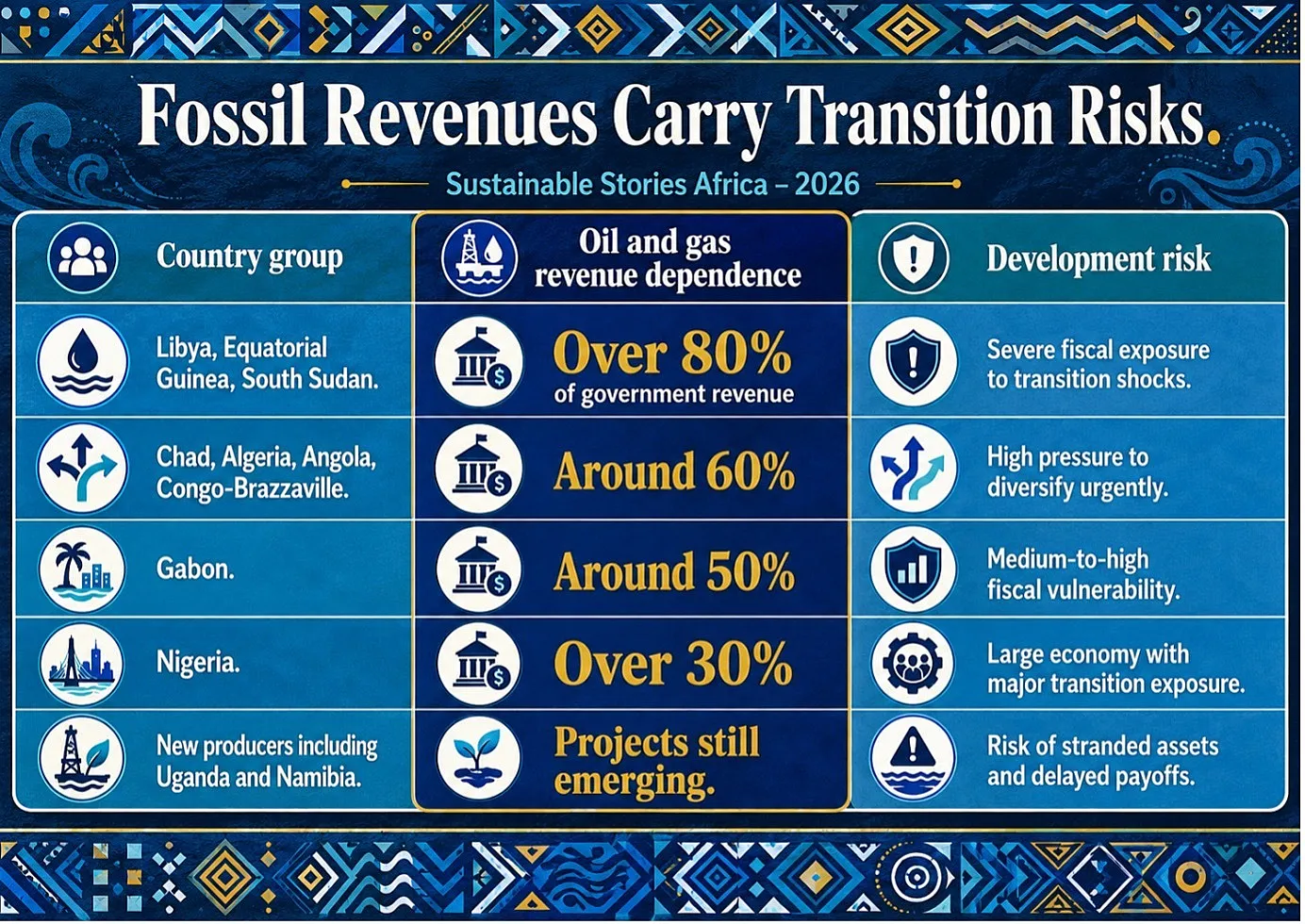
For emerging producers, such as Uganda, Mozambique, Namibia, Tanzania, the DRC and Côte d'Ivoire, the timing risk is acute: projects under development may arrive in markets already retreating from fossil fuels, leaving countries with stranded assets, weakened revenues and rising debt.
Existing producers face a parallel threat through fiscal dependence. Oil and gas account for over 80% of government revenues in Libya, Equatorial Guinea and South Sudan; approximately 60% in Chad, Algeria, Angola and Congo-Brazzaville; 50% in Gabon; and over 30% in Nigeria.
The report's conclusion is unambiguous: diversification is urgent, not optional.
Economic transformation takes decades, and the window to act remains open, but not indefinitely.
Renewables Offer A More Inclusive Route
The report's alternative is not simply less oil; it is a fundamentally different development model.
Renewable energy, it argues, can be deployed closer to communities, generate more jobs than fossil fuels and support local economic activity.
Decentralised solar, wind and mini-grid systems can reach rural and peri-urban populations faster than export pipelines or LNG terminals ever could.
The contrast is stark. Africa has approximately 600 million people without electricity, and nearly one billion without access to clean cooking. However, gas production in Nigeria, Mozambique and Equatorial Guinea is structured primarily around export markets.
Mozambique exported 90% of its gas in 2023, while 64% of its population lacked electricity, and 93% lacked access to clean cooking.
A renewable-led pathway shifts energy economics from extraction to productivity, powering irrigation, cold storage, clinics and small businesses while creating an estimated 14 million jobs by 2030, with renewables generating two to three times more jobs per dollar than fossil fuels.
Policy Must Shift From Export To Access
The action agenda is direct. African governments must stop treating fossil fuel extraction as a guaranteed development pathway and test every energy policy against three questions: does it expand access, build domestic productive capacity and reduce vulnerability?
- Projects exporting crude or LNG while local communities remain energy-poor deserve tougher scrutiny.
- Finance ministries need stronger contract, tax and transparency capacity to prevent resource wealth from exiting before it builds domestic resilience.
- Development finance institutions should prioritise renewable infrastructure, grid modernisation, storage, mini-grids and clean cooking, investments that serve both climate and economic stability objectives.
Most urgently, oil-dependent countries need credible diversification plans now, including agriculture, manufacturing, governance of critical minerals, green industrialisation and regional energy markets.
Waiting until export revenues decline will only make the transition more costly and more painful.
Path Forward – Build Sovereignty Through Clean Energy Systems
Africa’s development challenge is not whether it has oil and gas, but whether energy systems serve people, productivity and resilience.
The path forward is to shift from export-led extraction to people-centred energy access, stronger institutions, renewable industrialisation and fiscal diversification.
That is how African markets can turn energy transition from a threat into an economic sovereignty strategy.