Africa could produce 57% more electricity in 2030 than it did in 2023, supported by hundreds of planned and under-construction power plants. The expansion could improve access, industrial productivity and economic resilience.
But the emerging power system remains fossil-fuel-heavy and increasingly water-intensive. The central question is no longer whether Africa should generate more electricity, but whether it can do so without deepening carbon exposure, water insecurity and geographic inequality.
Africa’s Power Future Arrives With Trade-offs
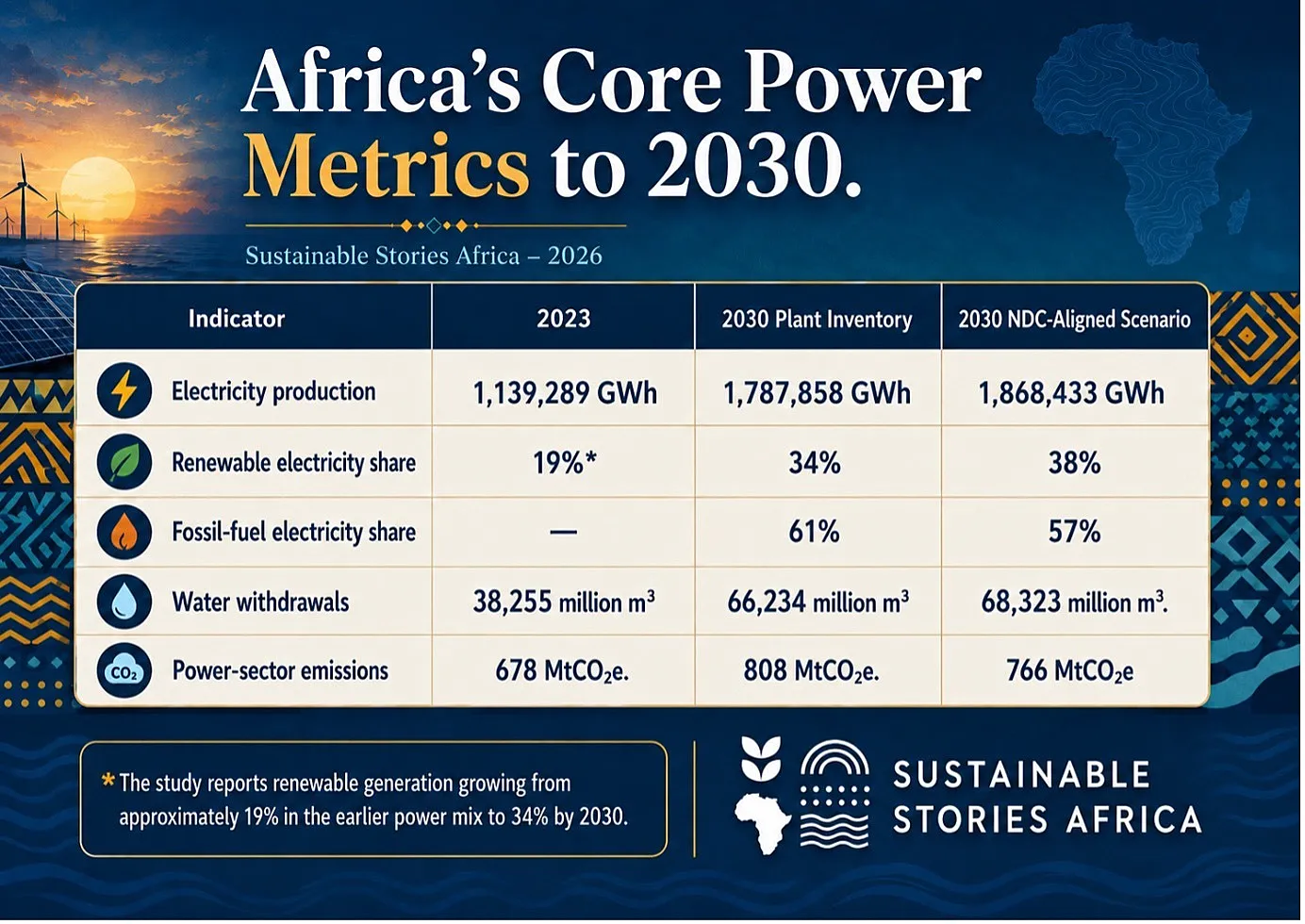
Africa is preparing for one of the largest expansions of electricity production in its modern history. A new continent-wide assessment forecasts generation rising from 1.139 million gigawatt-hours in 2023 to almost 1.788 million GWh by 2030—a 57% increase in seven years.
The expansion matters because only about 57% of Africa’s population currently has access to electricity. Reliable power is also essential for hospitals, schools, data centres, transport systems, manufacturing plants, mines and the small businesses that provide most of the continent’s employment.
Yet the projected increase carries an environmental price. By 2030, electricity-related water withdrawals could rise by 73%, while carbon emissions from power production could increase by 19%. Africa may therefore generate significantly more power while becoming more exposed to drought, river-basin competition and fossil-fuel transition risks.
A 57% Surge Rewrites Africa’s Power Outlook
A new forecast, drawn from a detailed inventory of 3,139 operational, planned and under-construction African power plants, offers a more granular alternative to statistical modelling.
Researchers identified 605 new plants expected online by 2030, geolocating 551 to map the generation that relates to water availability and emissions.
The findings show Africa is building capacity faster than historical trends suggest. Conventional models projected 2030 output at 1.155 – 1.414 million GWh, well below the inventory-based forecast of 1.788 million GWh.
However, this still trails the 1.868 million GWh implied by national climate commitments, a gap of roughly 80,575 GWh, signalling that policy ambition continues to outpace financed, constructed capacity.
As an article-in-press manuscript, the study had not completed final editorial review at release, and its forecast assumes timely project completion despite common delays due to financing gaps, conflict and currency instability.
The New Capacity Map Remains Deeply Uneven
Africa's headline growth conceals deep fragmentation. South Africa, Egypt and Algeria currently generate roughly 60% of the continent's electricity, and a handful of large projects will continue shaping outcomes through 2030.
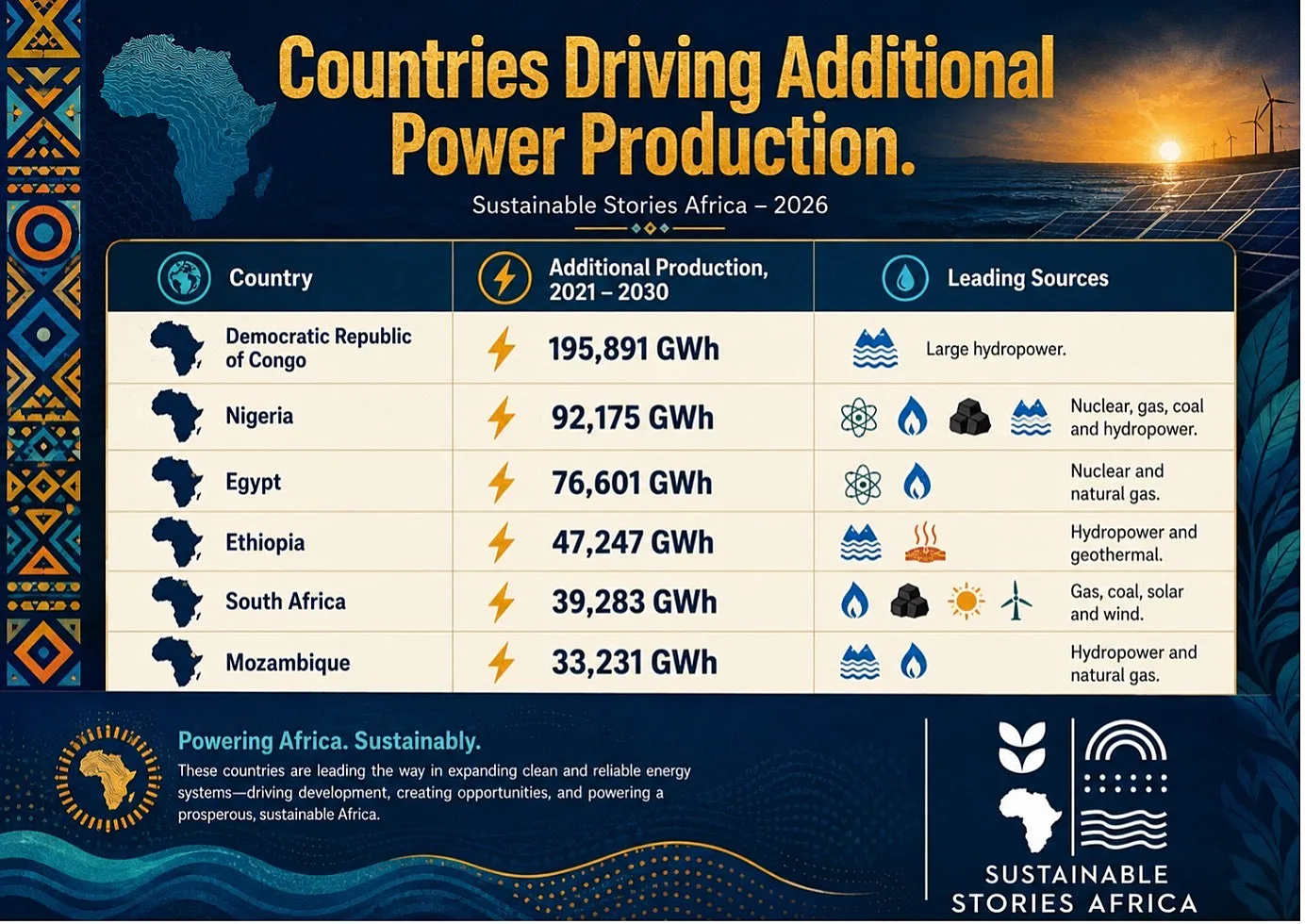
- The DRC leads projected additions with almost 195,900 GWh, largely from the Grand Inga and Inga III hydropower schemes
- Nigeria follows with 92,200 GWh across nuclear, gas, coal and hydro projects.
- Egypt adds 76,600 GWh, driven by the Dabaa nuclear plant and new gas facilities.
Relative growth is starker elsewhere: South Sudan (7,443%), the DRC (2,941%), Namibia (1,905%), Zimbabwe (328%) and Ethiopia (247%).
However, several countries remain untouched. Somalia's output rises just 6%, matching its dismal access rate.
Eritrea and Guinea-Bissau have no new plants recorded despite minimal electrification.
This marks the forecast's human dividing line: continental growth won't automatically reach unelectrified households or struggling markets.
Cleaner Growth Could Deliver Broader Development Dividends
Renewables are gaining ground, with their projected share rising to 34% under the plant inventory and 38% under the NDC-aligned scenario.
However, the energy mix matters: hydropower dominates expected expansion, generating an estimated 517,501 GWh by 2030, while solar and wind lag at just 24,570 GWh and 30,685 GWh, respectively.
Under the more ambitious NDC scenario, solar and wind surge to 179,645 GWh and 109,627 GWh.
This gap represents one of Africa's largest near-term opportunities.
- Solar and wind require less water and deploy faster, roughly one year for wind and two for solar, against ten years for major hydropower and seven for nuclear.
- Faster renewable rollout could narrow the gap between current construction and national commitments, ease pressure on delayed megaprojects, and extend power to communities beyond transmission networks.
A diversified system, such as blending of solar, wind, geothermal, hydropower, storage and regional trade, would also strengthen grid resilience against fuel-price shocks and drought.
Rising Water Demand Challenges Low-Carbon Assumptions
Hydropower may be low-carbon, but it isn't impact-free. Electricity-sector water withdrawals are projected to rise from 38.3 billion cubic metres in 2023 to 66.2 billion cubic metres by 2030, driven largely by hydropower's intensity, roughly 105 cubic metres per megawatt-hour, compared with 14.3 for natural gas and far less for wind and solar.
Pressure is mounting across major river basins: withdrawals could reach nearly 50% of available water resources in the Volta Basin, 14.5% in the Zambezi, 6.8% in the Niger, 6.5% in the Nile and 3.4% in the Congo.
These rivers also sustain agriculture, fisheries, households, ecosystems and cross-border livelihoods, meaning a "low-carbon" project can still carry significant social and ecological risks.
Southern Africa has already felt this danger: drought at the Kariba reservoir triggered severe shortages in Zambia, showing how hydropower dependence can turn climate volatility directly into blackouts and hardship.
What Governments, Investors and Utilities Must Do
Africa's energy transition demands coordinated, multi-dimensional action rather than a singular focus on megawatts:
- Assess every major project against output, carbon intensity, water use, drought exposure, biodiversity impact and community consequences—not electricity alone.
- Coordinate national power strategies across energy, water, agriculture, environment, industry and finance ministries, since siloed decisions can undermine shared resources like river basins.
- Accelerate solar, wind, geothermal and battery storage to diversify hydropower-dependent grids, cut emissions and reach underserved communities faster than traditional megaprojects allow.
- Distinguish announced capacity from executable capacity by demanding bankable procurement, creditworthy off-takers, transparent tariffs, currency-risk mitigation and reliable transmission links.
- Transform regional power pools into functioning infrastructure, enabling cross-border trade so surplus-producing nations can support neighbours facing drought or plant failures.
- Publish higher-quality plant, emissions and water-use data, building on the study's open-access inventory model.
The forecast itself carries real uncertainty. Modelling delays to major hydropower and nuclear projects dropped 2030 output to roughly 1.505 million GWh, 16% below the principal forecast, though still above historical-trend projections, underscoring how few megaprojects can sway continental outcomes.
The Path Forward Demands Integrated Power
Africa must expand electricity production, but the strongest pathway is not simply more capacity.
It is a diversified, distributed and investable power system that measures carbon, water, resilience and social access together.
Governments, utilities and financiers should prioritise faster deployment of solar and wind, storage, regional power trade, transparent project data and coordinated river-basin governance.
By doing so, Africa can turn its power surge into wider development without transferring today’s electricity deficit into tomorrow’s climate and water crisis.