
US venture capital set eye-catching records in the first half of 2026, but the recovery remains unusually narrow.
PitchBook and NVCA data show that AI, billion-dollar rounds and established fund managers are absorbing most of the capital, leaving smaller companies and emerging managers to navigate a market where headline value and broad liquidity tell different stories.
Record Capital, Narrower Access, Harder Questions
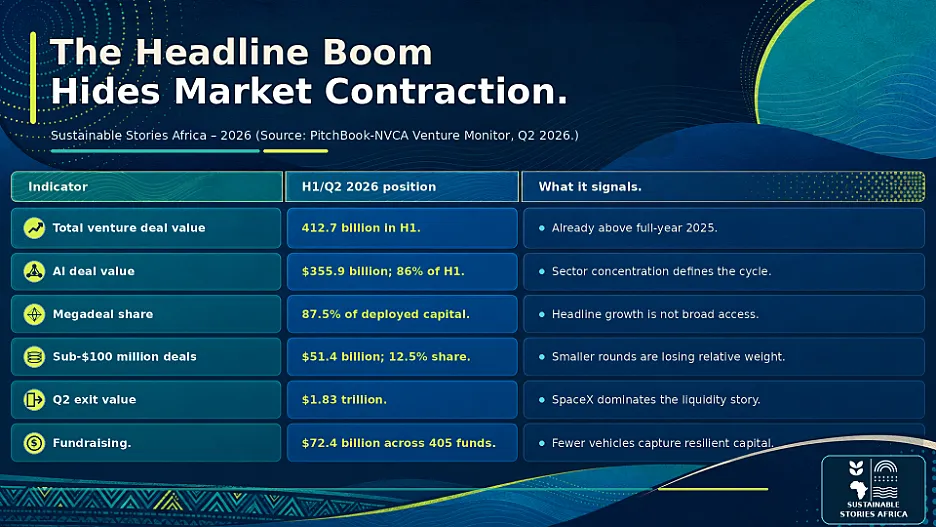
The US venture market deployed $412.7 billion in the first half of 2026, nearly 30% above the amount invested in all of 2025.
On the surface, the figures describe a powerful rebound. Beneath them, the PitchBook-NVCA Venture Monitor shows a market becoming more concentrated by sector, deal size, geography and manager reputation.
- Megadeals of $100 million or more represented 87.5% of capital deployed.
- Artificial intelligence companies captured $355.9 billion, or 86% of total deal value.
- Seven Q2 rounds worth at least $1 billion accounted for $87.2 billion, led by Anthropic's $65 billion financing.
For African founders, fund managers and policymakers, the report is less a direct measure of local venture conditions than a signal about the global price of attention.
When the world's deepest venture market directs most new money toward a handful of AI leaders, capital elsewhere becomes more selective, proof thresholds rise, and the distinction between a technology story and a durable business model becomes more important.
The Headline Boom Hides Market Contraction
PitchBook's data show the power law of venture capital at its most extreme.
- Deals below $100 million attracted $51.4 billion in H1, which is 12.5% of total value.
- That share has fallen from 43.8% in 2024 and 33.1% in 2025.
- A record aggregate is therefore coexisting with a far tighter market for ordinary rounds.
Liquidity is similarly deceptive.
- SpaceX's $1.7 trillion IPO drove Q2 exit value to $1.83 trillion.
- While its earlier $250 billion acquisition of xAI also transformed the year's totals.
However, the report cautions that a few large exits do not amount to a broadly reopened market.
Many funds have no exposure to those companies, and distributions remain constrained for the wider ecosystem.
The gap between private paper value and realised cash continues to matter.
- Active US unicorns reached a record 945 in Q2 with an aggregate value of $5.3 trillion.
If public markets do not validate private valuations across a wider range of companies, many investors may still face delayed or reduced exits despite the spectacular performance of a few names.
AI Rewrites Valuations, Geography and Risk
AI is no longer just the leading vertical; it is redefining valuation benchmarks across every funding stage.
Median pre-money valuations now exceed 2021 highs across all series, with pre-seed, seed and Series D+ more than doubling.
Anthropic's latest round illustrates this acceleration, its pre-money valuation jumping from $350 billion to $900 billion in three months (a 157.1% rise), pushing its post-money value to $965 billion.
- This surge reflects genuine demand for compute and infrastructure but also concentrates risk.
- Not every investor pays the headline price, and if revenue fails to match valuations, down rounds and weaker returns become likely.
Geography compounds the imbalance.
Talent and capital remain concentrated on the US West Coast; however, PitchBook estimates 5,674 first-time financings in H1, putting 2026 on track to record over 10,000 companies raising initial rounds. The pipeline is broad; the capital pool is not.
Fundraising confirms this: US venture funds raised $72.4 billion across 405 vehicles in H1, with experienced firms capturing 89% of all capital.
Liquidity Could Restart the Venture Flywheel
A broader reopening of exits would change the market's internal economics.
When shares can be sold, and cash returned to limited partners, investors can recycle capital into new funds and managers can support the next generation of companies.
Public listings also improve price discovery, giving private investors better comparables and clearer evidence about which growth models the market will reward.
OpenAI and Anthropic have confidentially filed for IPOs, according to the monitor.
- If those listings perform well and are followed by midsize technology and healthcare exits, liquidity could extend beyond the cap tables of a few mega-unicorns.
- The benefit would be less about matching SpaceX's scale than restoring a repeatable path from private financing to realised returns.
For African ecosystems, broader global liquidity can support international allocations, diaspora investment and specialist funds.
However, the more durable opportunity lies in attracting capital to businesses with measurable revenues, defensible distribution and solutions to infrastructure or public-service gaps, rather than competing directly for the most expensive frontier AI narrative.
African Founders Need a Different Playbook
Founders should plan for a selective capital market.
- That means raising against clear milestones, extending runway, separating AI-enabled efficiency from AI branding, and showing how products solve a local problem at a price customers can sustain.
- Governance, unit economics and credible reporting become more valuable when investors can choose among many companies.
African fund managers can reduce dependence on a single external cycle by diversifying limited-partner bases, developing local institutional participation and designing smaller, stage-appropriate vehicles.
Governments can help by improving pension-fund rules, exit infrastructure, data availability and cross-border investment frameworks rather than attempting to replicate US megafunds.
Investors should test concentration explicitly: exposure by model provider, cloud platform, geography, customer segment and follow-on capital need.
They should also distinguish the full headline size of a tranched financing from genuinely new cash. A market with record values can still punish weak diligence.
Path Forward – Build Resilience Beyond Megadeal Headlines
The next test is whether blockbuster AI listings produce broad, repeatable liquidity or simply reinforce concentration at the top.
African founders and investors should read the US record as a discipline signal: build durable revenues, preserve runway and expand local pools of capital. The strongest ecosystems will benefit from global innovation without becoming hostage to one theme, one geography or one exit window.
Primary source: PitchBook and National Venture Capital Association, PitchBook-NVCA Venture Monitor, Q2 2026.