Airport concession agreements quietly determine what passengers can buy, what they pay and how much non-aeronautical revenue an airport earns.
As aviation prepares for long-term traffic growth, an ACI guide argues that the strongest contracts must balance financial returns with service, resilience, data transparency and ESG performance—not simply reward the highest guaranteed rent.
The Contracts Behind Every Airport Journey
Every airport purchase, from bottled water before boarding to parking after arrival, is shaped by a contract most travellers will never see.
Those agreements determine who operates, what gets invested, how prices are controlled, when outlets open and which party absorbs losses when passenger traffic collapses.
The Airports Council International report, Concession Agreements: Guide for Airport Managers and Commercial Operators (2023), developed through its Airport’s Non-Aeronautical Revenue and Activities Committee, sets out how airports can design requests for proposals, allocate risk, select business models and standardise performance data.
The working group included airport and commercial specialists from multiple regions, including Ekelem Kenneth Airhihen of Nigeria’s Federal Airports Authority.
Its relevance for African and emerging-market airports is immediate. Where public budgets and aeronautical charges are constrained, commercial income can support airport operations and investment.
However, a concession designed alone to maximise rent can produce higher prices, weaker service, underinvestment and contract failure, the opposite of sustainable value.
Two Numbers Define Aviation’s Commercial Challenge
Passenger movements were forecast to double their 2019 level by 2040, with airports requiring an additional $2.4 trillion in capital expenditure over the same period, per ACI projections.
Meeting that demand requires more terminals, equipment and services, alongside commercial agreements capable of operating amid expansion and disruption.
Airports carry expensive, high-fixed-cost structures. Even when passenger volumes fall, security, maintenance, cleaning, personnel and financing obligations persist, while concessionaires face their own fixed costs in fit-out, inventory, staffing and rent.
The tension is structural: airports want predictable income, while operators need flexibility to survive demand shocks and keep investing.
The traditional solution, a minimum annual guarantee (MAG), often paired with a sales percentage, gives airports a revenue floor while pushing operators to outperform it.
However, when bidders overstate what they can pay to win tenders, the guarantee becomes a trap: resources shift from staff and service into rent, forcing renegotiations and sometimes operator failure.
The pandemic exposed this weakness starkly. The guide recommends contract-adjustment mechanisms for hardship events rather than improvised crisis negotiations; risk transfer shouldn't leave one party unable to deliver.
Contract Design Determines Passenger Experience
The guide proposes a tender structure that doesn't treat the highest payment as the best bid.
In its illustrative 100-point evaluation, marketing and the ten-year financial projection each receive 20 points; customer service, 15; operations, investment and the guarantee, 10 apiece; and qualifications, financial capacity and ESG, 5 each.
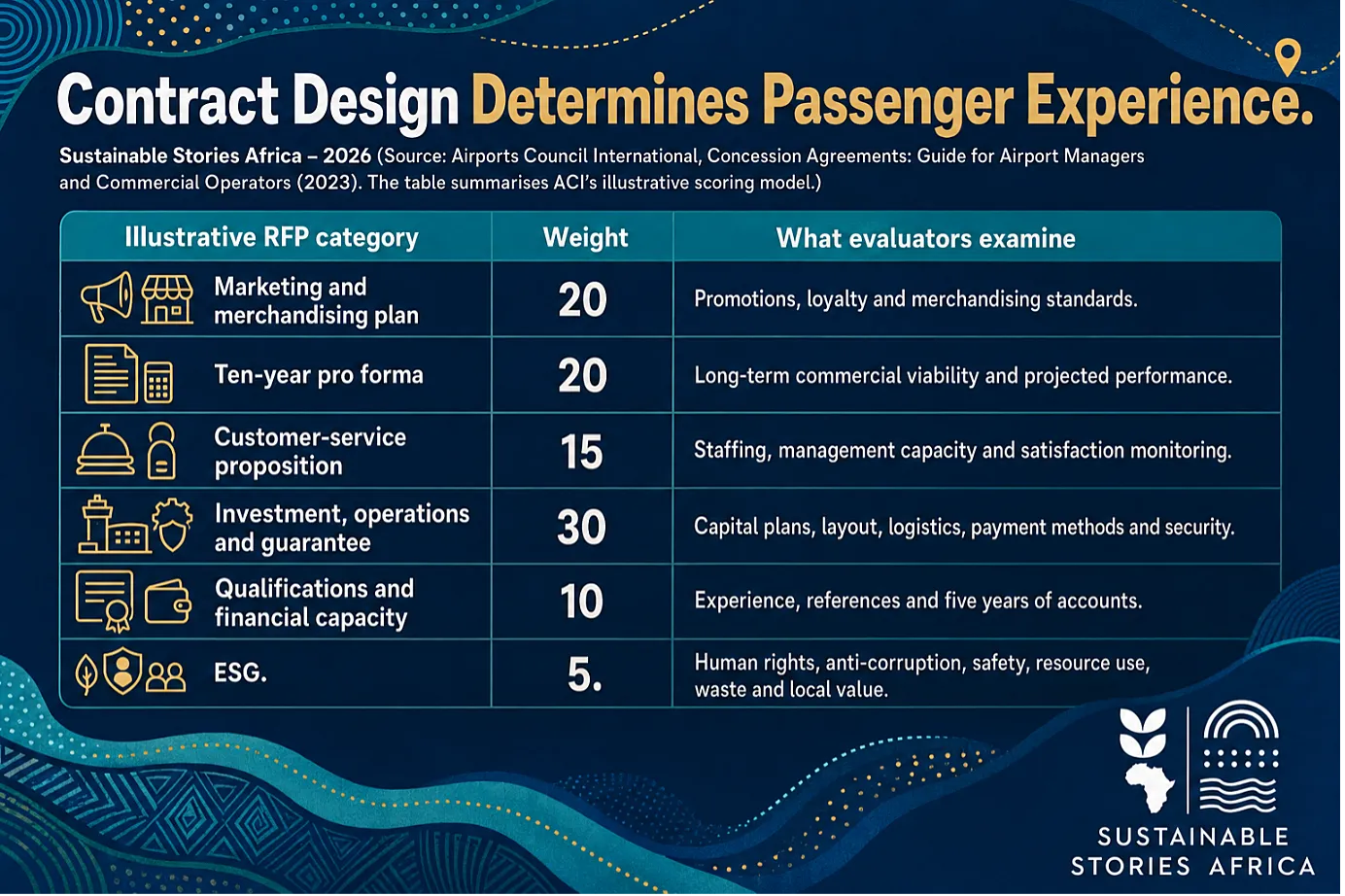
That five-point ESG allocation is a useful baseline but shouldn't become a ceiling.
For airports exposed to heat, flooding, energy constraints and social scrutiny, environmental and governance performance is commercially material; waste costs money, inefficient equipment raises utility bills, and weak labour practices disrupt service, while excluding local businesses can undercut community legitimacy and traveller appeal.
Contract form shifts responsibility too. Single-unit concessions create competition but add complexity; bundles support scale; master concessions simplify oversight while concentrating risk; joint ventures align incentives but demand stronger governance; supply contracts give airports more control at higher cost.
Revenue mechanisms add further nuance:
- Fixed rent is predictable but brittle
- Revenue sharing increases volatility
- Hybrids blend both
- Profit-sharing requires open-book trust.
For passengers, these aren't abstractions: they determine whether cafés open on time, shelves stay stocked, and prices, typically capped at 10% - 15% above off-airport rates, feel fair rather than exploitative.
Better Partnerships Can Unlock Shared Value
A well-designed concession can create a reinforcing cycle: operators gain enough time and commercial certainty to recover investment, airports receive dependable non-aeronautical income, passengers get better service and choice, and local economies gain employment and market access.
The term must be long enough for operators to recover costs and earn realistic returns during the period, while renewal, relocation and break clauses preserve the airport's ability to adapt, and construction schedules must clearly allocate responsibilities for utilities, safety and disruption.
Performance improves when both sides share the same data language. ACI recommends common definitions for conversion (transactions divided by total passengers), spend per passenger (net sales divided by total passengers) and average transaction value, without which airports and operators can dispute rent and performance using mismatched figures.
Regular reporting converts data into accountability, with weekly sales flagging problems quickly and monthly reports supporting billing reviews alongside service-level indicators such as satisfaction, energy use and local supplier participation.
For African airports, the opportunity lies in turning concessions into local development platforms, showcasing cities through credible local partnerships rather than generic imported-brand corridors.
Rewrite Tender Rules Around Resilience
Airport owners and regulators should begin with transparent, balanced procurement.
- Financial offers must be stress-tested against realistic traffic and operating costs, with evaluation panels weighting service, investment, innovation and ESG so an unsustainable MAG cannot overwhelm a stronger overall proposal.
Second, contracts should contain pre-agreed hardship triggers.
- Passenger volumes, terminal closures or disruption thresholds can activate temporary rent adjustments or variable MAGs, sharing pain without shifting every downside risk to the airport, and restoring normal terms once conditions recover.
Third, airport managers must specify measurable obligations:
- Pricing rules, flight-linked opening hours, reporting frequency, audit access, construction responsibilities and default remedies, alongside ESG schedules covering energy and water efficiency, labour protections, anti-corruption controls, accessibility and local employment.
Fourth, model choice must reflect institutional capacity and local law.
- Smaller airports may gain efficiency from master concessions but need safeguards against operator dependence, while larger airports can sustain competition through bundles or single-unit tenders.
Governments should publish award criteria transparently, enabling regulators and passenger groups to assess affordability and long-term value.
Path Forward – Contracts Built For Shared Resilience
African airports should treat concessions as long-term service partnerships, not auctions for the highest rent.
Balanced scoring, realistic guarantees, hardship clauses, common data definitions and enforceable ESG standards can protect revenue while improving passenger experience and local economic participation.
The next test is implementation. Airport authorities must match commercial ambition with transparent procurement, contract management and public reporting.
When risk, reward and responsibility are shared credibly, airport growth can finance better services without leaving passengers, workers or local businesses behind.