
CMS Consequence Metrics proposes five lenses for judging African progress: value retention, knowledge transfer, custodianship, consequence literacy and civic agency.
The framework addresses real gaps in GDP and ESG; however, its credibility will depend on transparent formulas, reliable data, independent governance and public pilots that turn compelling questions into comparable evidence.
Growth Figures Miss What Citizens Experience
An economy can grow while households struggle, natural assets decline, and profits leave the country.
It can attract foreign investment without transferring technology, or announce ambitious policies without building the institutions needed to deliver them.
GDP records economic activity; it was never designed to answer every question about wellbeing, distribution or resilience.
CMS Consequence Metrics, or CCM, enters that gap as an African-authored proposal. Developed by Albert K. Owusu within the Consequential Management System, it asks what remains after growth, what capabilities are transferred, whether leaders act as custodians, whether decisions anticipate long-term effects, and whether citizens exercise agency beyond elections.
The idea arrives within a wider movement.
- The United Nations has called for a dashboard that values people, the planet and the future.
- Agenda 2063 defines African prosperity through inclusive growth, wellbeing, good governance and citizen-driven development.
CCM's opportunity is to make those ambitions more operationally African and more visible in everyday accountability.
Output Alone Cannot Measure Shared Progress
GDP remains indispensable for measuring production and comparing economic activity. Its weakness begins when it is treated as a complete verdict on progress.
- Pollution clean-up can raise output after environmental damage
- Extractive production can expand while resource wealth is depleted
- Investment inflows can look impressive even when profits, expertise and strategic control remain offshore.
The original CCM article responds with a direct proposition:
- Africa should judge progress by "what remains, what is transferred, and what is transformed."
It presents the framework as a complement to GDP and ESG, not a replacement.
That distinction is important because a national accounts measure, a sustainability reporting system and a governance dashboard perform different jobs.
CCM is also explicitly proposed rather than established.
It is not yet a recognised statistical standard, a validated index or a cross-country ranking.
Its five dimensions are best understood as a research and governance agenda that must now move from persuasive concepts to definitions capable of surviving audit, comparison and political disagreement.
CM Adds Five Consequence-Focused Questions To Growth
This section outlines a proposed measurement framework designed to shift development assessment from inflow size to lived, retained impact.
- The Value Retention Index would track how much locally generated value remains in an economy after profit repatriation and other leakages
- The Knowledge Transfer Score would assess whether investment builds local skills, technology and institutional capacity, together redirecting focus toward domestic productive capability rather than headline figures.
Three further metrics extend this lens:
- The Custodianship Quotient examines whether leadership serves collective and intergenerational interests.
- The Consequence Literacy Index asks whether policies anticipate social, economic, ecological and diaspora effects.
- The Civic Agency Metric looks beyond voter turnout to citizens' ability to access information, audit decisions and enforce accountability between elections.
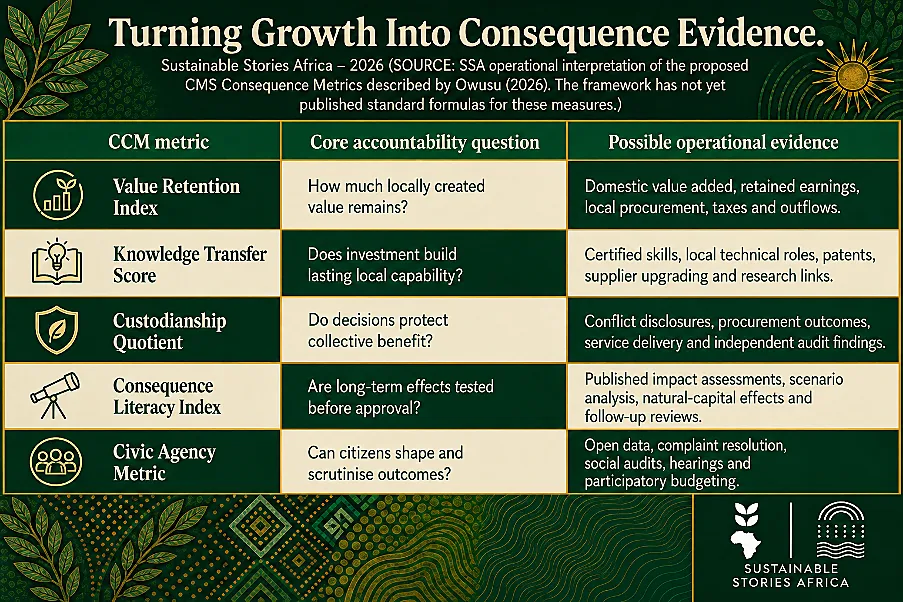
Rather than replacing existing systems, the World Bank wealth accounting, the UN SDGs, or Agenda 2063, this Citizen-Centred Measurement (CCM) approach adds a sharper political-economy lens on retention, reciprocity and capability-building.
It does not claim citizens are absent from ESG frameworks, since many standards already address communities and workers; instead, it tests whether disclosure and investment translate into consequences people can genuinely observe.
Better Metrics Could Change Investment Incentives
Measurement affects negotiation.
- If governments publish only project value and capital inflows, officials are rewarded for signing deals.
- If they also publish domestic value added, skills transfer, supplier development, environmental restoration and grievance outcomes, the definition of success changes.
Contracts can be designed around benefits that endure after incentives expire.
For investors;
- A credible CCM dashboard could reduce political and social risk by showing whether projects are building local legitimacy.
For citizens;
- It could connect national statistics with concrete questions: were local engineers trained, did suppliers upgrade, did public revenue fund services, were damaged ecosystems restored, and could communities challenge failures?
The framework could be piloted in sectors where the retention question is visible:
- Mining in Ghana, oil and gas in Nigeria, and digital investment in Kenya.
These examples should not become predetermined verdicts.
- A pilot must allow evidence to show strong as well as weak performance and should compare projects within sectors before attempting continental league tables.
Turn A Concept Into Auditable Measurement
The first requirement is a public technical manual.
- Each metric needs a definition, formula, unit, data source, reporting frequency, treatment of missing information and explanation of what the result cannot prove.
- Composite scores should disclose weights and sensitivity tests; a dashboard may be preferable because it prevents a strong result in one area from hiding harm in another.
Second, national statistics offices, the African Union, universities, civil society, businesses and affected communities should co-design pilots.
- Existing national accounts, balance-of-payments data, tax records, labour statistics, procurement data, natural-capital accounts and citizen-feedback systems should be reused before new reporting burdens are created.
Third, governance must protect the metrics from political capture.
- Independent verification, open input data where lawful, published revisions and conflict-of-interest rules are essential.
- The creator's intellectual property should be respected, while any public-policy application must be transparent enough for statisticians, communities and researchers to test.
Finally, CCM should map directly to Agenda 2063, the SDGs and national development plans.
- Alignment would allow the framework to add an African consequence lens without creating a parallel measurement universe.
- Success would be demonstrated when budget choices, investment approvals and public reviews change because the evidence changed.
Path Forward – Pilot, Publish And Improve
CCM should begin as an open, independently governed dashboard piloted in selected sectors and countries.
Clear formulas, source data, baselines and public feedback must come before rankings or claims of adoption.
If the pilots show that retention, capability, custodianship and civic agency can be measured reliably, Africa will gain a useful complement to GDP and ESG: one that asks not only how much was produced, but what lasting value people inherited.