Africa holds about 30% of global critical-mineral reserves, yet the strategic contest is increasingly about processing, finance and durable partnerships rather than deposits alone.
A Brookings report argues that the United States needs a coordinated investment strategy that combines six policy tools, resolves three difficult trade-offs and gives African value addition a central place in supply-chain design.
Africa's Minerals Move Beyond Extraction Politics
Critical minerals lie within the infrastructure of the digital and energy economy: batteries, fibre-optic cables, microchips, magnets and solar panels.
Africa holds about 30% of global reserves, giving its governments new leverage as the United States and other powers seek supply chains less dependent on geopolitical rivals.
Brookings researchers Dafe Oputu and Landry Signé argue that Washington needs a coherent US-Africa critical minerals investment strategy, not a series of disconnected transactions.
Their July 2026 report assesses six tools - loans, grants, supply management, risk insurance, equity and technical assistance and asks how public intervention can mobilise private investment at the speed and scale mining requires.
For African countries, the strategic question is whether new demand will deepen the old model of raw-material exports or finance local processing, infrastructure, skills and environmental protection.
A credible partnership must recognise that supply security for the United States and industrial development for Africa can reinforce each other, but only when the trade-offs are made explicit.
Strategic Competition Meets African Industrial Ambition
China already controls most processing for several minerals central to batteries and magnets:
- 71% of lithium
- 80% of cobalt
- 92% of rare earth elements
- 96% of graphite.
This is according to figures cited by Brookings. Its advantage reflects decades of vertically integrated investment across mining, processing and infrastructure.
The US starts with a different model. Private capital is a comparative advantage, but investors often perceive African projects as high-risk, while public financing processes can be slower than commercial timelines.
The scale gap is large: the US Development Finance Corporation managed a $41 billion portfolio in the comparison cited in the report, against $900 billion managed by China's Sinosure.
Mining also requires patience.
- The average lead time for a new mine is 18 years, and projects depend on transport, power, processing capacity and political continuity.
- Loans can address financing gaps but cannot by themselves resolve corruption, regulatory instability, community opposition or an equipment dispute at a port.
- Political risk and local legitimacy remain central investment variables.
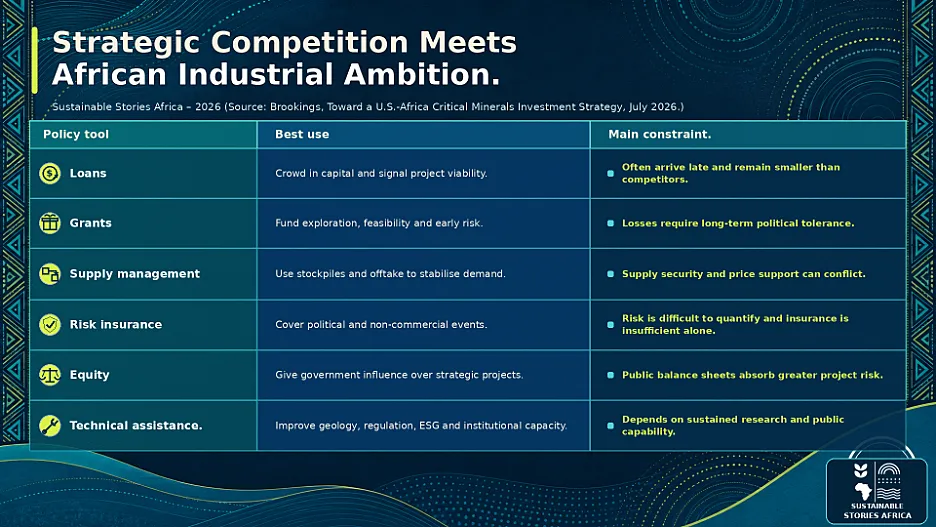
Six Tools, Three Trade-Offs, One Strategy
The tools become meaningful only after policy decides what success looks like. Brookings identifies three tensions.
- First, should processing remain in the United States or should African partners add value locally?
- African governments are increasingly reluctant to export raw ore while importing finished products and losing industrial opportunity.
The economics can support that ambition.
A BloombergNEF study cited in the report estimated that a 10,000-tonne battery-precursor facility in the Democratic Republic of Congo would cost $39 million, compared with $112 million in China and more than $120 million in the United States.
The DRC produces about 70% of global cobalt and can source other inputs regionally, creating a case for integrated African midstream capacity.
- Second, Washington must decide whether public investment should maximise financial returns or expand strategic market share.
- Competing with a state-supported processing system may require concessional finance, grants and tolerance for lower returns.
A commercial approach would prioritise self-sustaining projects, but may not shift market structure quickly enough.
- Third, stockpiles must balance reliable supply today against incentives for future mines.
- Releasing reserves can protect manufacturers from price spikes; guaranteed offtake at a floor price can make new projects viable.
- Those goals can point in opposite directions.
A strategy may therefore require different rules for different minerals rather than one universal mechanism.
Local Processing Can Align Mutual Interests
Local value addition offers a route to a more balanced partnership.
- Processing near mines can reduce transport costs, diversify supply away from a single country and create jobs, tax revenues and technical capability in African economies.
- It can also make political support for long-term projects more durable because communities and governments can see benefits beyond extraction.
The opportunity extends to environmental, social and governance performance.
- Technical assistance can strengthen geological surveys, labour protection, environmental regulation and public oversight.
- The report points to the 2025 collapse of a tailings dam at a Chinese-owned copper mine in Zambia, which spilt 50 million litres of waste into a major waterway, as evidence that investment scale cannot substitute for strong safeguards.
Blended finance is especially relevant.
- Sub-Saharan Africa accounts for 46% of blended-finance transactions cited by Brookings. Standardised processes could combine public loans, grants, guarantees and private capital participation.
- Institutions such as the African Development Bank, the Africa Finance Corporation, the World Bank and European partners.
Four Decisions Could Turn Interest Into Investment
First, the United States should standardise and accelerate blended-finance projects.
- A common platform, reusable documentation and coordinated agency review could reduce the gap between commercial deal timelines and public approvals without weakening due diligence.
Second, policy should prioritise a smaller group of minerals.
- The US Geological Survey identifies 60 critical minerals; however, Brookings argues that rare earths, cobalt, lithium and graphite deserve focus because of their industrial importance and concentrated processing.
- Africa holds 56% of global cobalt reserves and 22% of graphite reserves, while much of the continent remains underexplored.
Third, engagement must be bilateral and regional;
- African governments must be involved in defining value addition, infrastructure, local content and safeguards.
The report says the absence of US ambassadors in 34 African countries weakens diplomacy at a moment when dependable relationships are part of investment risk management.
Finally, the strategy must survive political cycles.
- China's position took roughly 30 years to build, while mines themselves can take close to two decades.
- Legislation, binding trade arrangements and continued support for infrastructure such as the Lobito Corridor can give investors and African partners greater confidence than short-lived announcements.
Path Forward – Build Partnerships That Survive Politics
A durable minerals strategy must combine focused finance, political risk management, technical capability and clear choices about processing and stockpiles.
The strongest US-Africa partnership would treat local value addition and high ESG standards as supply-security assets.
Consistent diplomacy and long-term implementation are essential if investment is to outlast commodity cycles and changes of government.