Canada is rethinking its Africa strategy at a moment when China’s trade, infrastructure and development footprint is reshaping the continent’s external partnerships.
The policy question is urgent: can Canada move beyond diplomatic goodwill and build practical, Africa-led partnerships in critical minerals, ESG governance, infrastructure, education and clean energy before the window narrows?
Canada’s Africa Moment Enters Harder Terrain
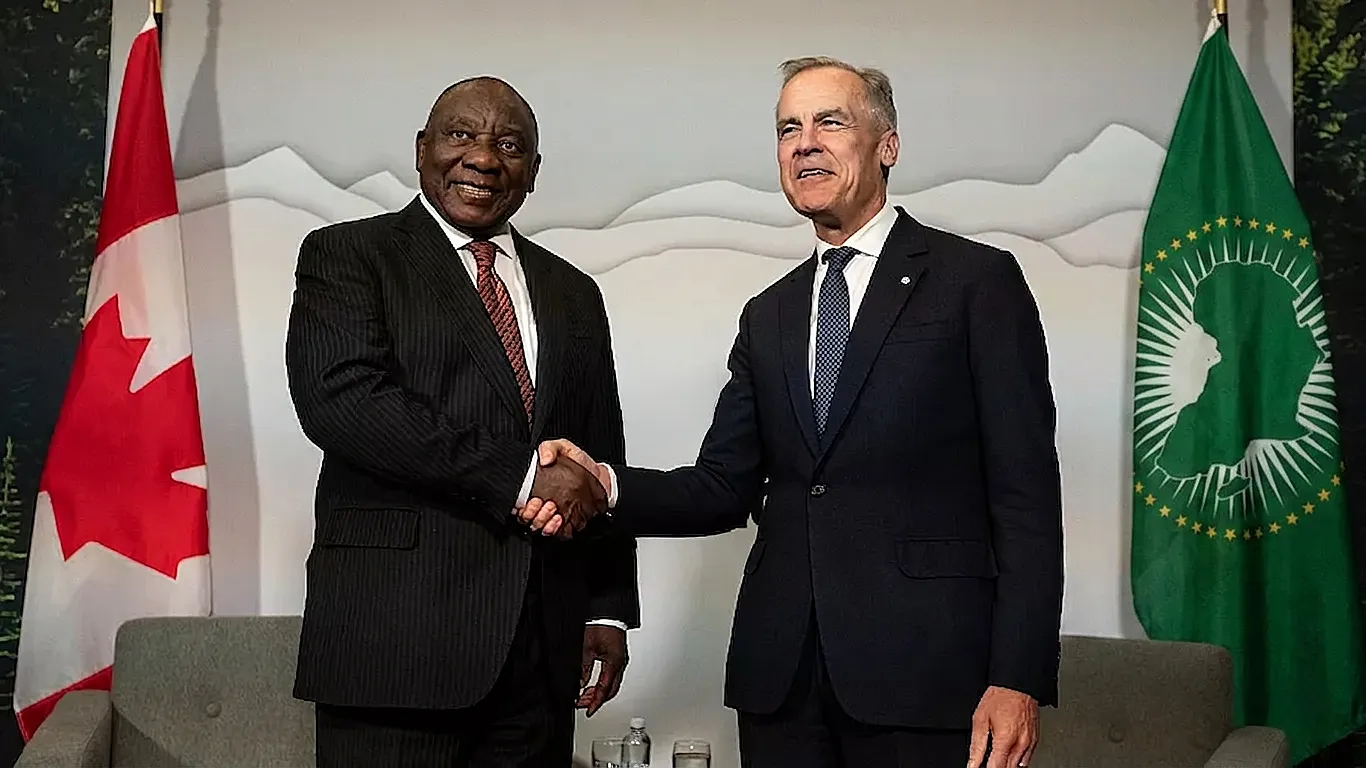
Canada’s Africa strategy is entering a more demanding geopolitical season, as African countries seek stronger partnerships, China deepens its continental reach, and middle powers look for relevance in a world no longer shaped by a single centre of power.
That was the central message from the Africa–China–Canada policy dialogue held on May 28, 2026, convened by the Africa–China Centre for Policy & Advisory and the Canadian Centre for African Affairs and Policy Research.
The session brought together Philippe Rheault, Director of the China Institute at the University of Alberta, and Ovigwe Eguegu, policy analyst and international development specialist, in a conversation moderated by Paul Frimpong, Executive Director of ACCPA.
Their shared conclusion was clear: Canada should not frame Africa through the lens of anxiety over China, but rather through long-term strategic partnerships that recognise African agency, development priorities and global bargaining power.
Africa Moves To Global Centre Stage
Africa has moved from the periphery of global diplomacy to its centre, a strategic arena for trade, climate cooperation, critical minerals, infrastructure finance and governance reform.
For countries seeking influence on the continent, presence alone is no longer sufficient.
Canada's official engagement now spans all 54 African countries through diplomatic coverage, development programmes and trade networks.
However, speakers at a recent dialogue warned that goodwill without commercial relevance and institutional credibility will not be competitive.
The urgency, one speaker noted, is practical; China's engagement is already comprehensive and accelerating.
Beijing has financed roads, ports, power projects, and industrial infrastructure, deepened trade ties, and recently extended zero-tariff access to 53 African countries with which it has diplomatic relations, signalling a clear appetite for deep commercial integration.
Canada cannot match China's infrastructure spending or speed of project delivery.
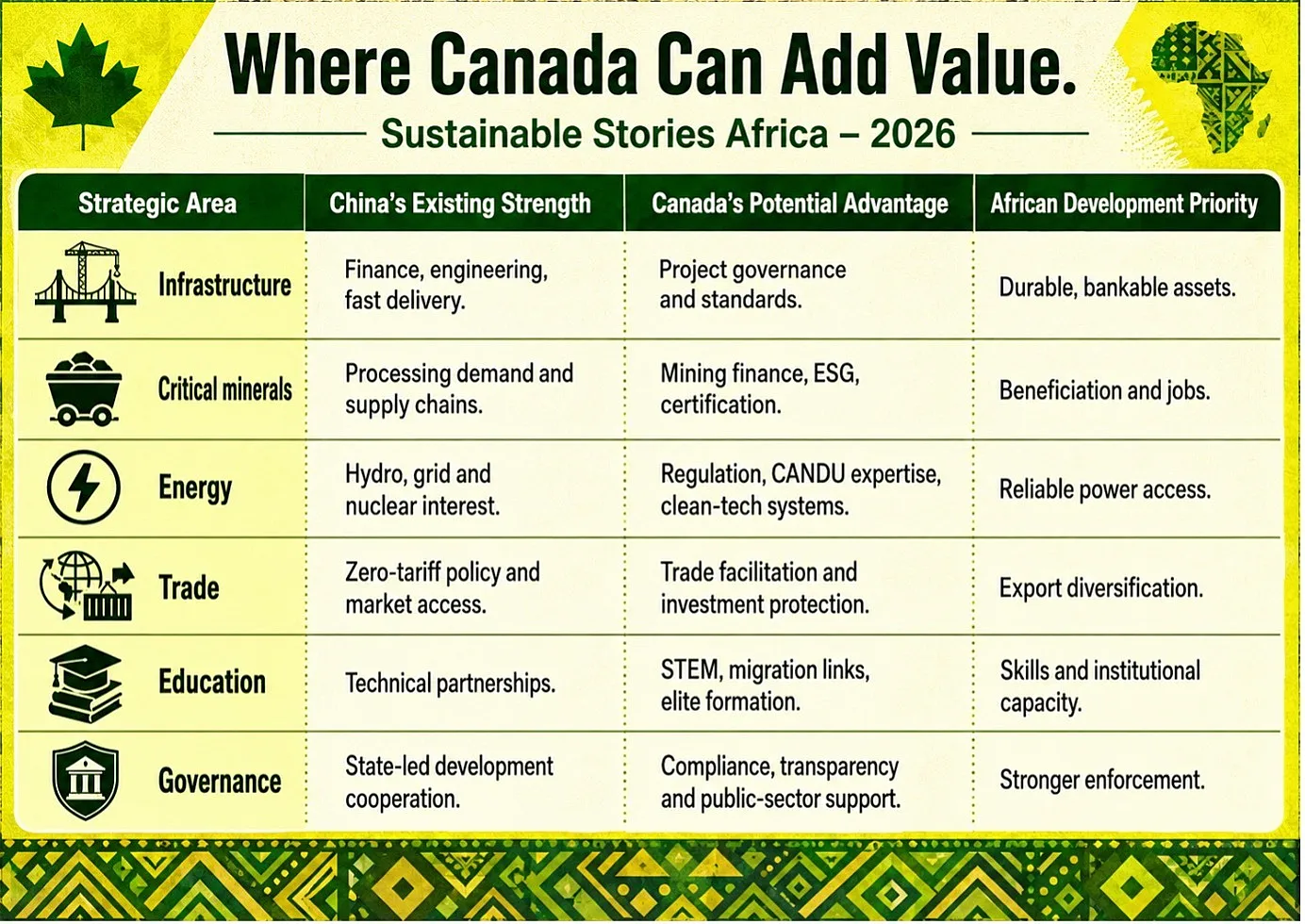
Its competitive advantage lies elsewhere: mining governance, ESG systems, certification of critical minerals, pension capital, clean energy and long-term policy partnerships built on trust and institutional credibility.
China’s Scale Raises Canada’s Stakes Now
The dialogue avoided a simplistic “China versus Canada” framing. Instead, it presented a more useful question: how can African countries use multiple partnerships to gain more value, more resilience and more control over their development choices?
Eguegu described Canada as a possible “translation layer” between Africa’s industrial ambitions and Western institutional acceptance. That phrase captures the strategic opening. African countries want to move up the value chain in minerals, energy and manufacturing. China brings industrial capacity, finance, engineering and market access. Canada brings mining finance, ESG governance, securities regulation, technical certification, environmental remediation expertise and institutional trust.
That mix matters most in critical minerals. Africa holds resources central to electric vehicles, batteries, renewable energy systems and digital infrastructure. But raw extraction alone will not deliver prosperity. The real value lies in processing, local jobs, technology transfer, traceability, sustainability reporting and access to higher-value markets.
The panel’s argument was not that Canada should replace China. It was that Canada can help African countries diversify their options and strengthen their negotiating position.
A Triangular Partnership Can Build Resilience
For African governments, the test of any foreign partnership is not ideological; it is structural.
Does the deal build local capacity, improve public revenue, protect communities and strengthen productive sectors?
If not, the financiers’ nationality is less important than the terms of the agreement.
This principle is especially urgent in mining. Communities near extractive projects across Africa share a common fear: minerals and profits leave, while environmental damage remains.
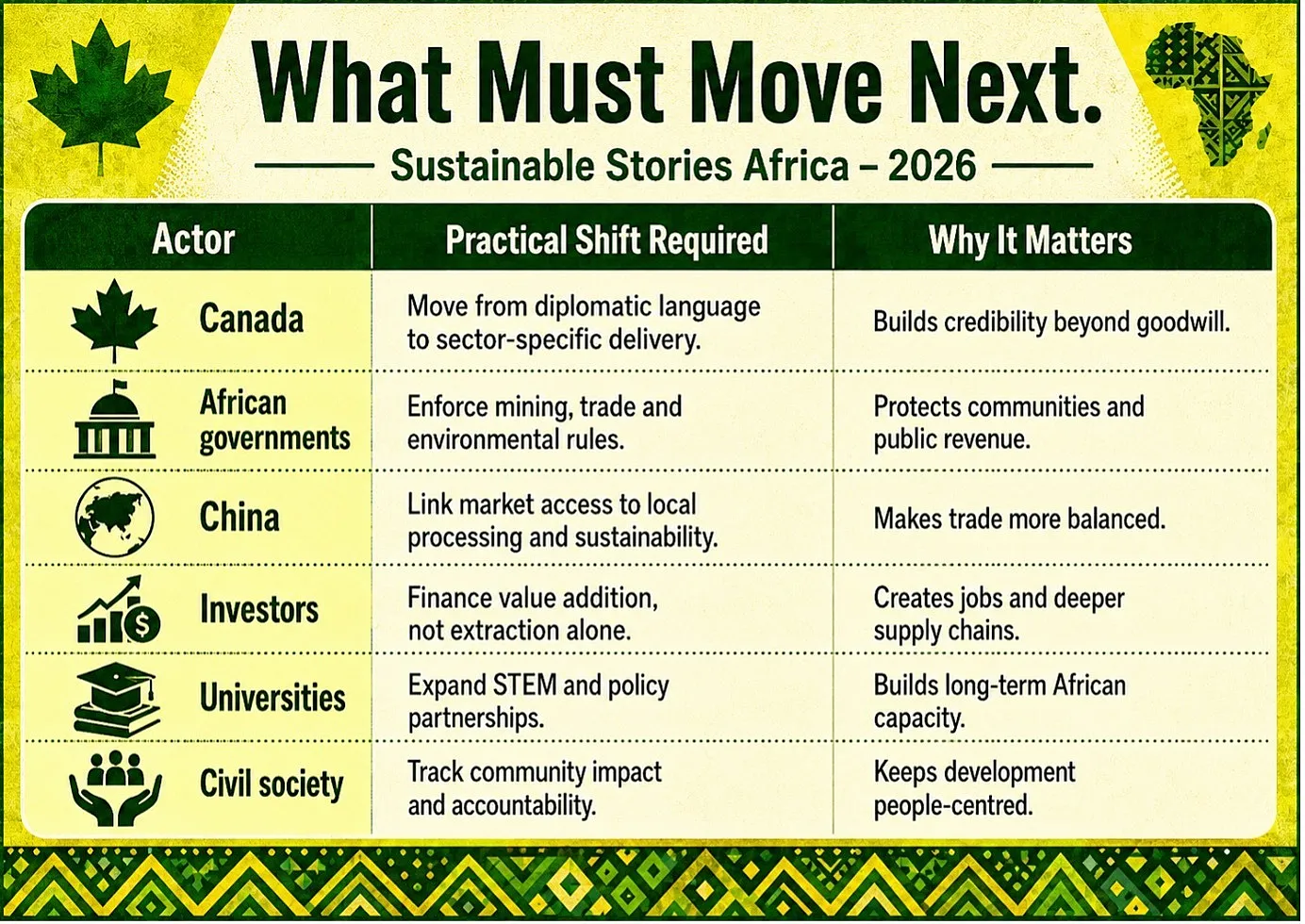
African governments bear the primary responsibility for enforcing mining codes, protecting ecosystems and ensuring companies do not leave communities worse off.
Comparisons between Canadian and Chinese mining behaviour, without like-for-like evidence, risk becoming anecdotal. What determines outcomes is enforcement, the capacity to inspect, regulate, penalise and require remediation.
Canada's practical value lies in strengthening that enforcement architecture: technical standards, sustainability reporting, traceability systems, environmental remediation tools and governance frameworks that make African mineral supply chains credible to ESG-conscious investors and buyers.
Energy presents an equally significant opening. Hydroelectric, nuclear and small modular reactor technologies represent areas where Africa's electricity demand intersects with Canada's technical expertise.
For economies constrained by unreliable power, energy cooperation is not diplomatic symbolism; it is a development necessity.
Africa Needs Standards, Value, and Agency
For Canada’s strategy to matter, it must become more transactional in the best sense: clear offers, measurable commitments and practical delivery.
- First, Canada should focus on sectors where it has a comparative advantage. These include critical minerals, clean energy, ESG systems, education, trade facilitation, financial regulation, climate resilience and peacebuilding.
A scattered Africa strategy will struggle. A focused one can build credibility.
- Second, Canada should make trade and investment easier. China’s zero-tariff policy is powerful because it is visible. Canada’s own trade offer must be better communicated and more commercially useful, especially for African exporters, diaspora investors and small businesses seeking market access.
- Third, African governments must strengthen their side of the bargain.
Beneficiation will not happen through speeches alone.
It requires power, transport infrastructure, industrial policy, skills, transparent licensing, regional coordination and credible enforcement.
- Fourth, businesses must treat ESG as a market condition, not a branding exercise. Mining companies, infrastructure developers and financiers will face rising scrutiny from communities, regulators and global buyers.
Companies that can prove local benefit, environmental responsibility and transparent reporting will be better positioned.
Middle Powers Can Still Shape Outcomes
The fragmentation of the liberal international order is creating strategic room for middle powers, and Canada is being asked to occupy it.
As the United States reshapes its global engagement and China positions itself as an anchor of an alternative order, Africa is simultaneously demanding a stronger voice in global governance.
Canada's credibility on the continent remains real, rooted in peacekeeping, immigration and education, assets that may not generate immediate GDP growth but build long-term influence.
A Canadian-educated policymaker or engineer can become a bridge for trade, investment and institutional cooperation decades later.
That long-term logic should anchor Canada's Africa strategy. Influence is built through consistency, education, research partnerships, regulatory cooperation, trade missions and diaspora engagement, which become strategic assets only when deliberately connected.
For African governments, the opportunity is optionality. More partners mean greater bargaining power; however, only when governments negotiate from clearly defined national and regional priorities.
Without that clarity, competition among external powers risks reproducing dependency under new flags.
Path Forward – Practical Follow-Through Can Build Shared Prosperity
Canada’s Africa strategy should move faster, focus sharper and deliver more visibly. Its strongest role is not to rival China project-for-project, but to strengthen African agency through ESG systems, governance of critical minerals, education, clean energy, trade facilitation and regulatory capacity.
Africa’s priority is disciplined optionality: diversify partners, enforce standards, localise value and protect communities.
In a multipolar world, the continent’s strongest position is not choosing sides; however, it is about shaping partnerships around its own future development.