Carbon footprints are moving from technical sustainability reports into boardroom decisions, investor assessments and market access conversations.
For African businesses, the question is no longer whether emissions matter. It is whether companies can measure them clearly enough to cut costs, protect credibility and compete in a carbon-conscious economy.
Carbon Data Now Shapes Competitiveness
A company’s carbon footprint is becoming a practical test of how well it understands its own operations, risks and future competitiveness.
At its simplest, the concept measures greenhouse gas emissions linked to a business.
However, in practice, it now includes fuel use, electricity consumption, staff movement, supply chains, product design, waste disposal and the emissions avoided through cleaner technologies.
The uploaded explainer frames this in highlighting Scope 1, Scope 2, Scope 3 and the emerging concept of Scope 4.
For African and emerging-market companies, the stakes are immediate. Many operate in economies shaped by unreliable power, diesel dependence, rising logistics costs, export scrutiny and growing ESG expectations.
In that context, carbon accounting is not just climate language. It is a management tool for reducing waste, improving efficiency, strengthening governance and preparing for stricter market rules.
Emissions Reporting Enters The Boardroom
The most important shift is that carbon footprints are no longer only an environmental concern. They are becoming a business survival metric.
Companies are increasingly expected to show where their emissions come from, how they are managed, and whether credible data backs their claims. That pressure is coming from investors, lenders, customers, regulators and global supply chains.
For businesses in African markets, it comes from the practical realities of energy costs, fuel reliability and production efficiency.
A carbon footprint provides companies with a clearer view of their exposure to emissions.
- Scope 1 covers direct emissions from sources owned or controlled by the organisation, including company-owned vehicles, on-site fuel combustion and industrial process emissions.
- Scope 2 covers indirect emissions from purchased electricity, steam, heating or cooling.
- Scope 3 captures wider value-chain emissions such as business travel, employee commuting, purchased raw materials, capital goods, waste disposal and end-of-life treatment.
- Scope 4, still an emerging concept, looks at avoided emissions linked to green technologies and sustainable practices.
That framework matters because businesses cannot reduce what they cannot measure. Without emissions data, net-zero targets risk becoming slogans. With it, companies can identify where carbon, cost and operational inefficiency overlap.
Four Scopes Explain The Footprint
Carbon accounting becomes clearer when emissions are separated by responsibility and source.
For many companies, the first step is not a complicated climate strategy. It is a clear map of where emissions are created and where reductions are possible.
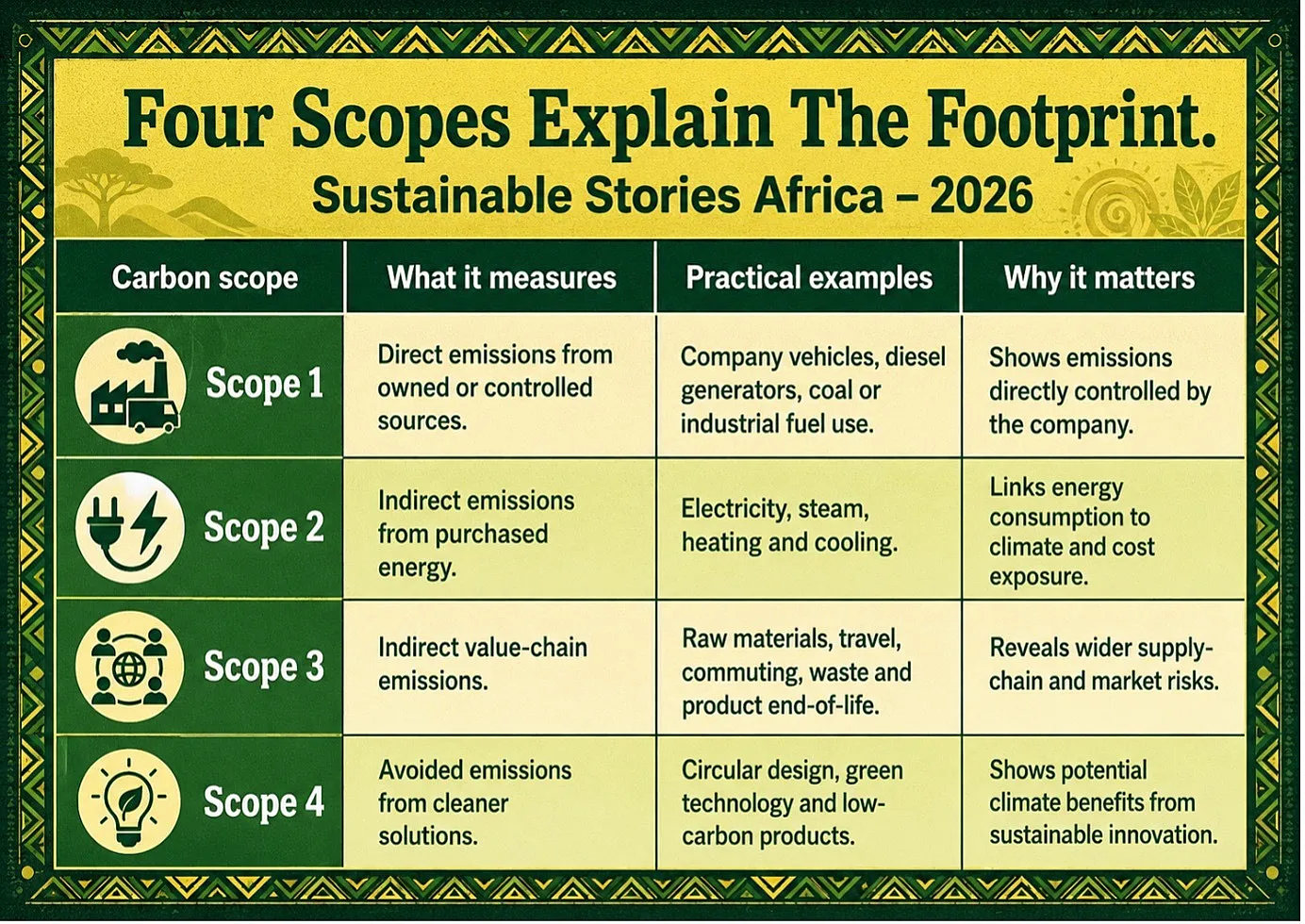
This breakdown is particularly relevant in African economies where energy access and climate ambition often collide.
- A manufacturer may rely on grid electricity during the day and diesel generators when power fails.
- A logistics company may operate a fleet exposed to fuel-price volatility.
- A food processor may depend on farmers, packaging providers, cold-chain operators and distributors, each adding emissions across the value chain.
The carbon footprint, therefore, becomes a mirror. It shows not just the environmental impact, but also operational design.
Data Turns Claims Into Accountability
Carbon accounting is resolving a credibility problem that sustainability rhetoric alone cannot fix.
As climate language proliferates, stakeholders are demanding proof, a baseline, identified emissions hotspots and measurable progress over time.
The diagnostic value is sector-specific and immediate.
- A retail chain may find that store electricity dominates its footprint.
- A cement producer may identify industrial processes and fuel as primary Scope 1 sources.
- A financial institution may discover its greatest climate exposure lies not in office operations but in the activities it finances.
- An agribusiness may trace Scope 3 emissions across fertiliser, transport, packaging and storage losses.
These insights reshape decision-making, directing investment toward energy efficiency, renewable power, route optimisation, supplier engagement and product redesign.
Critically, they give companies the evidence to communicate sustainability with integrity rather than aspiration.
For African markets, the stakes are commercial and strategic. Carbon accounting increasingly determines who secures financing, wins contracts, remains export-ready and demonstrates resilience in a carbon-constrained global economy.
Carbon Visibility Can Unlock Value
The strongest argument for carbon accounting is not regulatory compliance; it is operational advantage.
- Companies that measure fuel use across fleets identify opportunities for diesel reduction.
- Factories tracking electricity and heat consumption uncover equipment inefficiencies. Food companies studying value chains reduce waste and improve cold storage.
- Consumer-goods companies redesigning packaging cut both lifecycle emissions and material costs.
The benefits extend outward. Cleaner operations reduce local pollution, build demand for green skills and support community resilience.
Better emissions data helps regulators design smarter climate policy and enables financiers to direct capital toward businesses with credible transition plans.
Reputational value is also at stake. As ESG scrutiny intensifies, companies with honest, transparent carbon reporting are better positioned to build institutional trust.
Those relying on vague claims face growing exposure to greenwashing from increasingly sophisticated regulators and investors.
The risk of inaction is commercial, not only environmental; higher operating costs, weaker investor confidence and reduced export competitiveness await businesses that ignore their carbon footprint.
From Measurement To Market Strategy
The next phase is implementation. Carbon footprint reporting must move from technical documents into everyday business planning.
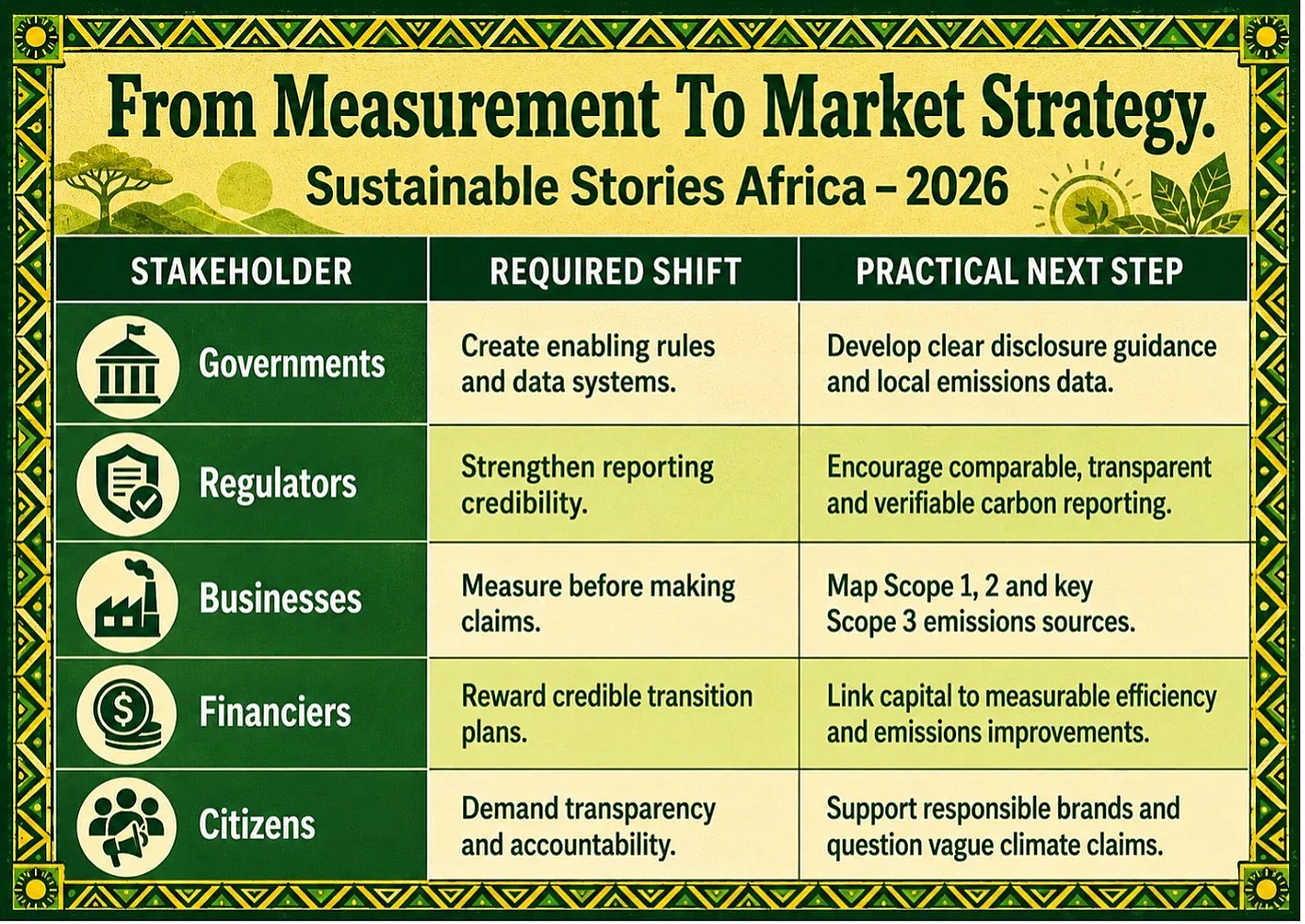
Governments can help by setting clear expectations without overwhelming smaller firms.
- Many small and medium-sized enterprises do not have large sustainability teams; however, they still sit inside supply chains where carbon data is increasingly required.
- Simple templates, sector guidance and shared data infrastructure can help make reporting more inclusive.
Businesses should begin with the most material areas.
- For some, that will be fuel and electricity.
- For others, it will be procurement, logistics, waste or product design.
The goal is not instant perfection. The goal is visibility, followed by disciplined improvement.
Financiers should treat carbon data as part of risk assessment.
- A company that understands its emissions may also understand its energy exposure, operational inefficiencies and future regulatory risks.
That makes carbon reporting useful not only for ESG teams, but also for credit officers, insurers and investors.
Integrity Will Separate Serious Companies
The most credible companies will be those that treat carbon footprints as decision-making tools, not public-relations badges.
That means reporting should be transparent about boundaries, assumptions and data quality.
- If a company measures only Scopes 1 and 2, it should say so clearly.
- If Scope 3 data is incomplete, it should explain what is missing and how it plans to improve.
- If it claims that it avoided emissions under Scope 4, it should avoid exaggeration and show how the benefit is calculated.
This integrity matters because avoided emissions can be powerful but also sensitive. A company selling solar systems, low-carbon building materials, electric mobility solutions or circular packaging may genuinely help customers reduce emissions.
However, those claims must be handled carefully. Scope 4 should complement direct emissions reductions, not distract from them.
For Africa’s sustainability transition, this distinction is important. Markets need innovation; however, they also need trust.
Carbon-footprint reporting can support both when it is clear, comparable and connected to real operational change.
Path Forward – Needs Credible Carbon Action
Carbon footprints should enable practical roadmaps for African businesses, not decorative ESG language.
The priority is clear measurement, honest reporting and targeted action across operations, electricity use, supply chains and product design.
Governments, companies and financiers should now connect carbon data to cleaner energy, efficient logistics, circular production and credible governance. That is how emissions disclosure becomes a development strategy.