Carbon pricing now covers 29% of global greenhouse gas emissions, with governments using taxes, trading systems and border rules to reshape investment decisions.
For Africa, the issue is no longer distant climate policy. Carbon pricing is becoming a trade, finance and competitiveness question, one that could raise revenues, attract investment or expose exporters to new costs.
Carbon Pricing Enters The Trade Era
Carbon pricing is moving from a climate-policy niche into the centre of fiscal strategy, industrial competitiveness and global trade, according to the World Bank’s State and Trends of Carbon Pricing 2026 report.
The report finds that 87 carbon pricing instruments are now in force across 47 countries and the European Union, covering 29% of global greenhouse gas emissions.
If instruments under development are fully implemented, nearly one-third of global emissions could be covered by 2030.
For African markets, the shift matters because carbon pricing is no longer only about reducing emissions at home.
It is increasingly linked to export access, energy reform, industrial policy, public revenue and the integrity of carbon credit projects that could channel finance into clean cooking, forests, agriculture and renewable energy.
Carbon Prices Now Shape Trade
The most important message from the World Bank’s 2026 report is that carbon pricing is expanding even as governments face fiscal pressure, energy volatility and development demands.
Direct carbon pricing, through emissions trading systems and carbon taxes, now covers 29% of global emissions.
That is a major increase from 2016, when 39 instruments covered around 12% of emissions.
The landscape has more than doubled and become more diverse in design, with new national-level instruments implemented in India, Japan, Mauritania, Serbia and Viet Nam over the past year.
The report’s timing is important. It was prepared against a backdrop of commodity-market disruption, rising energy prices and questions over how governments should protect households while still encouraging cleaner investment.
That makes carbon pricing politically sensitive, but also fiscally attractive: ETSs and carbon taxes generated more than $107 billion in government revenue in 2025.
For African policymakers, this is the practical dilemma. Price carbon too weakly, and countries may miss revenue, investment and trade-positioning opportunities.
Price it poorly, and households, small firms and energy-intensive industries may absorb costs without seeing better services, cleaner power or stronger competitiveness.
Markets Expand As Prices Rise
Global carbon pricing markets are expanding in coverage, revenue and complexity. Average carbon prices have doubled over the past decade, rising from approximately $10 per tonne of CO₂ equivalent in 2016 to nearly $21/tCO₂e in 2026, with prices increasing 7% between April 2025 and April 2026, driven largely by emissions trading systems (ETSs).
Coverage under ETSs has tripled since 2016, from under 8% to around 26% of global emissions, while carbon taxes have remained relatively stable at 4% to 5% of market coverage.
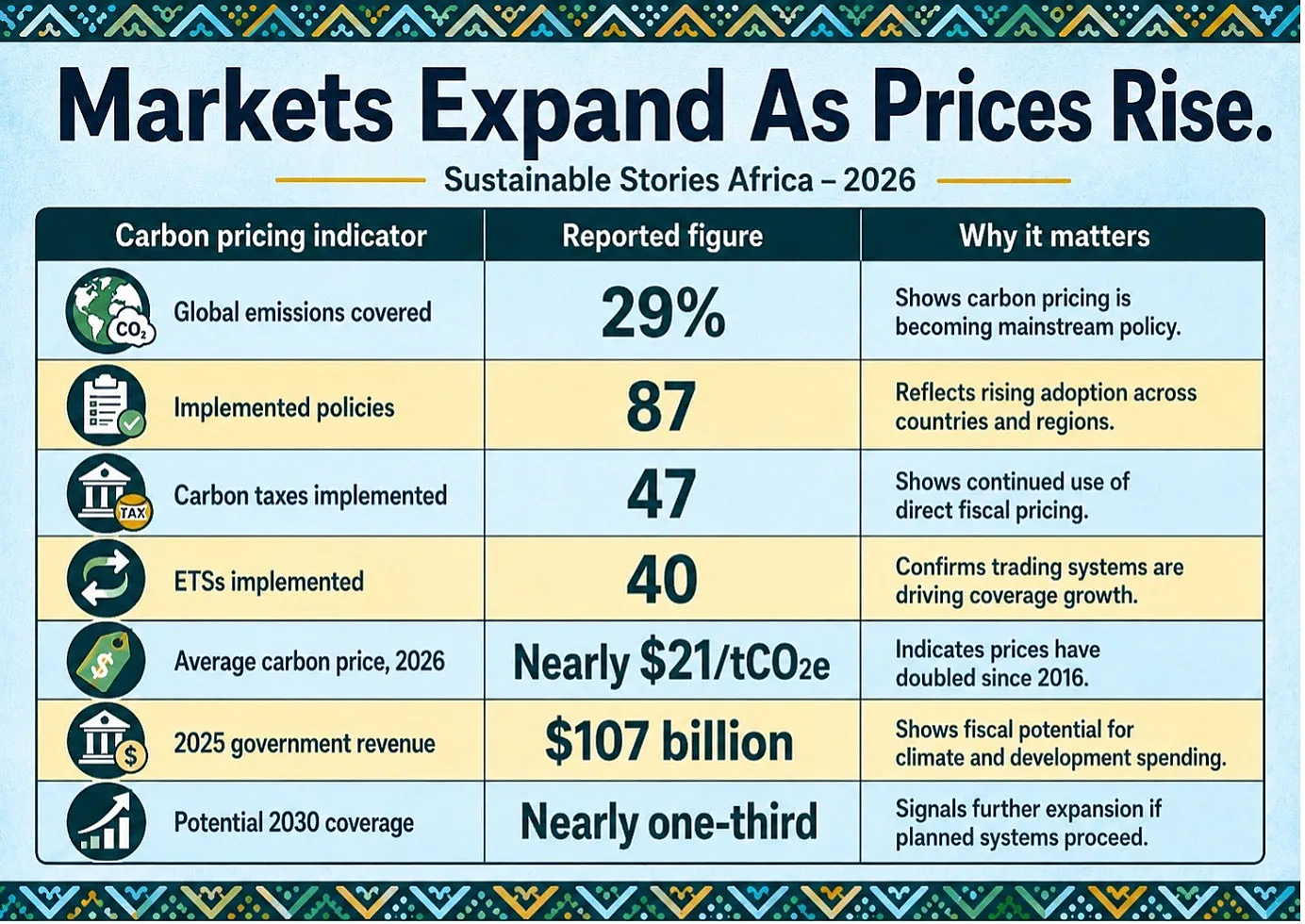
Revenue growth reinforces the market's expanding significance. Carbon pricing revenues rose approximately 2% in 2025 to $107 billion, with ETSs contributing over 70% of the total.
ETS revenues increased 13% to more than $80 billion, while carbon tax revenues fell 20% to $27 billion, partly reflecting Canada's decision to reduce its federal fuel charge to zero from April 2025.
However, the benefits remain deeply uneven. Despite approximately 70% of emissions covered by carbon pricing occurring in middle- and low-income countries, almost all carbon revenues are collected in high-income countries.
For Africa, lower carbon prices, limited auctioning mechanisms and weaker institutional frameworks continue to constrain the continent's ability to capture the potential of carbon pricing revenue.
Border Rules Raise Export Stakes
Carbon pricing is increasingly intersecting with international trade, with direct implications for African exporters.
The European Union's Carbon Border Adjustment Mechanism entered its definitive phase in 2026, applying a carbon price to embedded emissions in selected imports, including cement, steel, aluminium and fertiliser.
Although CBAM currently accounts for less than 0.5% of global emissions, its formal adoption has accelerated interest in border carbon adjustments globally.
The competitive exposure for African exporters is material. Countries and sectors supplying EU markets face higher compliance costs if they cannot demonstrate emissions intensity or operate outside jurisdictions that recognise a credible carbon price.
The regulatory landscape is also broadening.
The UK CBAM is expected in 2027, Serbia has introduced a border carbon adjustment alongside its carbon tax, Thailand's climate law includes border adjustment provisions, and policymakers in Australia, Canada and Taiwan are considering similar instruments.
For Africa, this convergence transforms carbon accounting into a direct export-readiness challenge.
- Businesses will require reliable emissions data and credible monitoring, reporting and verification systems.
- Governments face a critical strategic decision: whether to establish domestic carbon pricing frameworks that retain carbon revenue locally, rather than allowing exporters to pay compliance costs in foreign markets.
Better Pricing Can Fund Development
Beyond emissions reduction, carbon pricing offers African economies a multi-dimensional development tool.
The World Bank highlights its potential to raise public revenue, incentivise efficiency, support clean-energy investment, and strengthen responses to international trade measures.
Several African markets are already acting. South Africa operates a carbon tax and increased its rate by 31% in 2026, Mauritania has implemented a national carbon tax, and Nigeria's gas flaring penalty supports its 2030 goal of ending routine flaring and venting.
The development case is tangible. Carbon revenues can finance clean power, public transport, climate-smart agriculture, resilient infrastructure and industrial upgrades.
However, policy design is critical, revenues must cushion vulnerable households, expand reliable energy access and deliver visible public benefits to maintain social legitimacy.
Carbon credit markets offer a complementary financing pathway. The World Bank notes that carbon credits can mobilise public and private capital for emissions-reducing projects while delivering broader development co-benefits.
Nature-based projects have attracted particularly strong buyer interest, capturing 70% of capital committed or raised for carbon credits between 2021 and 2024, signalling a significant opportunity for African countries with substantial natural capital assets.
Credit Markets Seek More Integrity
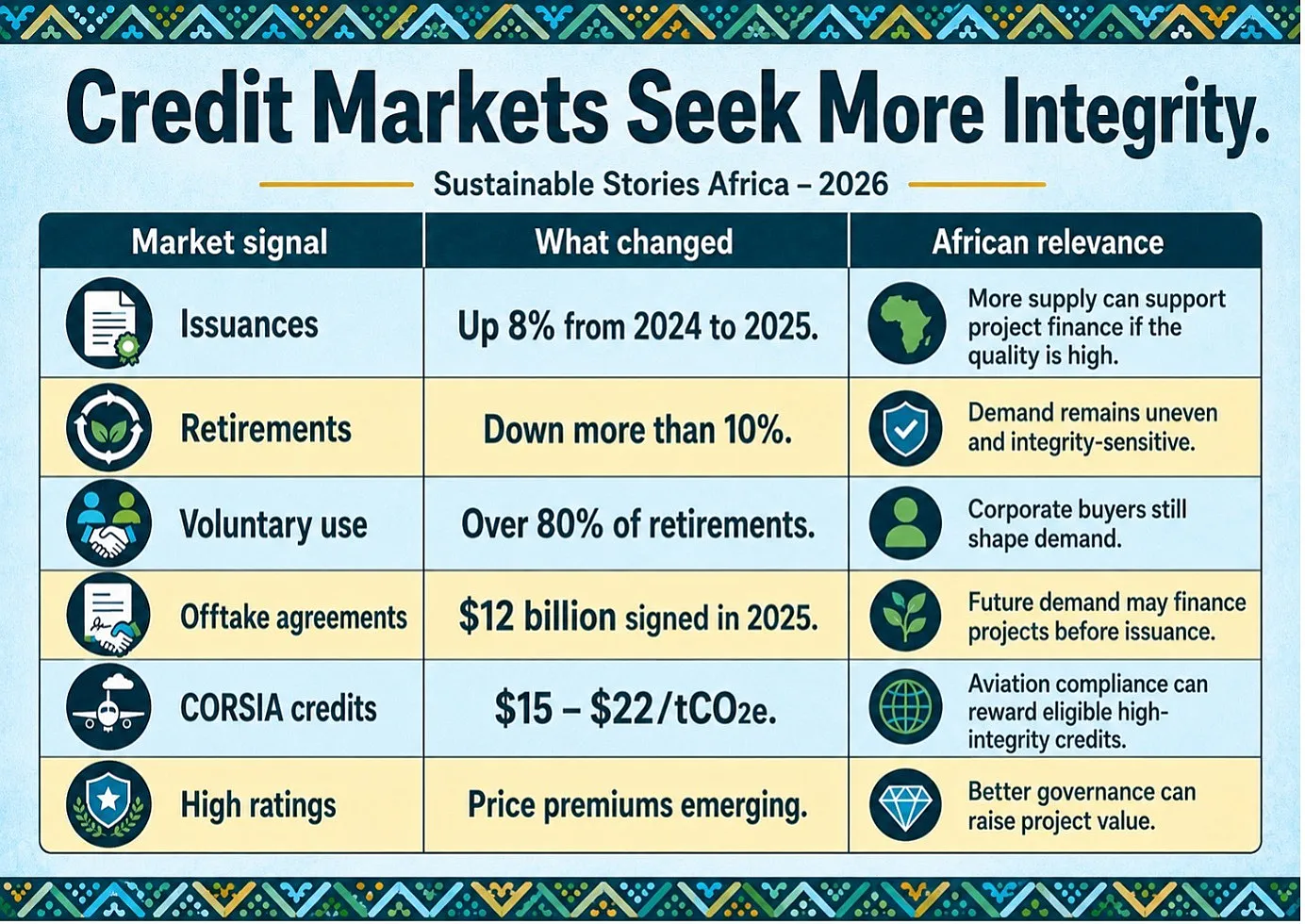
Carbon credit markets are expanding but unevenly. Overall credit issuances rose 8% between 2024 and 2025, though they remained 20% below 2022 levels.
Governmental crediting mechanisms grew from 24 to 34 over the past decade, while issuances from independent mechanisms fell approximately 4% between 2024 and 2025, yet still accounted for around 70% of total issuances.
Retirements moved in the opposite direction, falling more than 10% from 2024 to 2025, largely as California compliance use returned to 2023 levels following a 2024 spike. Voluntary use continued to dominate, accounting for more than 80% of credits retired in 2025.
Quality differentiation is increasingly shaping market value. CORSIA-eligible credits traded between $15/tCO₂e and $22/tCO₂e from September 2025, significantly above the $1–$14/tCO₂e range for most other credit types.
Reforestation projects showed an 87% price premium per rating band, confirming that buyers are paying more for credibility.
For Africa, this distinction is critical. High-integrity carbon markets require clear land rights, equitable benefits sharing, strong community safeguards, credible baselines and transparent use of revenue.
Carbon credits must generate genuine local development value rather than functioning as low-cost offsets extracted from communities with minimal benefit.
Build Credible Local Market Systems
African governments must embed carbon pricing within a broader development strategy rather than deploying it as a stand-alone climate levy. Sector-specific diagnostics are the essential starting point, as power, cement, steel, oil and gas, transport, agriculture, and waste each require tailored policy instruments.
Carbon taxes suit simpler administrative contexts, while emissions trading systems are better suited to markets where data infrastructure and regulated entities are sufficiently mature.
Revenue transparency is equally critical. Households and businesses must see clear connections between carbon pricing and tangible public benefits, including energy access, clean cooking, industrial efficiency, worker transition support, climate adaptation and public transport; otherwise, political sustainability will weaken.
Credible monitoring, reporting and verification systems underpin everything else. CBAM compliance, carbon credit integrity and domestic carbon pricing all depend on reliable emissions data.
Fragmented continental approaches compound this challenge, making regional coordination, through shared registry standards, common credit-integrity principles and African-led carbon market governance, a strategic necessity for strengthening collective bargaining power.
Businesses must proactively map emissions exposure across supply chains, identify CBAM-relevant products and build auditable emissions records. Financial institutions should treat carbon pricing as both a credit-risk signal and a commercial opportunity, particularly when assessing energy-intensive borrowers.
Path Forward – Price Carbon With Purpose
Carbon pricing is expanding, but Africa’s priority should be purposeful design: fair prices, credible data, transparent revenues and strong safeguards.
The goal is not simply to copy global models. It is to build carbon pricing and credit systems that protect households, strengthen exporters, finance clean infrastructure and turn climate policy into measurable development value.