Global heat production for district heating networks reached approximately 20 exajoules in 2024, a 35% increase since 2010 and 60% since 2000.
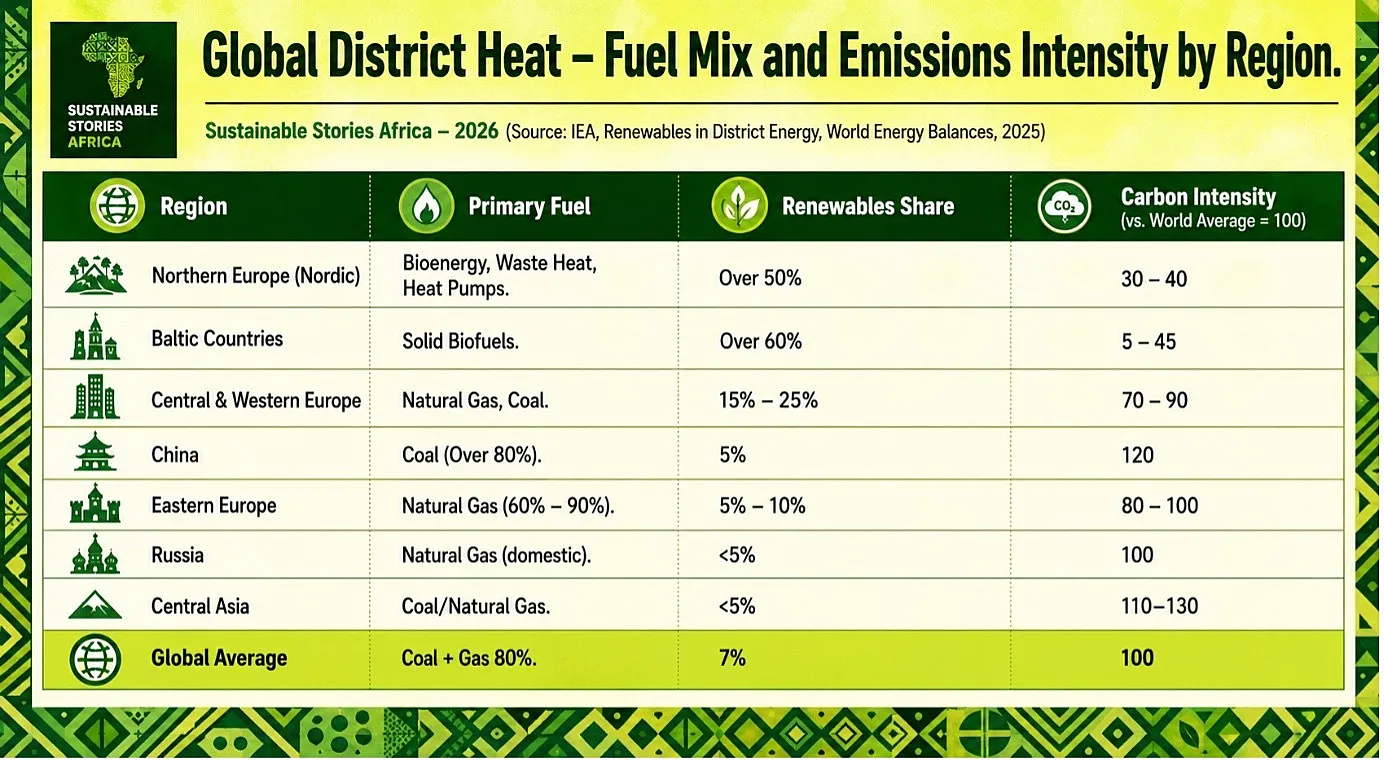
However, despite two decades of growth, the fuel mix has barely shifted: coal and natural gas still account for roughly 80% of global district heat production, with renewables contributing just 7%.
The IEA's 2025 district energy report reveals dramatic regional contrasts.
- Nordic countries run on bioenergy, waste heat, and heat pumps.
- China has built the world's largest district heating network almost entirely on coal.
- Eastern Europe remains trapped in Soviet-era gas dependency.
- The Global South, including most of Africa, has barely begun the journey.
For emerging African cities, this is simultaneously a cautionary tale and a clear strategic opening.
The Numbers That Define the World's Heating System
Understanding district energy is, above all, an exercise in understanding contrasts.
The same technology, centralised production of heat or cold, distributed through insulated pipes to buildings, can be powered by geothermal springs, forest residues, data centre waste heat, or Chinese coal.
It can reduce a country's fossil fuel import bill by billions of dollars a year, or it can entrench it. It can cut urban carbon emissions dramatically or accelerate them. Which outcome a country experiences depends almost entirely on the policy choices, resource endowments and governance frameworks that shape the system.
The IEA's 2025 report Renewables in District Energy provides data that verify a better understanding of these differences with unprecedented clarity, drawing on the IEA's World Energy Balances and a comprehensive review of national district energy systems across Europe, China, Russia, Central Asia, and emerging markets.
The findings reveal a world deeply divided between the systems that are transitioning successfully and the vast majority that are not, and they identify the exact conditions that separate the two.
20 Exajoules, Still Mostly Coal and Gas
On the global scale, the numbers are stark. District heating produced approximately 20 EJ of heat in 2024; around 80% of that came from coal (roughly half) and natural gas (close to one-third).
The overall fossil fuel share has fallen by about three percentage points since 2010; the absolute use of coal has nearly doubled over the same period, driven by the explosive expansion of China's district heating network.
China, Russia and Europe together account for over 90% of total global district heat output. China now produces more than five times the district heat it did 20 years ago, a trajectory underpinned by strong central planning and coal-fired combined heat and power (CHP) plants across northern provinces.
China now has the highest carbon intensity of district heat production worldwide, approximately 20% above the global average and nearly double Europe’s.
The Nordic Model – What Policy, Planning and Local Resources Can Achieve
The sharpest counter-narrative to the global fossil-fuel default is written in Northern Europe.
In Denmark, Finland and Sweden, district heating meets around half of all building heat demand, powered predominantly by bioenergy, waste heat and, increasingly, large-scale heat pumps.
The transition was not accidental. It was built over four decades through:
- Carbon taxes and energy taxes that progressively raised the cost of fossil fuels
- Mandatory heat planning that gave municipalities the authority and obligation to direct how buildings connect to district heating networks
- Public infrastructure funding and subsidies for bioenergy and renewables
- Dense domestic biomass supply chains from forest industries that provided abundant, low-cost, drop-in-ready solid biofuels
- Finland's waste-heat integration has reached 18% of total district heat production, from data centres, wastewater treatment plants, metro systems and industry.
- Denmark uses large solar thermal fields with seasonal storage, pairing summer solar energy with winter heat delivery. Iceland powers nearly 100% of its district heating from geothermal resources.
By contrast, countries such as Estonia, Finland, Latvia, Lithuania and Sweden, which have little or no domestic natural gas production, avoided becoming gas-dependent by building renewable-based systems early.
Their import dependence on district heating is now around 14%. Without their renewable systems, it would be more than fourfold higher.
The Baltic Transformation – A Replicable Lesson for Emerging Markets
The Baltic experience is perhaps the most directly instructive for African policymakers. Estonia, Latvia and Lithuania built their district heating systems on Soviet-era gas infrastructure.
Over the past two decades, with EU support and national funding, they systematically replaced ageing infrastructure with biomass-based systems, dramatically reducing their exposure to gas import price volatility and geopolitical risk.
- Solid biofuels and waste now account for 66% of energy used in district heating across the Baltic region, 100% sourced domestically.
The result: 25% of district heat supply still relies on imported fuels, but without their renewable transition, that figure would be far higher, and replacing remaining gas use with renewables could reduce total regional gas imports by a further 16%.
The lesson for Africa is clear: local resource mobilisation, biomass from agricultural residues, geothermal from the Rift Valley, solar thermal from abundant irradiation, waste heat from growing urban industrial and commercial sectors can form the foundation of energy-secure, low-carbon urban thermal systems.
The technology is mature. The financing is available. What is required is the planning framework and the political will.
Data-Driven Priorities for Africa's District Energy Strategy
The IEA's regional data points to four evidence-based priorities for African governments and development institutions:
Thermal demand mapping first:
- Before any infrastructure investment, African cities must complete urban heating and cooling demand maps, identifying where density thresholds make district energy systems economically viable, as IEA data shows these thresholds can be met in many African urban centres with significant cooling demand
Prioritise greenfield design for new urban developments:
- Unlike Eastern Europe or China, many African cities still have the chance to build from scratch, designing new districts with low-temperature, renewables-ready thermal networks from day one
Leverage geothermal potential for East Africa:
- Countries along the East African Rift, Kenya, Ethiopia, Tanzania, Uganda, Rwanda, sit on some of the world's most accessible geothermal resources, already demonstrated at scale by Iceland's district heating system
Build bioenergy supply chains in agricultural regions:
- West and Central African agricultural sectors generate biomass residues that could power district energy systems in regional cities, a development opportunity currently left largely untapped
Path Forward – Africa's Regional Data Gap Must Be Closed
Building the Evidence Base for African District Energy
The IEA's Renewables in District Energy report is built on World Energy Balances data drawn primarily from Europe, China and Russia, regions where district energy is already established.
Africa remains near-blank on this data landscape. Closing that gap requires continent-specific research, urban energy mapping, and pilot project development that can feed into the IEA's next iteration of this analysis, and inform the investment decisions of AfDB, the World Bank and national development banks across the continent.
The data gap is not just an intellectual problem. It is an investment barrier, and filling it is a prerequisite for attracting the finance that Africa's urban thermal energy opportunity deserves.