For the first time, conflict and violence triggered more internal displacements than disasters, reshaping the global risk map and exposing fragile systems.
Africa sits near the centre of the crisis: millions remain displaced, while climate shocks, conflict, weak data and shrinking humanitarian resources complicate recovery.
Displacement Numbers Hide A Deeper Warning
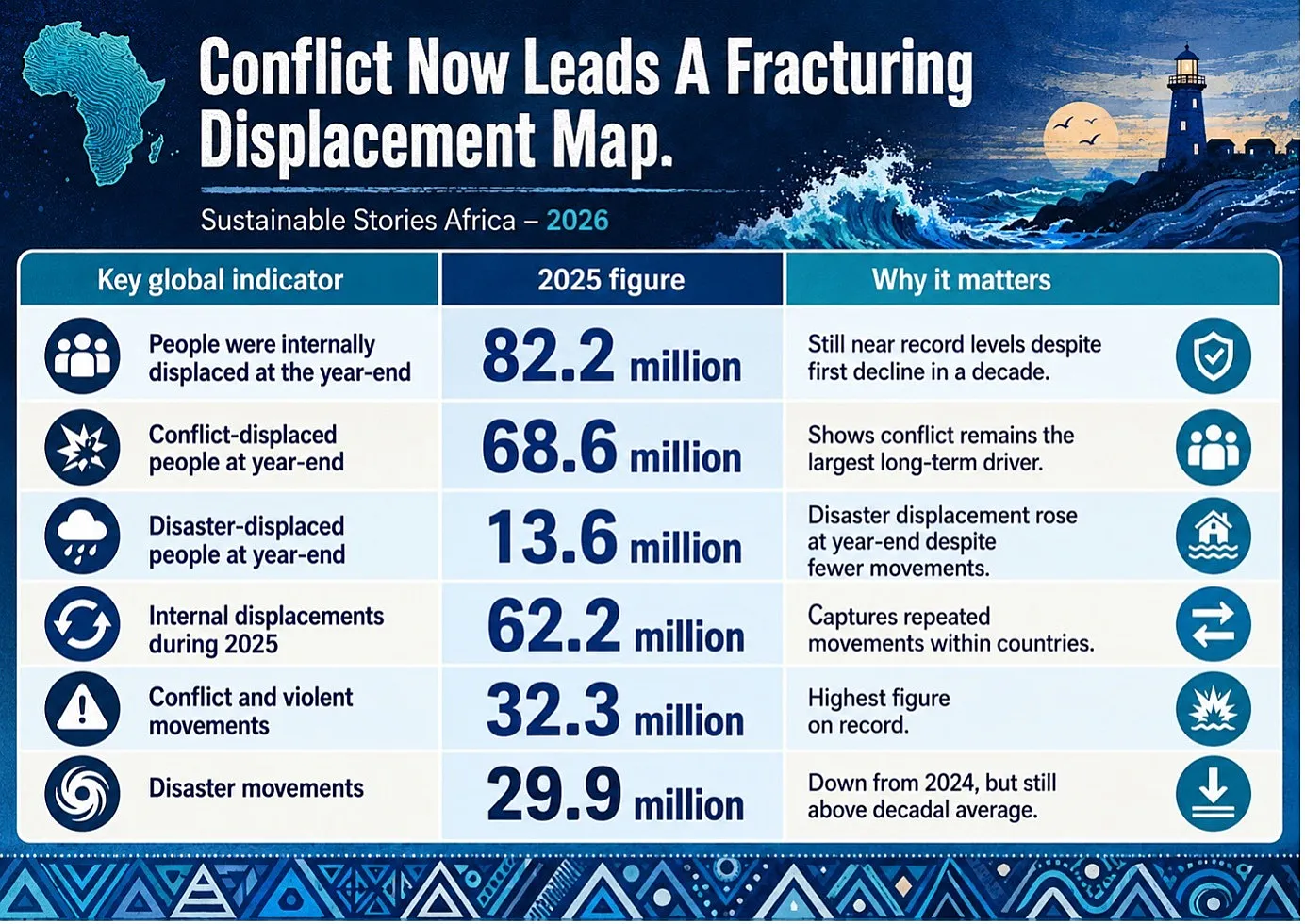
More than 82.2 million people were living in internal displacement across 104 countries and territories at the end of 2025, according to IDMC’s Global Report on Internal Displacement 2026.
The figure declined for the first time in a decade, but the report warns that the headline drop should not be mistaken for durable progress.
The bigger shift is in what is forcing people to move. IDMC recorded 62.2 million internal displacements in 2025, with conflict and violence accounting for 32.3 million movements and disasters for 29.9 million.
It was the first time that conflict displaced more people during the year than disasters.
For African governments, investors and development institutions, the report frames internal displacement as more than a humanitarian emergency.
It is a governance, climate risk, public finance and social stability test, especially in countries where conflict, flooding, food insecurity and data gaps now overlap.
Conflict Now Leads to a Fracturing Displacement Map
The most urgent finding is stark: conflict displacement reached a record high in 2025. IDMC says conflict and violence triggered 32.3 million new or repeated movements across 48 countries and territories, a nearly 60% increase from 2024 and more than double the decadal average.
That shift matters because displacement is no longer only a response problem. It is becoming a signal of state fragility, weak urban resilience and rising protection risks.
When violence reaches cities, IDMC notes, the damage goes beyond homes. It disrupts markets, transport, governance, communications, education and healthcare, while making emergency response and reconstruction harder.
The report’s global map on page two shows how concentrated and uneven the crisis has become.
Sub-Saharan Africa recorded 14.46 million conflict-related movements and 2.86 million disaster-related movements in 2025, accounting for 27.8% of the global total shown in the report’s regional breakdown.
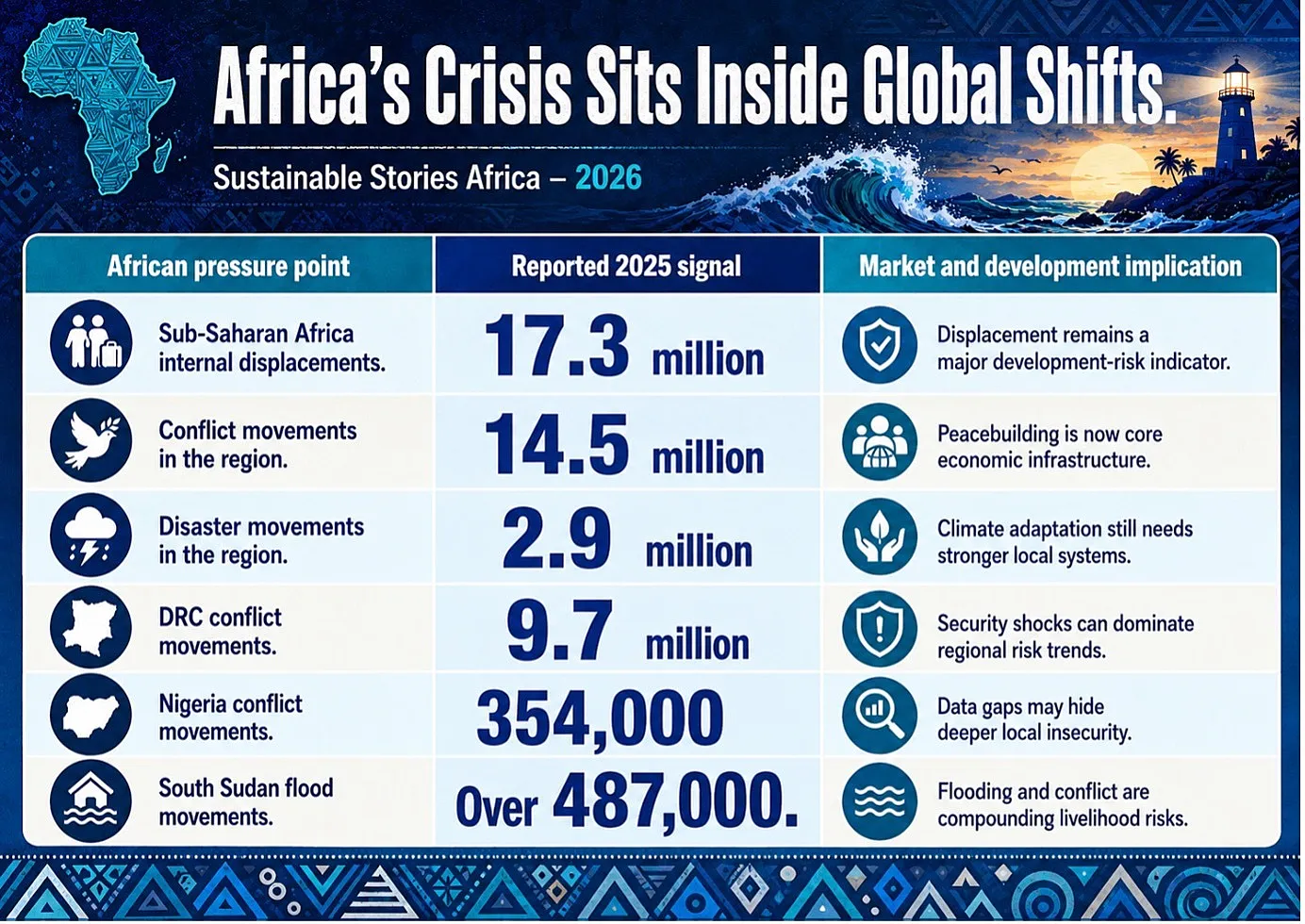
Africa’s Crisis Sits Inside Global Shifts
Sub-Saharan Africa recorded 17.3 million internal displacements in 2025, most of them caused by persistent conflict and violence.
Conflict accounted for 14.5 million movements, or 83% of the regional total, while disasters accounted for 2.9 million movements after a sharp fall in flood displacement.
The Democratic Republic of the Congo was the regional epicentre. IDMC says DRC accounted for 67% of conflict displacements in sub-Saharan Africa, with 9.7 million movements in 2025.
The country’s highest figure on record, and almost a third of all conflict displacements globally.
Advances by non-state armed groups triggered major waves of movement in North and South Kivu.
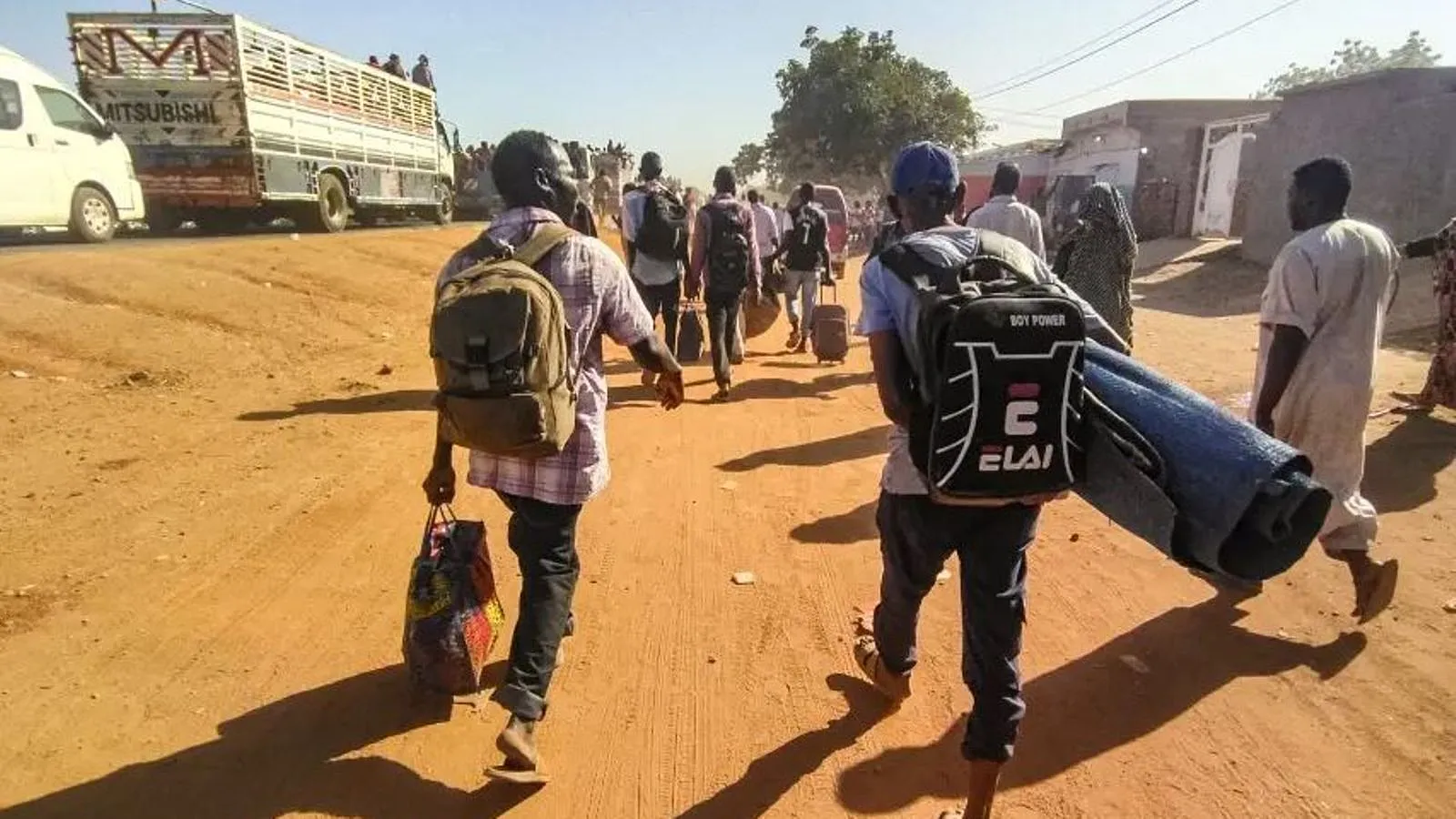
Sudan remained central to the region’s displacement story. Although returns helped reduce the total number of internally displaced people in some areas, IDMC cautions that returns do not necessarily mean durable solutions, particularly where insecurity persists.
Sudan still hosted 9.1 million internally displaced people at the end of 2025, the largest IDP population in the world for a third consecutive year.
Nigeria’s figures also underline the risk of undercounting.
The report says Nigeria recorded 354,000 conflict-related movements; however, the report describes the figure as conservative due to limited geographical coverage. Criminal violence in Katsina, Sokoto and Zamfara accounted for nearly 40% of the total, while communal violence in Benue triggered nearly 59,000 movements.
Better Data Can Protect Lives Faster
The report’s deeper message is that displacement data is now part of resilience infrastructure.
Without knowing who has moved, where they are and whether they have found safe, lasting solutions, governments cannot plan schools, clinics, food systems, housing, transport corridors or climate adaptation investments.
IDMC’s director, Tracy Lucas, frames the issue clearly: “Displacement is not inevitable.”
The report links it to unresolved crises, unaddressed risks and underlying vulnerabilities, while calling for reliable data, targeted policies and long-term investments to help displaced people rebuild their lives.
This is where Africa’s opportunity lies. Better displacement monitoring can help governments identify hotspots earlier, provide social protection more quickly, prioritise climate-resilient infrastructure and improve investor understanding of fragile regions.
It can also support ESG reporting by turning social risk from a vague concern into measurable exposure.
For communities, the gains are more immediate. Better data can mean quicker evacuation, stronger flood preparedness, safer host-community planning, and more credible pathways for return, resettlement or local integration.
Governments Must Turn Risk Into Systems
The action agenda is practical.
- First, governments need to treat displacement as a whole-of-government development issue, not only as an emergency managed by humanitarian agencies. That means linking national statistics offices, disaster management agencies, social protection registries, security agencies, local governments and climate adaptation units.
- Second, countries need stronger data systems. IDMC observed reduced availability of displacement data in 15% of the countries and territories it monitored in 2025. This is three times the share affected in 2024. Nearly three-quarters of countries and territories hosting people displaced by conflict and violence lacked up-to-date end-of-year data.
- Third, African states must close the gap between early warning and early financing. Disaster movements fell in 2025, but this should not create complacency. Floods still accounted for half of sub-Saharan Africa’s disaster displacement, while consecutive cyclones in south-eastern Africa triggered nearly a third of the region’s disaster movements.
- Fourth, investors and development finance institutions should integrate displacement indicators into infrastructure, agriculture, housing, insurance and climate-finance decisions. A road, power project or water system in a high-displacement area is not only a capital asset, but also a stabilisation tool.
- Finally, peacebuilding must be financed with the seriousness of infrastructure. Conflict displacement now leads the global count. Without security, justice and local dispute-resolution systems, climate adaptation and development spending will keep chasing crises, creating displaced families.
Path Forward – Build Resilience Before Displacement
Africa’s priority is clear: prevent displacement where possible, protect people when movement becomes unavoidable, and finance durable solutions beyond emergency aid.
The next phase should combine peacebuilding, climate adaptation, social protection, resilient infrastructure and credible displacement data. That is how ESG commitments become visible in lives protected, communities stabilised, and markets made more resilient.