Climate adaptation funding remains overwhelmingly public, yet the communities most exposed to climate shocks are rural and undercapitalised.
A new investment framework proposes a dedicated Ecosystem-based Adaptation (EbA) Small Grants Facility to bridge that gap.
By blending public de-risking capital with ESG-aligned private finance, the framework aims to convert biodiversity protection and rural resilience into structured, investable outcomes.
Unlocking Capital for Ecosystem-Based Adaptation - Small Grants Facility Targets Climate Resilience
A new Framework for Accelerating Investments in Ecosystem-based Adaptation (EbA) proposes the creation of a dedicated Small Grants Facility to mobilise capital toward vulnerable rural landscapes, where climate impacts are intensifying, and financing remains constrained.
Developed under the United Nations Environment Programme (UNEP) in partnership with the African Centre for a Green Economy and South Africa’s Department of Forestry, Fisheries and the Environment, the framework sets out a structured investment pathway to align biodiversity restoration, socio-economic upliftment and private capital mobilisation.
The proposal responds to a widening funding gap in climate adaptation, where public resources dominate and private sector participation remains limited.
Financing Resilience Where Markets Fail
Climate adaptation is capital-intensive. Biodiversity conservation, habitat restoration and resilience-building require sustained financing; however, current funding flows are “grossly inadequate” and largely donor-driven.
The framework positions Ecosystem-based Adaptation (EbA) as a cost-effective alternative to conventional adaptation measures, capable of delivering ecological restoration alongside rural livelihood improvements.
However, unlocking investment requires structured guidance, especially for ESG-focused investors seeking measurable social and environmental returns.
The proposed Small Grants Facility is designed to move EbA beyond conceptual pilots toward scalable, results-based investment programmes embedded in national policy frameworks such as the NDC and SDGs.
Adaptation Financing Gap Persists
The framework identifies three urgent funding needs:
- Reallocating non-climate funding streams toward adaptation.
- Leveraging technology-driven mechanisms such as crowdfunding.
- Linking finance to measurable, results-based frameworks.
Private capital remains cautious. While ESG integration is expanding, investors lack guidance on where to channel adaptation investments that generate both financial returns and co-benefits.
Without structured pipelines and de-risking mechanisms, adaptation finance risks remaining fragmented and reactive.
Structuring Investable EbA Pipelines
The investment framework introduces a three-step structuring process:
Step 1: Clearly Define EbA Objectives
- Projects must articulate ecological resilience goals and socio-economic co-benefits upfront. This includes spatial planning, vulnerability assessments and alignment with national biodiversity and climate priorities.
Step 2: Identify Investment Entry Points
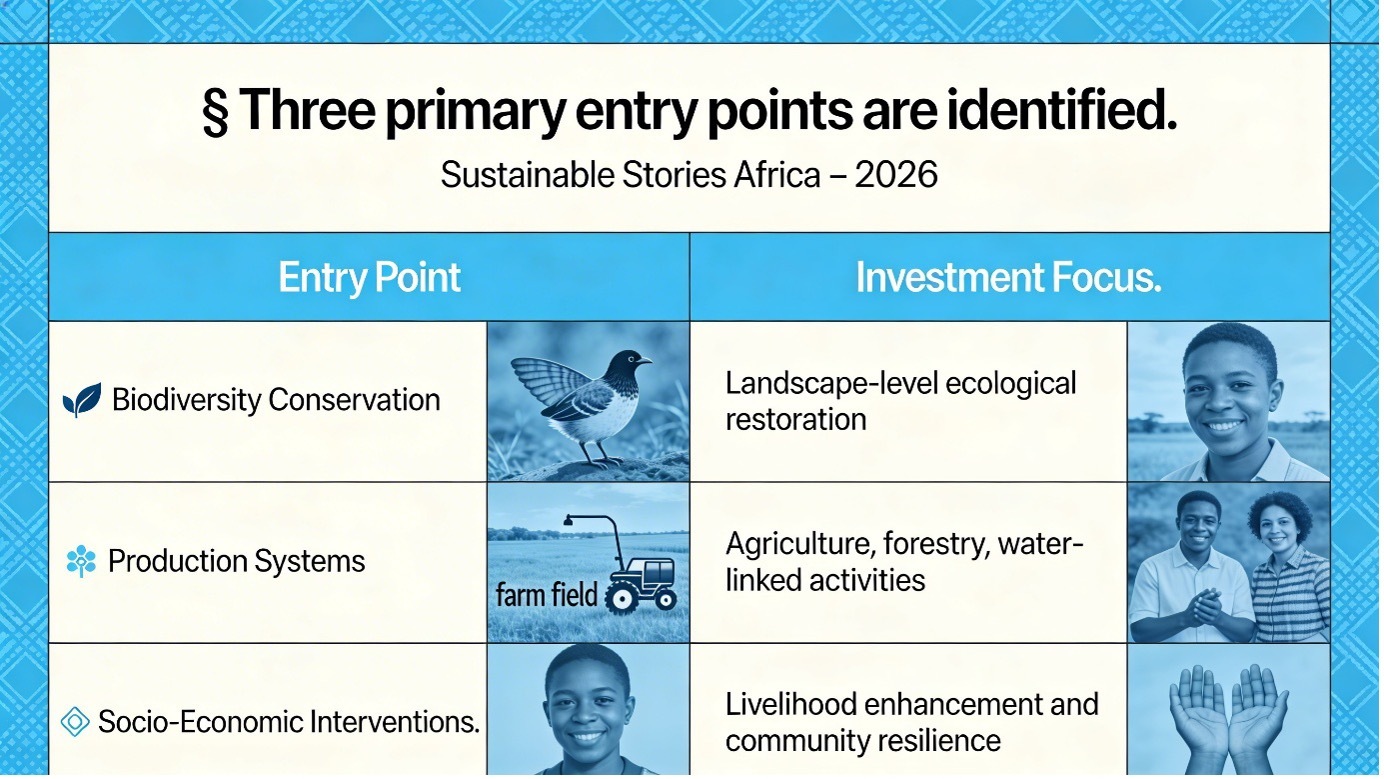
- Three primary entry points are identified:
Entry Point | Investment Focus |
|---|---|
Biodiversity Conservation | Landscape-level ecological restoration |
Production Systems | Agriculture, forestry, water-linked activities |
Socio-Economic Interventions | Livelihood enhancement and community resilience |
Step 3: Blend Financing Mechanisms
- The framework distinguishes between:
- Enabling Investments – Institutional and policy foundations, primarily public and foundation-backed.
- Asset Investments – Revenue-generating activities capable of delivering returns to investors.
Most EbA financing today falls into enabling categories, underscoring the need for innovative blended structures.
Linking ESG Capital to Landscapes
Private sector engagement is framed through ESG alignment. Companies operating within target landscapes, especially those dependent on natural resources, may invest to mitigate supply chain risk or meet sustainability reporting requirements.
Green products and services offer commercial pathways. Examples include:
- Timber-based product development through forest restoration.
- Ecotourism initiatives.
- Sustainable agriculture and water-linked production systems.
The framework cautions that ecological outcomes often materialise over longer timelines than typical business cycles, necessitating de-risking and structured incentives.
Operationalising the Small Grants Facility
The proposed EbA Small Grants Facility is positioned as the most pragmatic mobilising instrument.
Core Design Elements
- Clearly defined funding windows.
- Results-based payment mechanisms tied to agreed milestones.
- Rapid, flexible disbursement capacity.
- Dedicated support for green entrepreneurship.
The preliminary Theory of Change (ToC) links activities such as invasive alien plant clearing, habitat restoration and business incubation to outcomes, including resilient rural economies and enhanced EbA investments.
Governance and Procurement
Robust governance frameworks are central. The facility would require:
- Annual external audits.
- Independent grant review committees.
- Transparent procurement processes based on ethics, impartiality and value-for-money principles.
Knowledge management is embedded as a strategic pillar, ensuring evidence-based policymaking and dissemination of best practices across government, civil society and investors.
Potential: Rural Economies and Ecosystem Integrity
The Theory of Change identifies long-term impacts as:
- Resilient rural economies.
- Functional ecosystems.
- Improved livelihoods.
Cross-cutting priorities include gender empowerment, youth inclusion and private sector engagement, and ensuring inclusive adaptation pathways.
By structuring public funds to de-risk landscape projects, the facility aims to crowd in private ESG-aligned capital, transforming adaptation from a public expenditure burden into a blended investment opportunity.
Path Forward – Piloting Blended Climate Finance
The framework recommends piloting the EbA Small Grants Facility in partnership with institutions experienced in climate finance mobilisation, aligned with national NDC priorities.
If successfully implemented, the facility could unlock new financing streams, strengthen rural resilience, and build credible business cases for ecosystem-based adaptation, positioning EbA as both a climate strategy and an economic catalyst.