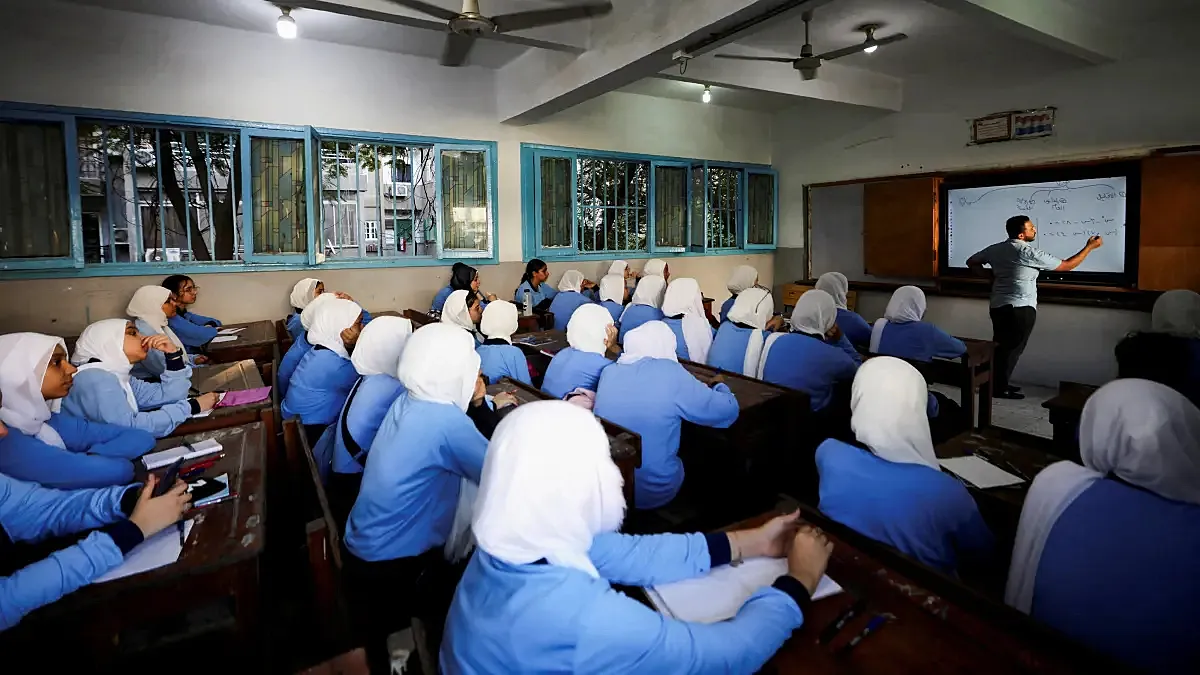
Seven years after Egypt launched its ambitious Education 2.0 overhaul, classrooms tell a more complicated story.
Teachers broadly support its student-centred vision; however, they struggle to reconcile reform rhetoric with overcrowded classrooms, rigid inspections, and exam pressures.
A comparative study reveals that the real barrier is not resistance, but misalignment between culture, institutions, and pedagogy.
Reform, it finds, must move beyond curriculum design to reshape the ecosystem around teachers.
Reform Vision Meets Classroom Constraints
Egypt’s Education 2.0 reform, introduced in 2018, promised a decisive shift: away from rote memorisation toward competency-based, student-centred learning.
It sought to integrate digital tools, multidisciplinary curricula, and expanded Teacher Professional Development (TPD). The ambition was systemic transformation.
However, seven years later, many teachers still experience a disconnect between reform expectations and daily classroom realities, according to Translating Egypt’s Education 2.0 into Classroom Practice.
The Brookings–FSDD SPARKS study, based on 39 participants across a public and a community school in rural Greater Cairo, argues that reform outcomes are filtered through what it calls Invisible Pedagogical Mindsets (IPMs), the interplay of culture, institutional ecosystems, and learning theories.
The result: reform design is ambitious; implementation is uneven.
Reform Is Structural, Not Technical
Education 2.0 rests on five pillars:
- Multidisciplinary curriculum reform
- Technology integration
- Teacher and leadership development
- Infrastructure improvements
- Assessment reform
However, structural headwinds persist:
Key System Pressures
Structural Factor | Current Reality |
|---|---|
Teacher hiring | Freeze (2004–2021); 30,000 annual hiring pledge only partially fulfilled |
Class sizes | Public schools often exceed 50–70 students per class |
Teacher incentives | Promotions largely seniority-based |
TPD alignment | Highly centralised, compliance-oriented |
Assessment system | Exam-driven, pacing-pressured |
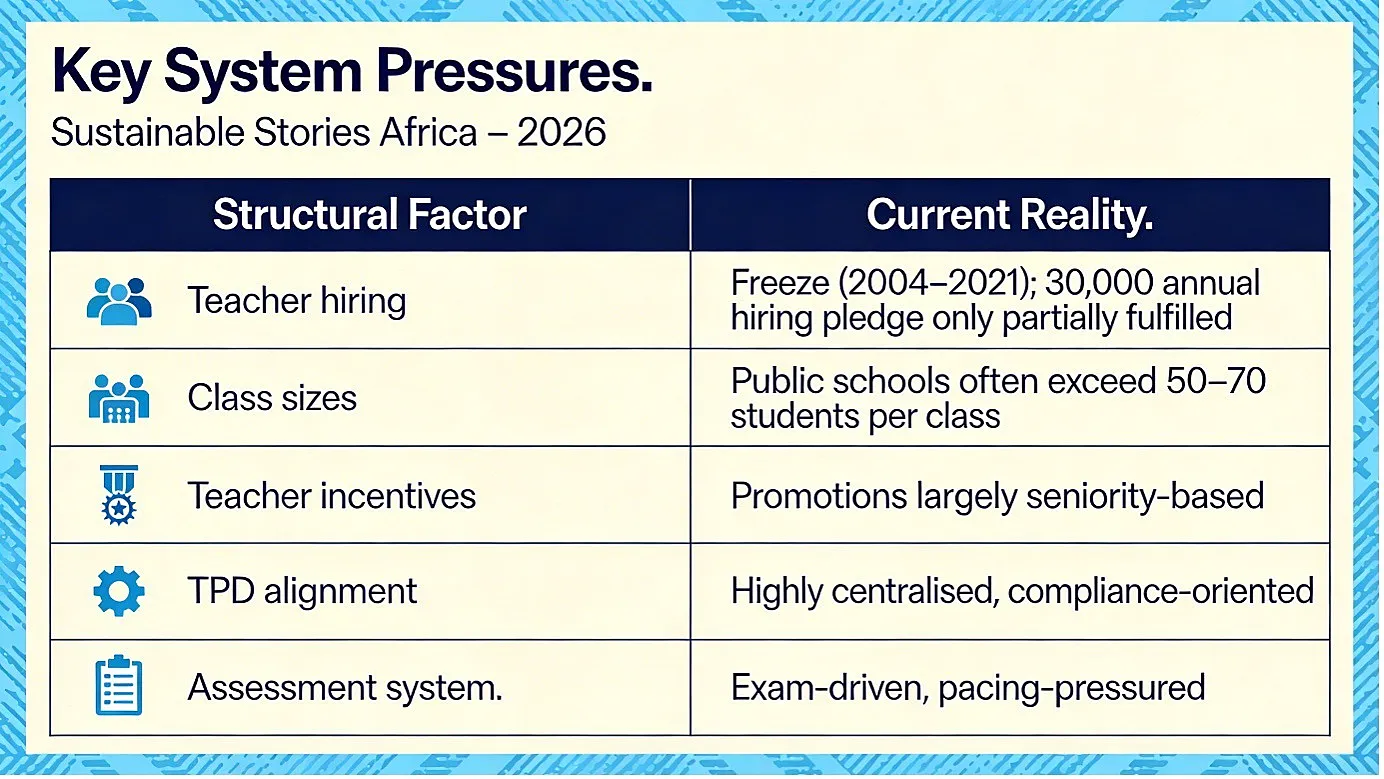
Between 2004 and 2021, a hiring freeze forced reliance on temporary and hourly contracts. Though a presidential initiative pledged 30,000 hires annually, implementation has lagged.
This staffing strain directly affects reform capacity.
As one teacher noted:
“It’s not that the teacher doesn’t want to. But the teacher has a class of seventy kids.”
Reform, in practice, is occurring within legacy constraints.
Culture and Ecosystem Shape Reform Outcomes
The study finds that implementation differs significantly between:
- Public Schools
- Centralised governance
- Larger classes (>50 students)
- Formal inspector audits
- Structured career ladder
- Limited autonomy
- Community Schools
- NGO-administered with MoE oversight
- Smaller classes (<30 students)
- Peer mentoring culture
- Greater local flexibility
The divergence is cultural as much as institutional.
Public school teachers described a “feararchical” structure, in which inspection emphasises compliance.
Attempts at interactive learning, such as pair-and-share, were sometimes criticised for classroom “noise.”
One teacher captured the paradox:
“We use the activities, but not the mindset.”
Meanwhile, community schoolteachers reported stronger collegial trust, peer review, and family engagement, structural supports that enabled meaningful reform adaptation.
Reform success correlates strongly with trust density and institutional flexibility.
Teachers Support Reform – But Lack Alignment
Contrary to assumptions of resistance, teachers broadly support the aims of Education 2.0.
Teacher Perspectives (Sample of 27)
Survey Insight | Percentage |
|---|---|
View themselves primarily as moral role models (morabbi) | 85% |
Prioritised salary increases as key reform need | 52% |
Prioritised reducing class size | 41% |
Felt limited voice in shaping reform | 33% |
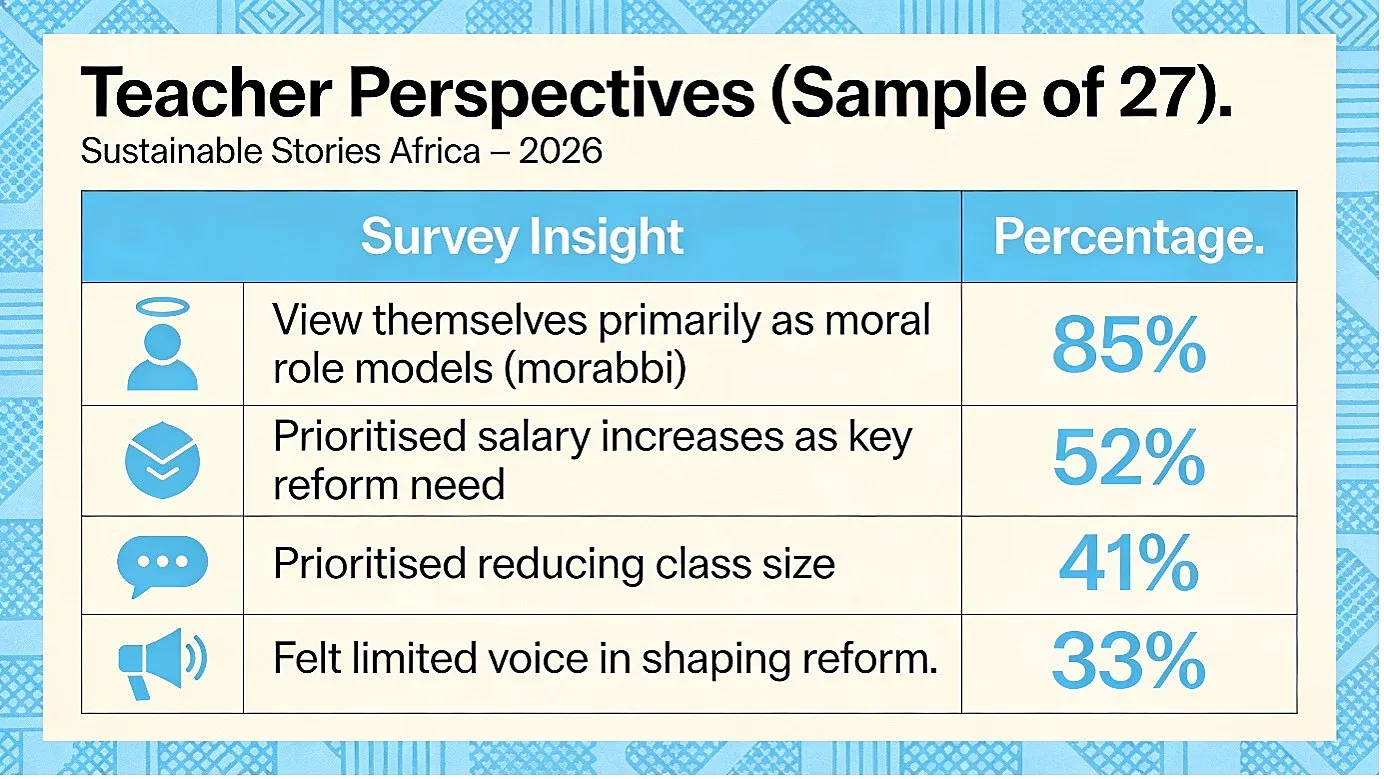
Teachers overwhelmingly endorse student-centred goals. However:
- TPD often remains theoretical and compliance-focused
- Assessment systems remain exam-driven
- Promotion is not tied to pedagogical innovation
- New subjects (e.g., Discovery, Values & Ethics) lack staffing allocations
The reform encourages higher-order thinking — yet teachers feel pressured to complete pacing guides for standardised evaluations.
As one teacher stated:
“2.0 is based on higher-order thinking… But people aren’t paying attention to this part. They just write the evaluations.”
This creates “surface reform”, visible adoption without a philosophical shift.
Align Incentives, Assessment, and Support
The report proposes three systemic adjustments:
- Reframe TPD Toward Reflective Practice
- Link TPD completion to promotions and financial incentives
- Integrate teacher voice in design
- Establish peer-led communities of practice
- Develop Arabic-specific pedagogical training
- Strengthen Institutional Coherence
- Establish a dedicated MoE coordinating body
- Align donor-supported programs under a unified strategy
- Conduct curriculum–staffing mapping studies
- Adjust staffing for multidisciplinary teaching
- Align Assessment with Competency Goals
- Redesign student and teacher evaluations
- Redefine the inspector role toward coaching
- Create anonymous teacher feedback channels
The emphasis is clear: reform must become ecosystemic, not episodic.
Path Forward – From Policy Intent to Practice
Meaningful reform requires coherence across culture, incentives, and institutional design.
Aligning curriculum, assessment, and teacher development will determine whether Education 2.0 becomes an embedded practice or remains policy rhetoric.
Trust, professional recognition, and structural alignment, not curriculum redesign alone, will decide the reform’s durability.