The World Bank’s Women, Business and the Law 2026 report shows that women still enjoy only about two-thirds of the economic rights men exercise in practice, despite a decade of legal reforms.
By exposing a deep implementation gap across 190 economies, the study recasts gender equality as an agenda for growth and jobs, one that will shape whether millions of young women find decent work or remain locked out of opportunity.
Women’s rights lag behind economic ambition
Women, Business and the Law 2026 exposes a core contradiction of today’s economy: countries promise growth and jobs; however, they still deny women full legal and practical equality at work, in business and at home.
Using data from 190 economies, the World Bank highlights that in reality, women enjoy only about two-thirds of the economic rights men do, turning the launch event into a stark ultimatum: fix enforcement or forfeit future prosperity.
The new WBL 2.0 framework separates laws on paper from the policies, services and enforcement that make them real.
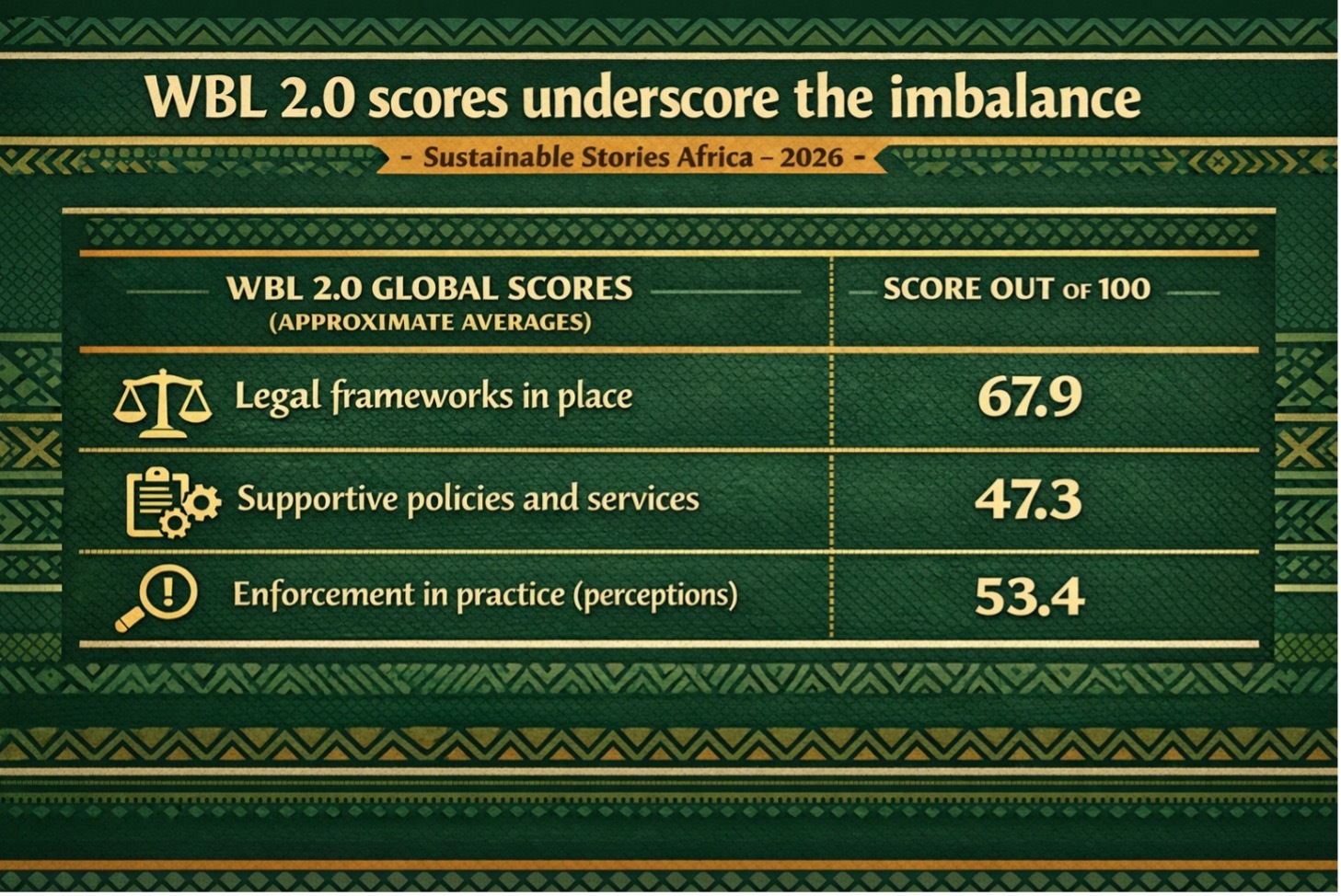
Global averages tell a sobering story: legal frameworks highlight between 67 and 68 out of 100, supportive systems 47, and enforcement just above 53, leaving millions unprotected despite “good” laws.
Speakers argued that this is no longer a niche gender issue but a macroeconomic brake.
Removing barriers could lift global output by between 15% and 20%; however, most governments have delivered less than half the necessary follow-through.
Laws advance, lived equality stalls
Women, Business and the Law 2026, the eleventh edition of the World Bank’s global gender-equality scoreboard, lands with a sobering message.
Across 190 economies, laws that should secure equal economic opportunity for women average 67.9 out of 100, but when policies, institutions and enforcement are examined, the picture deteriorates and women encounter invisible walls despite rights on paper.
The new WBL 2.0 framework sharpens this reality into three pillars: legal frameworks, supportive frameworks and enforcement perceptions.
It shifts the debate from “Do laws exist?” to “Do they work in women’s lives?”, casting weak implementation as an economic self-inflicted wound, especially for low- and middle-income economies that must either unlock young women’s potential or accept slower, more unequal growth.
What the 2026 numbers reveal
The 2026 report paints a three-speed world of gender equality: laws are advancing, but supporting systems lag and enforcement falls furthest behind.
Safety is the weakest link, with only about a third of needed protections in place and enforcement failing in roughly 80% of cases.
Childcare gaps, unequal pay and unequal access to credit continue to push women out of the labour market or confine them to low-wage, informal work.
However, there is real momentum in reforms. In just two years, 68 economies passed 113 positive legal changes, 33 in Sub-Saharan Africa alone.
The problem is that these gains coexist with stubborn implementation gaps, as most countries have built fewer than half of the institutions, services and budgets required to make legal equality real in women’s daily lives.
WBL 2.0 scores underscore the imbalance.
| WBL 2.0 global scores (approximate averages) | Score out of 100 |
|---|---|
| Legal frameworks in place | 67.9 |
| Supportive policies and services | 47.3 |
| Enforcement in practice (perceptions) | 53.4 |
Economies that pair legal reforms with real budgets, specialist enforcement bodies and responsive gender services, from childcare support to survivor hotlines, see women work, compete and win more in public markets.
Turning legal equality into shared prosperity
Closing gender gaps emerged as the panel’s most underused lever for jobs, productivity and resilience. Removing barriers to women’s economic participation could lift global output by up to one-fifth, a prize comparable to discovering a new growth engine.
For countries with ageing populations and tight budgets, fully using women’s skills is no longer a “social” debate but a competitiveness strategy.
The report’s examples show that when paid parental leave covers both parents, childcare is subsidised, procurement rules are gender responsive and credit laws ban discrimination, women work more, build bigger businesses and move into formal finance, turning gender equality into core economic policy, not a box-ticking exercise.
The reform opportunity is highlighted in the discussion.
- Economic upside – Removing legal and practical barriers to women’s work could lift global GDP by between 15% and 20% over time.
- Demographic urgency – More than 600 million girls will enter the workforce this decade, but without stronger laws and enforcement, many will face constrained choices.
- Reform momentum- 68 economies passed 113 positive reforms in two years, led by Sub‑Saharan Africa with 33 changes.
- Implementation deficit – Fewer than half of the required support policies and services are in place on average.
From paper promises to funded enforcement
Speakers landed on a blunt message: the time for passing laws without paying to enforce them is over.
Governments must move from drafting reforms to resourcing them, with real budgets, specialist agencies and accountability systems that make rights tangible for women in every community.
That means 24/7 hotlines and specialised police units for survivors, expanded childcare and accessible legal aid.
For finance ministries, gender equality now sits at the heart of growth strategy. Using WBL data in budgets, investment promotion and labour planning can target reforms with the highest job and productivity pay-offs.
Development partners were urged to fund not just new statutes but measurable improvements in enforcement and services. In Africa and other emerging markets, where youth unemployment, rapid urbanisation and informality collide, sidelining women’s skills has become economically untenable.
Path Forward – Funding rights, unlocking women’s potential
Women, Business and the Law 2026 argues that the gender agenda has entered an implementation decade: many laws are in place, but budgets, institutions and enforcement are lagging. Governments are now challenged to treat gender-equality reforms as macro‑critical investments in jobs and growth, not symbolic gestures.
If countries use the WBL 2.0 data to close safety gaps, build care systems, expand fair credit and track enforcement, hundreds of millions of women could shift from surviving at the margins to powering inclusive, resilient growth. The real test is whether political will and public pressure rise to match the evidence.