In an era of overlapping climate, debt, and security crises, IDA20 has become the quiet shock absorber for the world’s poorest economies, especially in Africa. But a new retrospective on its performance shows that stretching concessional finance is no longer enough.
Unless IDA and its partners rethink risk, speed, and local ownership, the continent’s climate and development ambitions risk being outpaced by intensifying shocks.
IDA20 billion stretched as crises deepen
Africa’s climate-finance story is unfolding under intense pressure.
The World Bank’s International Development Association (IDA) is being pushed to deliver more impact with fewer concessional resources, just as climate shocks, debt distress and conflict deepen across vulnerable African economies.
The question facing policymakers is stark: can the IDA20 package still catalyse transformational change when domestic fiscal space is tightening, and private capital remains wary?
The IDA20 Retrospective, “Delivering Impact in Times of Crisis”, shows funds being deployed faster than planned to stabilise fragile states, expand social protection and finance climate adaptation.
However, a core imbalance persists: the poorest countries are being asked to decarbonise and adapt on timelines shaped in richer capitals, even as their macro buffers erode.
Panellists warned that without more risk-tolerant instruments, faster delivery and stronger country ownership, Africa’s development and climate goals could drift further away.
Crises outpacing concessional firepower
The IDA20 Retrospective shows how quickly reality has outrun the original financing envelope, agreed before Russia invaded Ukraine and the latest wave of climate shocks.
Governments battling inflation and currency pressures have leaned on IDA for emergency budget support, safety nets and climate-resilient infrastructure at a scale no one planned for.
Panellists said IDA is now both first responder and long-term investor, averting deeper crises but diverting money from transformative change into fiscal firefighting.
For African countries, that means delayed investment in renewables, climate-smart agriculture and urban resilience just as climate risks rise.
At the same time, donor fatigue is squeezing aid budgets just when demand for concessional finance peaks, creating a damaging gap between what Africa needs and what the system is currently resourced to deliver.
What the data reveals about delivery
The IDA20 story is framed as “impact in times of crisis”, but the numbers reveal both progress and strain.
Disbursements to fragile, conflict-affected states have surged, signalling a deliberate pivot toward places where climate and security risks collide.
Climate-focused allocations also now take a larger share of commitments, especially in the Sahel, Horn and coastal Africa.
However, the spending mix raises hard questions. Too much climate-tagged finance still goes into long-horizon infrastructure, while communities facing immediate livelihood losses need faster, flexible support.
Where IDA has blended early warning systems, social protection and local infrastructure, recovery from floods and droughts is quicker, but scaling these integrated models remains difficult within conventional project cycles and risk rules.
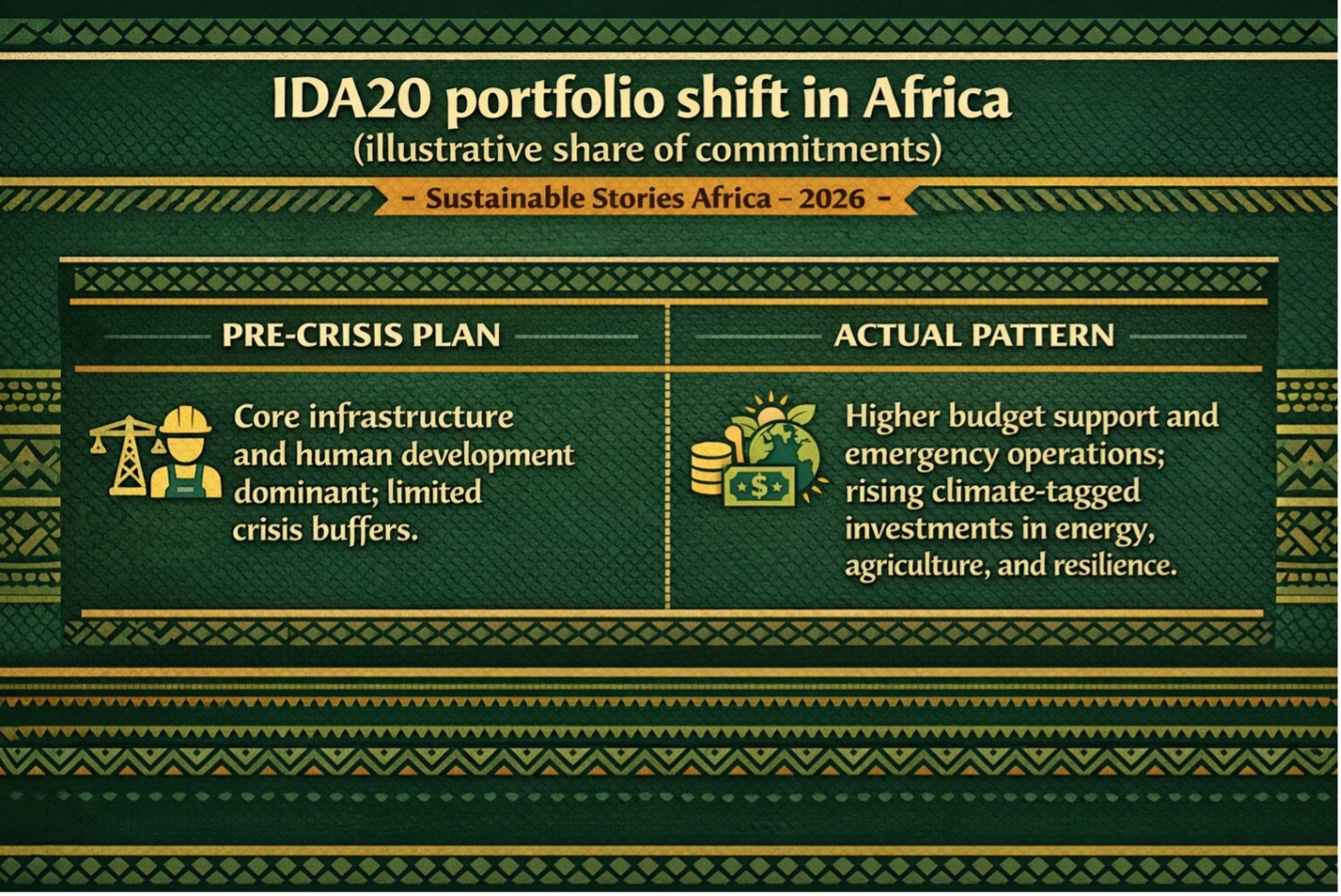
To illustrate the shifting emphasis, the table below outlines how IDA20 resources to African IDA countries are being pulled toward crises and climate action.
| IDA20 portfolio shift in Africa (illustrative share of commitments) |
|---|
| Pre-crisis plan: core infrastructure and human development dominant; limited crisis buffers. |
| Actual pattern: higher budget support and emergency operations; rising climate-tagged investments in energy, agriculture, and resilience. |
Rewiring concessional finance for African realities
The panel’s central message was clear: for IDA to stay relevant, it must become more agile, genuinely catalytic and firmly anchored in country priorities, especially in Africa.
That requires a shift from merely filling gaps left by markets to actively creating markets for climate-resilient infrastructure, nature-based solutions and strong social protection systems.
Speakers stressed that blending grants and highly concessional loans with guarantees and risk-sharing tools can de-risk sectors enough to attract private and institutional capital, particularly in renewables, digital infrastructure and climate-smart agriculture.
When this finance is aligned with national development plans and just transition strategies, it strengthens rather than distorts domestic priorities.
Governance surfaced as the quiet force‑multiplier. Countries that use IDA engagement to improve public financial management, procurement and transparency achieve deeper, longer-lasting results.
For African leaders, that turns concessional finance from cheap money into a driver of institutional reform, at a time when credible institutions are themselves a vital form of resilience.
Pressure points across African IDA countries
Below is a snapshot summarising key stress lines and opportunities discussed in relation to African IDA borrowers.
- High vulnerability, low emissions – African IDA countries contribute a small share of global emissions but face disproportionate climate impacts, heightening the case for concessional climate finance.
- Debt constraints – Many are already in or near debt distress, limiting room for additional non-concessional borrowing and making IDA terms critical.
- Fragility overlaps – Conflict and governance risks intersect with climate shocks, increasing the cost and complexity of service delivery.
- Private capital gap – Risk perceptions, shallow capital markets, and policy uncertainty inhibit large-scale private investment despite strong renewable and adaptation potential.
This combination explains why the panel emphasised that IDA’s next evolution must be designed “with” African policymakers and communities, not merely “for” them.
Aligning expectations, instruments, and impact
IDA20’s retrospective shows an institution often delivering more with less, especially in fragile African contexts, but it also exposes a model under mounting strain.
Crises are now faster and more interconnected than the replenishment cycles and project-approval timelines IDA was built around.
Panellists outlined three urgent fixes. Donors and shareholders must stabilise, and where possible expand - IDA’s concessional firepower, treating it as a global public good for stability and climate resilience. IDA itself needs to accelerate internal reforms that cut approval times, simplify processes without weakening safeguards, and give country teams flexibility to adapt quickly as conditions change.
It must also lean more intentionally into blended finance and risk-sharing tools, particularly in African markets where development, climate and security risks collide.
For African governments, the assignment is equally clear. Using IDA engagement to anchor credible transition plans, strengthen governance and crowd in domestic and international capital will determine whether concessional funding becomes resilient, inclusive growth on the ground.
Civil society and media, including Sustainable Stories Africa, have a critical role in monitoring whether high-level commitments translate into real protections and opportunities for communities on the climate frontlines.
Path Forward – Recalibrating IDA for shared resilience
IDA’s retrospective shows a system that has absorbed shocks but now needs recalibration to keep pace with compound crises in Africa and beyond. Future cycles must embed faster delivery, deeper country ownership, and smarter risk-sharing at their core.
If donors, borrowers, and implementing partners align in that agenda, concessional finance can evolve from a crisis backstop to an engine of resilient, low-carbon development for the world’s poorest countries.