As debt risks climb and poverty deepens across vulnerable economies, the World Bank’s IDA20 cycle delivered a record $97.4 billion in commitments, proving that concessional finance can move fast and at scale when crises converge.
From electricity access for 54 million people to safety nets for 122 million, IDA20 positioned flexibility, agility and resilience as the new grammar of development finance in an age of poly-crisis.
IDA20 Redefines Crisis Finance for Resilient Development – Finance Reimagined for Poly-Crisis Era
When the International Development Association (IDA) launched its 20th replenishment cycle in July 2022, one year early, it did so against the backdrop of a global pandemic, rising conflict, climate shocks and mounting debt distress.
What followed was the largest financing envelope in IDA’s history, with a total commitment authority of $97.4 billion.
Backed by $23.5 billion in donor contributions, IDA leveraged each donor dollar nearly 3.5 times, combining balance-sheet optimisation and market borrowing to expand its impact.
In a world of constrained aid budgets, the IDA20 cycle became a test case in how multilateral finance can stretch scarce public capital without sacrificing concessionality.
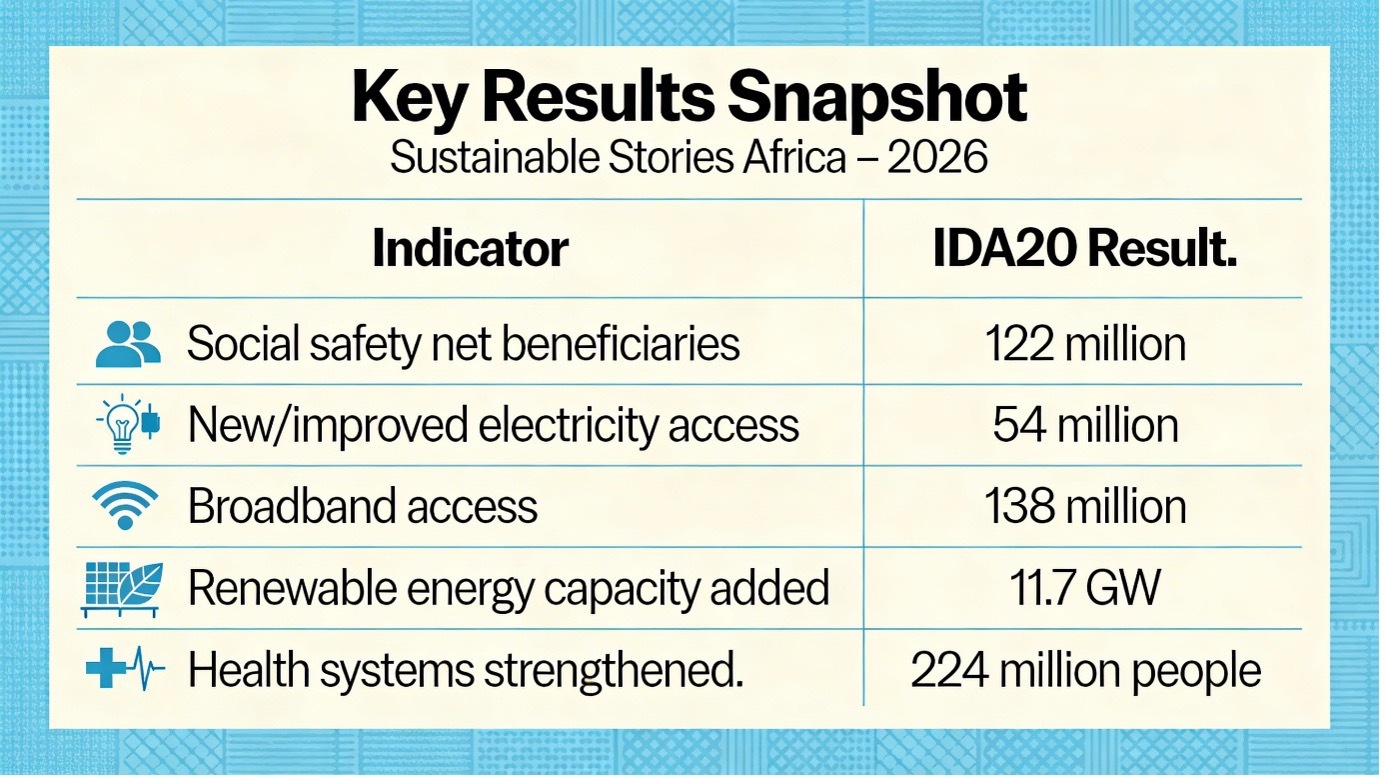
The results were measurable: 122 million people supported by social safety nets; 54 million gaining new or improved electricity; 138 million connected to broadband internet.
Development Under Mounting Strain
IDA20 unfolded amid escalating vulnerability. External debt stocks in IDA countries more than doubled over the past decade, reaching $1.2 trillion by 2024, with nearly half of the countries at high risk of or already in debt distress.
No country graduated from IDA during the cycle; Sri Lanka reversed its graduation due to crisis conditions.
At the same time, poverty trends stagnated. While global poverty has halved over two decades, progress slowed significantly in IDA countries, particularly in Sub-Saharan Africa and fragile contexts.
However, IDA remains central to the global development finance architecture, accounting for 32% of official development assistance (ODA) to IDA countries between 2022 and 2023. Its role is no longer supplementary; it is systemic.
Flexibility as Operational Doctrine
IDA20’s defining feature was speed.
- $1.7 billion reallocated within the first year to priority needs
- $8.2 billion recommitted from lower-priority operations
- Crisis Response Window allocated 75% of resources in 15 months, focusing on food security
Portfolio efficiency improved despite scale. IDA’s total portfolio doubled from $92 billion (FY15) to $188 billion (FY25); however, undisbursed balances remained stable, and implementation quality strengthened.
IDA achieved 88% of Results Measurement System targets and 88% of policy commitments, materially improving on IDA19.
The architecture also evolved. New instruments included 50-year credits, expanded tools for catastrophe financing, climate-resilient debt clauses for small states, and a broadened Crisis Preparedness and Response Toolkit.
Flexibility became embedded in the design.
Scaling Impact Across Sectors
IDA20 delivered measurable outcomes across five special themes and four cross-cutting issues.
Key Results Snapshot
Indicator | IDA20 Result |
|---|---|
Social safety net beneficiaries | 122 million |
New/improved electricity access | 54 million |
Broadband access | 138 million |
Renewable energy capacity added | 11.7 GW |
Health systems strengthened | 224 million people |
In fragile and conflict-affected situations (FCS), financing rose from $14.0 billion (FY21) to $14.3 billion (FY25). About two-thirds of IDA’s poor now live in fragile settings, underscoring the pivot toward resilience-building.
Private sector mobilisation expanded through the Private Sector Window (PSW):
- $6.2 billion in PSW financing mobilised $39 billion in commercial investment
- Each $1 of PSW financing mobilised between $6 and $8.5 in private capital, depending on the instrument
In an era of declining foreign direct investment, IDA20 demonstrated that concessional capital can de-risk frontier markets.
Simplify, Scale, Sustain
However, pressure is mounting.
Almost half of IDA countries are classified as high-risk or in debt distress. Average institutional capacity scores have declined modestly across cycles.
Demographic pressures and job deficits intensify urgency.
IDA21, now under replenishment, responds with structural simplification: policy actions reduce the administrative burden by more than half. The agenda prioritises:
- Jobs and economic transformation
- Electricity expansion under Mission 300
- Debt transparency and fiscal sustainability
- Strengthened private capital mobilisation
IDA’s long-term concessionality moderated to 58% in IDA20, down from the pandemic peak of 66%, but remains above historical averages, balancing sustainability with affordability.
The message is clear: scale without discipline is unsustainable; discipline without flexibility is ineffective.
Path Forward – Faster, Simpler, Impact-Oriented
IDA21 will focus on simplifying policy frameworks, strengthening delivery capacity and accelerating results in electricity, health, gender equality and job creation.
Private capital mobilisation will be mainstreamed across operations, building on the lessons from PSW.
As aid budgets tighten globally, IDA’s pooled, leveraged and country-led model must secure long-term sustainability while preserving concessionality.
Flexibility and agility are no longer optional; they are structural requirements for resilient development finance.