
Environmental, Social and Governance (ESG) strategies are increasingly determining their financial value, challenging the long-held belief that sustainability initiatives add cost to corporate operations.
New evidence suggests companies that integrate ESG into their core strategy achieve lower financing costs, improved operational efficiency and stronger talent retention, turning sustainability from a compliance exercise into a measurable competitive advantage.
Sustainability Strategy Driving Corporate Value
For years, critics of ESG investing argued that sustainability programmes drained corporate resources while delivering limited financial returns.
However, a growing body of evidence suggests the opposite: companies embedding ESG principles into their operating models are unlocking measurable economic benefits.
Across global markets, ESG is shifting from a compliance-driven reporting exercise to a strategic tool that improves operational efficiency, strengthens governance and attracts long-term investment capital.
Businesses that integrate sustainability across supply chains, risk management systems and financing strategies are increasingly outperforming peers in resilience and stakeholder trust.
The emerging lesson is clear. ESG is no longer merely about corporate responsibility; it is becoming a core driver of long-term value creation.
For companies navigating complex global markets and rising regulatory expectations, sustainability strategy is rapidly evolving into a competitive advantage.
ESG Compliance Debate Reshaping Corporate Strategy
At the heart of the ESG debate lies a persistent misconception: that sustainability initiatives are primarily a cost centre rather than a value creator.
This narrative has historically framed ESG as a compliance burden, something organisations pursue largely to satisfy regulators, improve public relations or meet investor expectations.
However, emerging evidence challenges this assumption.
According to the infographic in the uploaded document, the myth that ESG generates no tangible returns is a sharp contrast to operational realities.
Companies integrating sustainability into their strategy are discovering that ESG can drive measurable financial and strategic benefits.
These include:
- Lower cost of capital
- Improved operational efficiency
- Stronger workforce attraction and retention
- Enhanced reputation among investors and regulators
In other words, ESG is gradually moving from compliance to value creation.
Integrating ESG Across Enterprise Operations
A major shift in corporate ESG strategy involves moving beyond isolated sustainability initiatives to a fully integrated operating model.
The framework diagram in the uploaded document illustrates a structured ESG transformation pathway: starting with sustainability benchmarking and governance, then building organisational capabilities, and ultimately embedding ESG into long-term strategy.
ESG Integration Across Business Functions
ESG Integration Layer | Strategic Purpose |
|---|---|
Governance & Policies | Establish accountability and compliance frameworks |
ESG Risk Analytics | Identify environmental and social exposure risks |
Enterprise Risk Management | Align sustainability risks with corporate strategy |
Sustainable Supply Chains | Reduce environmental footprint across operations |
ESG Financing | Access green capital and sustainability-linked investment |
Data Governance & Reporting | Strengthen transparency and regulatory compliance |
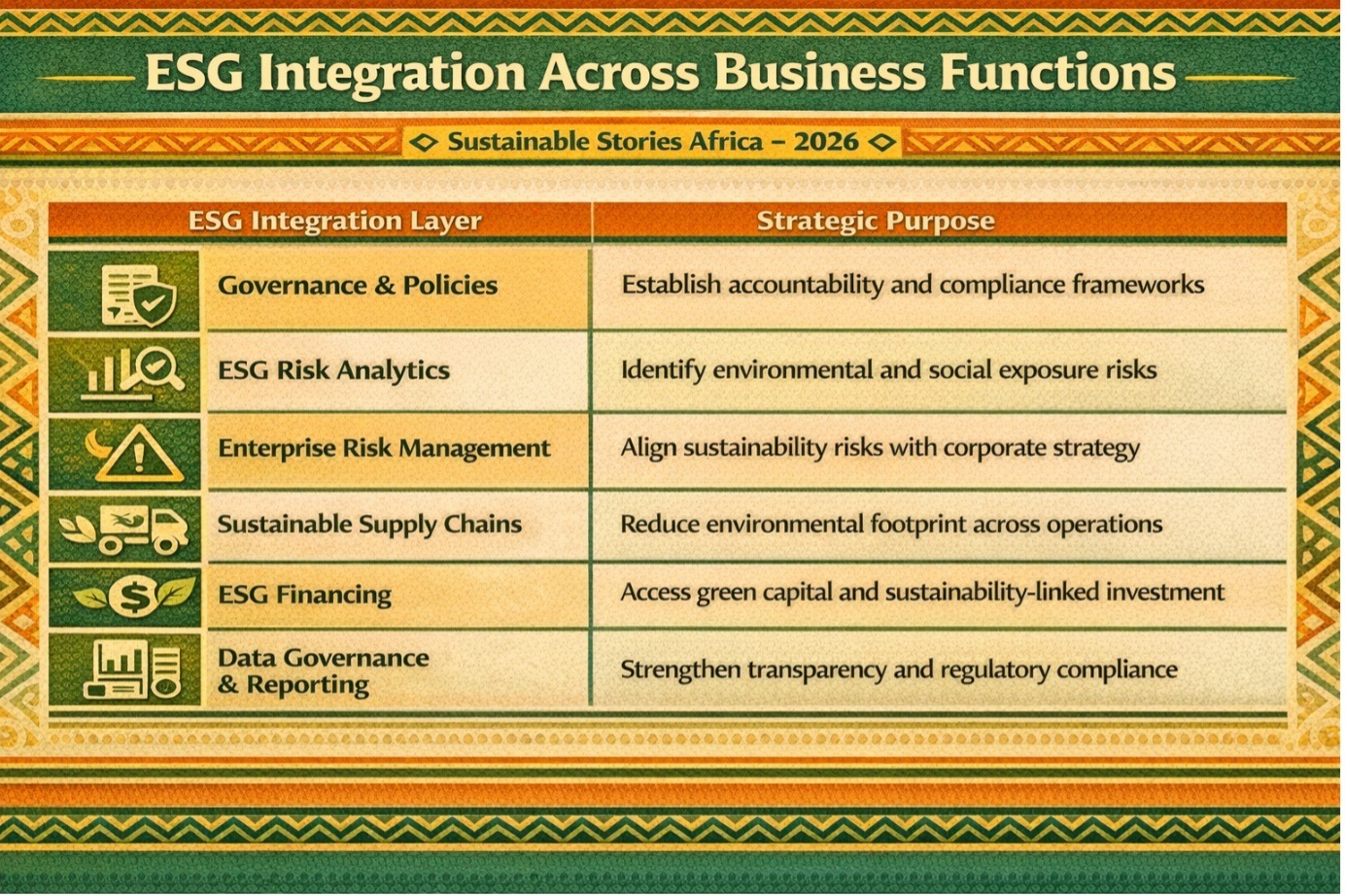
This model demonstrates how ESG integration extends far beyond environmental reporting.
Instead, sustainability becomes embedded across governance structures, supply chain management, financial strategy and risk oversight.
For many companies, this transformation marks the shift from ESG compliance to ESG-led strategy.
The Financial Case for ESG Investment
The financial benefits of ESG adoption are becoming increasingly evident across capital markets.
The Research highlighted in the document reveals several key advantages associated with ESG-aligned companies.
Measurable Business Benefits of ESG Adoption
ESG Impact Area | Business Outcome |
|---|---|
Financing | Lower borrowing costs through sustainable finance |
Operations | Improved efficiency through resource optimisation |
Talent | Higher employee retention and attraction |
Risk Management | Reduced regulatory and reputational exposure |
Market Position | Enhanced brand credibility with investors |
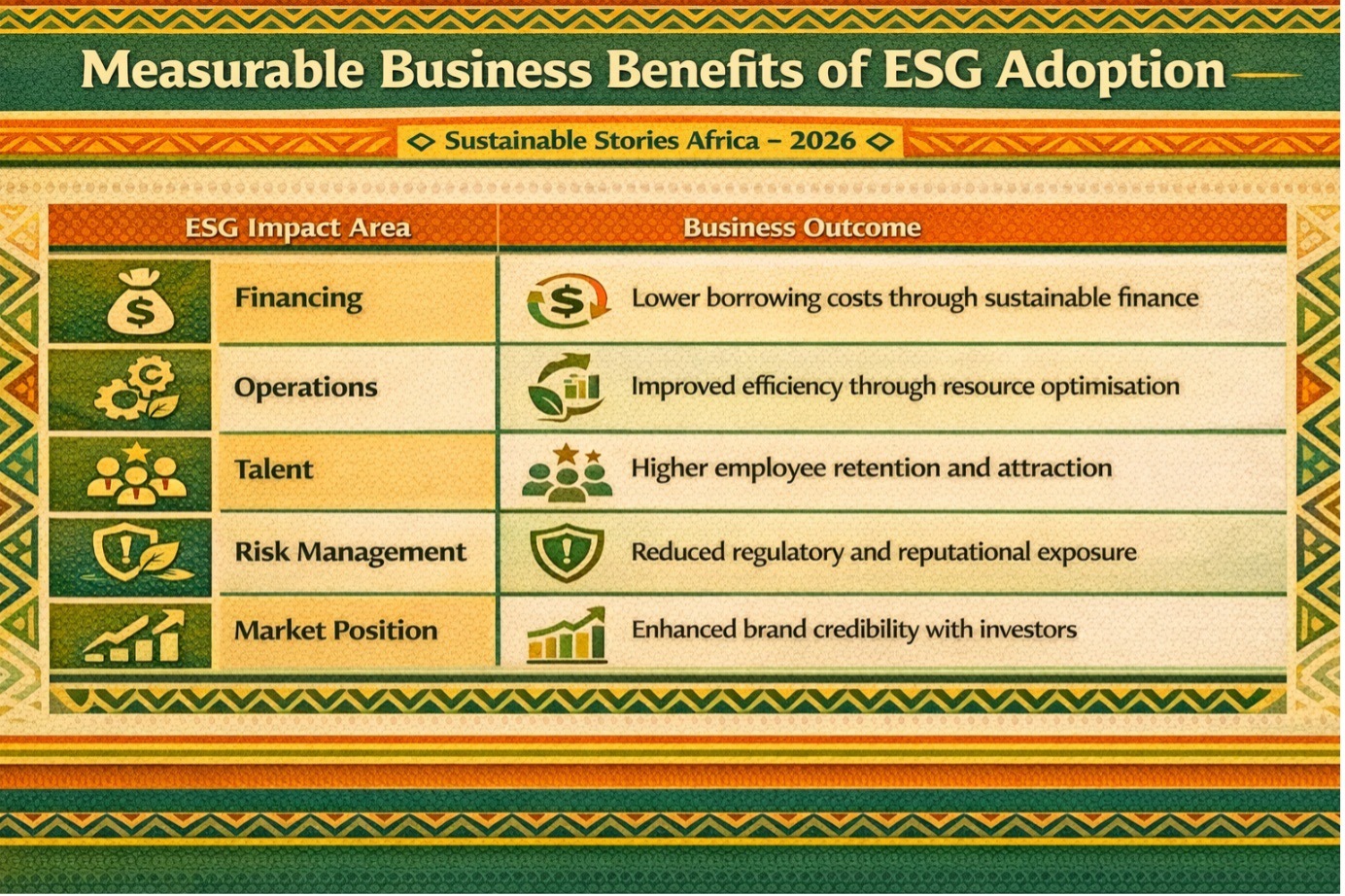
While critics claim ESG “drains financial resources,” evidence suggests it reduces operational costs and improves strategic positioning.
Companies implementing sustainability strategies often discover that energy efficiency, waste reduction and responsible supply chain practices directly lower operating expenses.
At the same time, ESG transparency strengthens investor confidence—often translating into improved access to capital.
From Compliance Reporting to Strategic Advantage
The challenge for many organisations now is not whether ESG matters, but how quickly they can integrate it effectively.
Companies that delay sustainability integration risk facing rising regulatory pressures, supply chain disruptions and growing investor scrutiny.
Conversely, businesses embedding ESG into long-term strategy stand to gain significant advantages:
- stronger access to sustainable finance markets
- improved operational resilience
- enhanced stakeholder trust
- greater adaptability in climate-sensitive industries
As global standards such as IFRS sustainability disclosures and EU ESG regulations expand, companies across emerging markets, including those in Africa, will increasingly need robust ESG governance systems.
This transition represents not merely regulatory compliance but a strategic opportunity to build resilient businesses aligned with future economic trends.
Path Forward – Moving ESG From Compliance To Value
Companies must move beyond viewing ESG as a reporting obligation and instead integrate sustainability across governance, risk management and operational strategy.
This requires stronger data systems, transparent reporting frameworks and leadership commitment.
For emerging markets, the opportunity lies in leveraging ESG not only for regulatory alignment but also to unlock sustainable finance, strengthen investor confidence and build resilient businesses capable of competing in a low-carbon global economy.